

The Georgia LLC annual report is a misnomer. As of 2026, Georgia LLCs actually file an Annual Registration, due between January 1 and April 1 each year. Here’s what’s required, what it costs, and how to avoid the $25 late penalty.
Does Georgia Require an Annual Report for LLCs?
Yes, Georgia requires every domestic LLC and every foreign LLC authorized to transact business in Georgia to file annually, though the official document is the Annual Registration, not an annual report. Under O.C.G.A. § 14-11-1103, each entity must deliver an Annual Registration to the Secretary of State for filing. The form goes to the Georgia Corporations Division through the Georgia eCorp portal, and the Georgia SOS Annual Registration guide sets out the rules.
The naming difference is more than cosmetic. Filing clerks at the Corporations Division will correct anyone who calls it an “annual report” on the phone, and the state’s online materials use Annual Registration consistently. If you’re still working through the basics of running an LLC here, the Georgia LLC formation guide covers naming, registered agent, EIN, and the first-year compliance calendar that ends in your first Annual Registration. For a wider review of operating here, see the Georgia LLC overview.
Georgia LLC Annual Registration Deadline (January 1 to April 1)
The Georgia Annual Registration filing window is fixed by statute, not tied to your LLC’s formation anniversary. Under O.C.G.A. § 14-11-1103, the registration is due each calendar year between January 1 and April 1, as confirmed by the Georgia.gov Renew an LLC guide. After the first filing year, Georgia LLCs generally share the same January 1 to April 1 annual window. Do not file before January 1. Georgia eCorp states that Annual Registration filings made before January 1 will not be applied to the next annual registration period.
Filing in January is the safest move. The Georgia eCorp portal processes online Annual Registrations immediately, and there’s no expedite fee to pay. Wait until late March and any technical hiccup (lost login, expired card, bank verification on the credit card) eats into a margin that’s already tight.
One thing to watch: don’t rely solely on state reminders. The Georgia Secretary of State sends annual registration notices under Georgia Administrative Code Rule 590-7-22, but notices may not be sent if the LLC has not maintained a valid mailing address on file. Calendar the deadline yourself.
When the First Annual Registration Is Due for a New Georgia LLC
Newly formed Georgia LLCs do not file an Annual Registration in their formation year. The first filing is due between January 1 and April 1 of the year after the LLC was formed or authorized to do business. A Georgia LLC formed in October 2025 has its first Annual Registration window opening January 1, 2026.
This rule differs from the Georgia corporation rule, which requires a 90-day initial annual registration. Don’t apply corporate timing to your LLC; it’s the source of a lot of unnecessary panic. If you’re still in setup, our guide on how long it takes to form an LLC in Georgia covers the formation timeline that decides your first registration year.
Georgia Annual Registration Filing Fee in 2026
The Georgia Annual Registration fee for a domestic or foreign LLC is $60 total in 2026. That number comes from the Georgia SOS fee schedule effective September 6, 2025. The breakdown: a $50 statutory filing fee under O.C.G.A. § 14-11-1101 plus a $10 service charge.
You’ll see older articles quote $50, and some still quote $55. Both are stale. The $60 total applies whether you file online or by mail. Worth flagging: the service charge is per filing, so if you file an Amended Annual Registration mid-year to update your registered agent, that’s another $30 on top.
| Filing | Total (2026) | Statutory fee | Service charge |
|---|---|---|---|
| LLC Annual Registration | $60 | $50 | $10 |
| Amended Annual Registration | $30 | $20 | $10 |
| Late penalty | $25 | $25 | n/a |
| Domestic LLC reinstatement | $260 | $250 | $10 |
| Certificate of Existence | $20 | $10 | $10 |
One detail people miss: the Georgia Secretary of State says annual registration fees are non-refundable and non-transferable, even if the LLC is later dissolved, terminated, withdrawn, administratively dissolved, or revoked. Pay only when you’re sure the entity should remain active.
One option easy to overlook: O.C.G.A. § 14-11-1103.1 lets Georgia LLCs file a multi-year Annual Registration covering up to three calendar years in a single sitting. The fee multiplies (so $180 for three years), but you offload the calendar problem twice over.
How to File the Georgia Annual Registration Step-by-Step
Most Georgia LLCs handle the annual report filing online in under 10 minutes. The Georgia eCorp system has two filing paths, plus a paper option that takes weeks longer. Pick the route that matches whether your LLC needs to change anything this year.
Filing Online via Georgia eCorp One Click Annual Registration
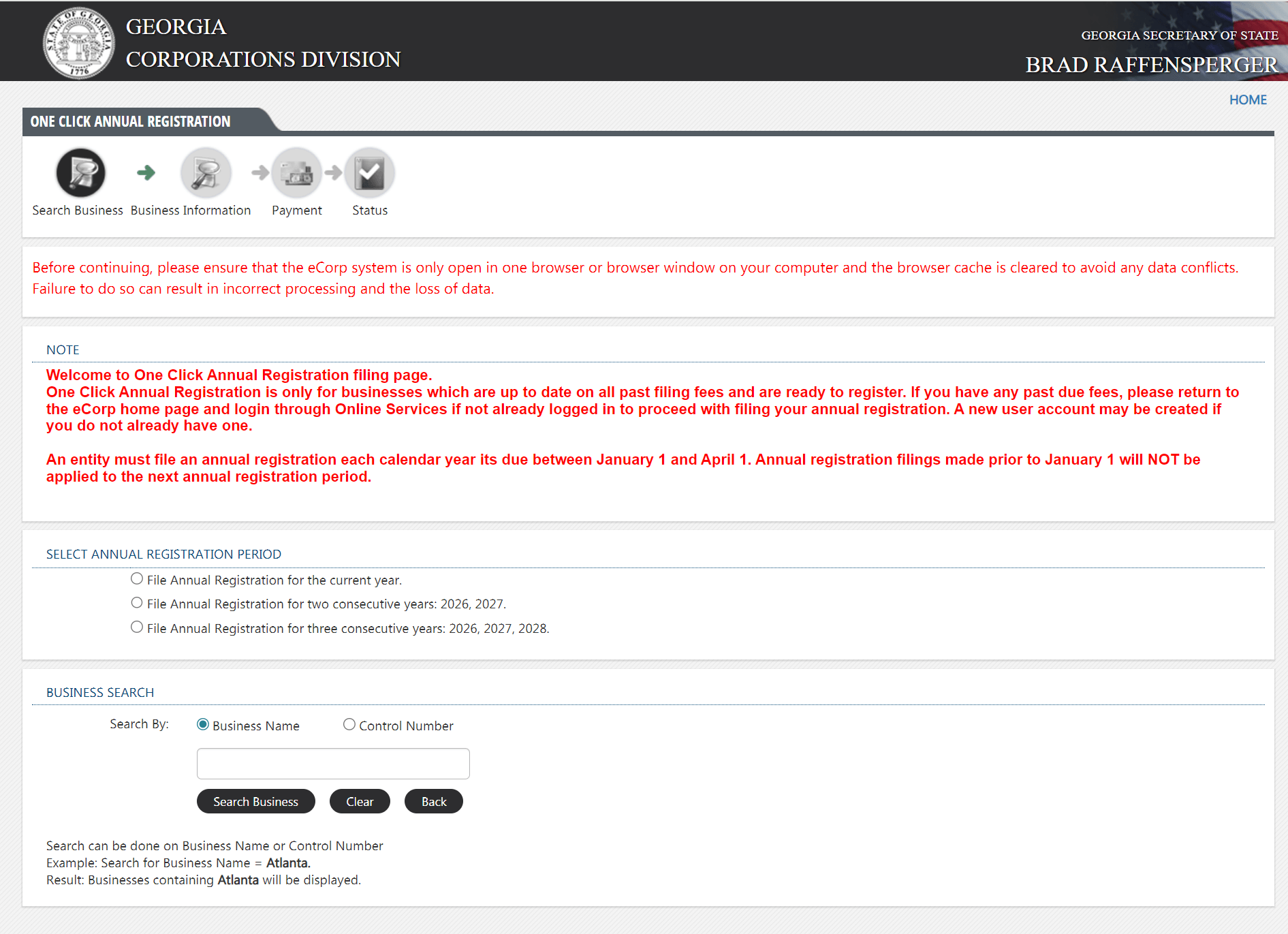
The One Click Annual Registration option at ecorp.sos.ga.gov/OneClickAR is the fastest route. Use it when your LLC is current, has no past due fees, and needs no changes to the registered agent or principal office. The system pulls your existing record, asks for filer name and email, and processes payment by credit card.
Online Annual Registrations are processed immediately by the Georgia Secretary of State, and the filer receives the updated registration and receipt by email. Keep that receipt; some banks and licensing agencies ask for proof of a current filing during account or permit reviews.
Filing With Changes Through eCorp Online Services
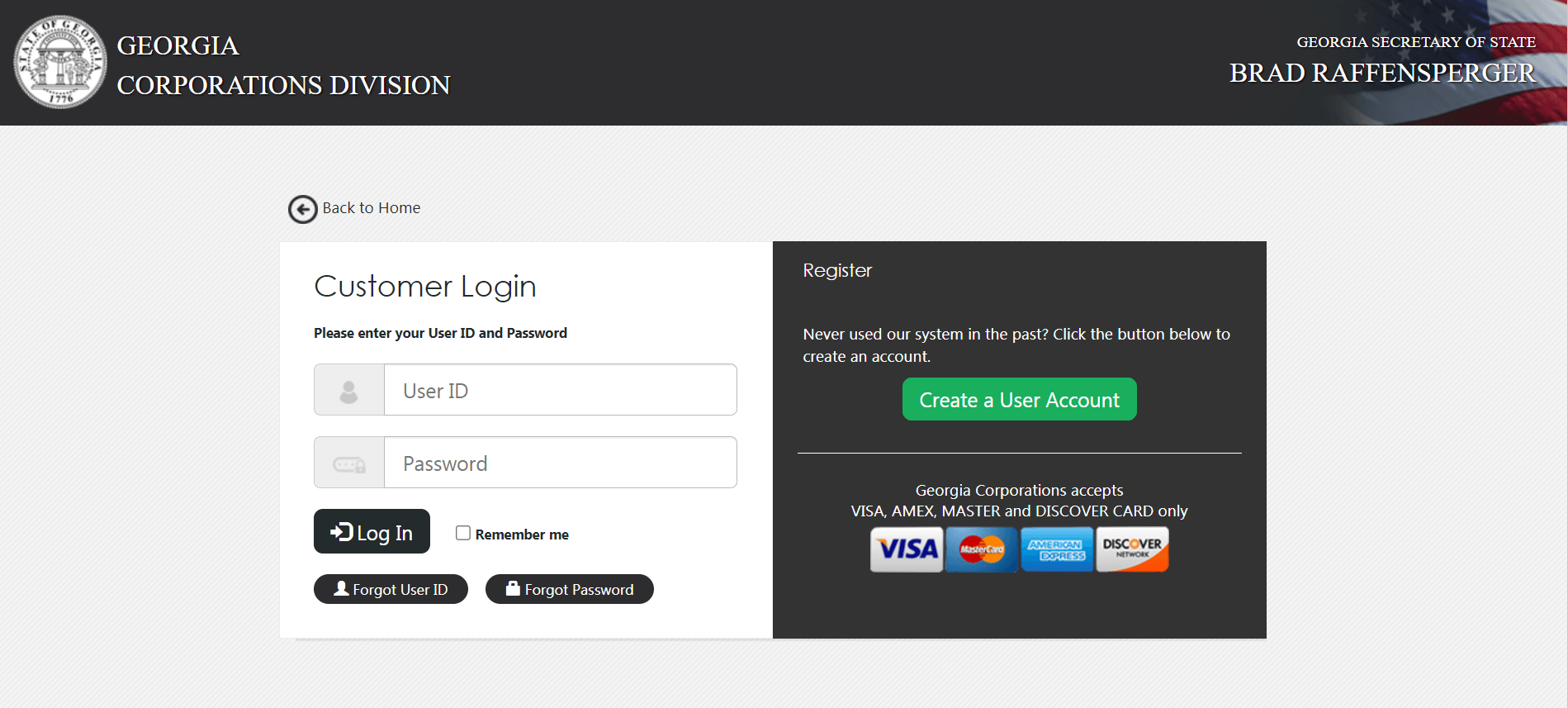
If your LLC needs to update its registered agent, change its principal office mailing address, or has past due fees, the One Click route won’t work. Log into the eCorp Online Services dashboard at ecorp.sos.ga.gov/Account, search for your entity, and file an Annual Registration With Changes from there.
The Online Services dashboard stores every filing receipt, which helps if your CPA or bank asks for historical proof of registration. Georgia Administrative Code Rule 590-7-22 provides that filed annual registrations are retained by the Secretary of State for five years. Updating your registered agent through this path costs the same $60 as a standard Annual Registration; there’s no separate registered agent change fee on top. If you’re shopping for a new agent, our best registered agent in Georgia review walks through the trade-offs.
Filing by Mail
Paper filing is available, but slow. The process: search your entity through eCorp, print the Paper Annual Registration Form the system generates, and mail it with payment to:
Georgia Corporations Division
2 MLK Jr. Dr.
Suite 313, Floyd West Tower
Atlanta, GA 30334
Payment is by check, certified bank check, or money order; cash isn’t accepted. For mailed filings, the envelope must be postmarked by April 1 of the current year to avoid the $25 late fee. The state mails the updated registration and confirmation back in about 3 to 4 weeks. Mail or hand-delivered Annual Registrations can be expedited to 2 business days for an extra $60. Online is still faster and avoids the expedite fee entirely.
Update Your Georgia Registered Agent with Northwest
Northwest gives your Georgia LLC a dependable registered agent with a real Georgia street address, privacy-focused handling, and reliable support for state notices.
What You’ll Need Before Filing the Georgia Annual Registration
Pulling the right information up front cuts the filing time to a few minutes. The Georgia Secretary of State publishes the official list of required fields, and there are no surprise add-ons for standard LLC filings:
- Your LLC’s control number or exact business name (look it up via Georgia LLC search)
- Name of the person filing the registration
- A valid email address for the confirmation receipt
- Registered agent’s name and physical Georgia street address (P.O. boxes are not accepted)
- Mailing address of the LLC’s principal office
- Credit card (online) or check, certified bank check, or money order (mail)
What you don’t need: the EIN, NAICS code, or any tax information. Georgia’s standard LLC Annual Registration does not require listing LLC members or managers; that information stays in your operating agreement and internal records. A NAICS Code Update exists as a separate $20 service on the SOS fee schedule, but it isn’t part of the required Annual Registration fields.
Verify all information before submitting. Once filed, the Georgia Secretary of State says corrections require another annual registration or amended annual registration, and the office cannot rescind the filing or refund the fee.
Late Penalty and Administrative Dissolution in Georgia
Missing the April 1 deadline triggers a $25 late penalty under O.C.G.A. § 14-11-1101. That’s not a typo. Georgia’s late fee is one of the most modest in the country, which is part of why owners get casual about the deadline. The state’s bigger lever is what happens next.
Under O.C.G.A. § 14-11-603, the Secretary of State can start administrative dissolution after 60 days past the April 1 deadline. The unfiled Annual Registration must include all fees and penalties owed. The SOS mails a written notice to the registered agent or to the principal office on file, and from the date of that notice, the LLC has another 60 days to cure or show grounds don’t exist.
A returned check or dishonored card payment can trigger a $30 NSF charge. If payment is not made after notice from the Georgia Secretary of State, the SOS may pursue civil collection or administrative dissolution proceedings.
If the LLC doesn’t cure in time, the SOS files a certificate of dissolution. The administratively dissolved LLC continues to exist on paper but can only wind up and liquidate. It loses the ability to carry on regular business, which makes new contracts and bank accounts problematic fast. The catch: a foreign LLC’s authority is revoked rather than dissolved, and revoked foreign LLCs cannot reinstate.
Protect Your Georgia LLC from Dissolution with Bizee
Bizee helps Georgia LLC owners stay on top of annual registration deadlines, avoid late penalties, and keep their business in good standing with the state.
How to Reinstate a Georgia LLC After Administrative Dissolution
Domestic Georgia LLCs that get administratively dissolved have 5 years to file an Application for Reinstatement under O.C.G.A. § 14-11-603, per the Georgia SOS reinstatement guide. The total cost is $260 ($250 reinstatement fee plus the $10 service charge). The application must include a statement confirming all taxes owed to the state have been paid.
Reinstatement relates back to the dissolution date, so the LLC is treated as if administrative dissolution never happened. Your LLC’s name stays reserved during that 5-year window. After the 5-year reinstatement period, another entity may reserve or file under that name. Foreign LLCs whose authority was revoked have to re-qualify with a new Certificate of Authority; reinstatement isn’t an option. While you’re cleaning things up, check the Georgia LLC operating agreement to confirm it still reflects your current setup.
Georgia LLC Annual Registration Questions Owners Ask Most
A few questions surface in almost every Georgia LLC compliance conversation. Here are the practical answers, with statute and fee references where they matter.
Is the Georgia Annual Registration the same as an annual report?
Functionally yes, officially no. The Annual Registration is Georgia’s version of what most states call annual reports. The Corporations Division never uses “annual report” in its materials. Search engines use it because that’s how owners search; the state’s portal does not.
When is the first Annual Registration due for a new Georgia LLC?
The year after formation. A Georgia LLC formed any time in 2025 has its first Annual Registration due between January 1 and April 1, 2026. The 90-day corporate initial filing rule doesn’t apply to LLCs.
Can I file the Georgia Annual Registration for multiple years at once?
Yes. Under O.C.G.A. § 14-11-1103.1, the state lets you file for the current year plus one or two additional calendar years at the same time. A 3-year filing comes out to $180 total ($60 × 3). It’s useful if you’re tired of the annual reminder.
Can I update my registered agent on the Annual Registration?
Yes. Updating the registered agent or registered office is included in the Annual Registration filing at no extra charge through eCorp’s Online Services path. If you already filed your registration this year and need to change the agent now, file an Amended Annual Registration for $30.
Are LLC members and managers reported through Georgia SOS?
No. Georgia’s standard LLC Annual Registration does not require listing LLC members or managers. The required fields are limited to the registered agent and the principal office address. Track member changes internally through your operating agreement and written consents.
Does a Georgia LLC pay franchise tax in addition to the Annual Registration?
Georgia does not impose a franchise tax on standard LLCs through Annual Registration. According to the Georgia Department of Revenue LLC FAQ, each LLC is classified as a partnership for Georgia income tax purposes unless classified otherwise federally. The Georgia DOR net worth tax only applies when an LLC is treated as a corporation for Georgia income tax purposes. SOS filings and DOR tax filings are separate.
How do I get a Certificate of Existence for my Georgia LLC?
Order one through eCorp for $20 ($10 fee + $10 service charge). Your LLC has to be current on its Annual Registration to qualify. Banks, lenders, and out-of-state agencies often ask for this document during onboarding.
- Georgia SOS: How to File Annual Registration
- Georgia eCorp: One Click Annual Registration
- Georgia.gov: Renew an LLC
- Georgia SOS Filing Fees Schedule (effective September 6, 2025)
- Georgia SOS: How to Reinstate an Entity
- Georgia Department of Revenue: LLC FAQ
- Georgia Administrative Code Rule 590-7-22: LLC Annual Registrations
- O.C.G.A. § 14-11-1103: Annual registration (Justia code reproduction)
Keep Your Georgia LLC on Track with Harbor Compliance
Harbor Compliance helps Georgia LLC owners manage annual registration requirements, monitor filing deadlines, and maintain good standing with the state.