

The annual cost of a USPS PO Box as of USPS Notice 123 (October 4, 2026 edition) typically runs about $62 to $1,354 per year (i.e., $31-$677 per 6 months, multiplied by two), depending on the box size and your post office’s fee group. Rural post offices often fall into lower fee groups than high-demand ZIP codes, which is why prices can vary so much. While USPS is usually the cheapest option, private mailbox providers and virtual mailboxes may offer more features at higher prices. This guide breaks down the price ranges, hidden fees, and smart alternatives so you can choose the best fit.
Annual PO Box Pricing: What You’ll Pay in 2026
USPS PO Box pricing is set by box size and the fee group assigned to the ZIP Code where the box is located. Each location is also classified as Market Dominant or Competitive, which is a major driver of why the “same box size” can cost very different amounts in different places.
USPS publishes PO Box rates in 3-month and 6-month terms; if you’re budgeting for a full year, you can estimate it as (6-month price × 2). If you only need a box for a few months, see PO box costs per month.
To streamline mail handling without a physical location, many startups opt to obtain virtual office address for enhanced credibility and operational convenience.
USPS Yearly Rates by Box Size (Annualized from 6-Month Pricing)
USPS offers 5 sizes (Size 1–5). Using the official USPS rate tables in Notice 123 (October 2026), here’s what the annual cost typically looks like across fee groups (Market Dominant at the low end, Competitive at the high end).
- Extra-Small (Size 1): $62-$340 / year
- Small (Size 2): $82-$450 / year
- Medium (Size 3): $120-$790 / year
- Large (Size 4): $180-$904 / year
- Extra-Large (Size 5): $312-$1,354 / year
Longer terms are usually cheaper in practice. For example, one Market Dominant case shows $81 × 2 = $162 (two 6-month periods) versus $50 × 4 = $200 (four 3-month periods) for the same box size/fee group.
Cost Variations by Location Type (Competitive vs. Market Dominant)
USPS PO Box pricing isn’t just “urban vs. rural.” What actually drives the price swings is how USPS classifies the Post Office (Market Dominant vs. Competitive) and which fee group your ZIP Code falls into. That’s why two people renting the same box size can pay dramatically different annual totals—sometimes by hundreds of dollars.
If your main goal is privacy + a professional mailing presence, it’s also worth comparing a PO Box against a true business address option for your LLC.
| Scenario (Same Box Size, Different Fee Group) | Small Box (Annual) | Medium Box (Annual) | Large Box (Annual) |
|---|---|---|---|
|
Lowest-cost Market Dominant (Fee Group 7) | $82 | $120 | $180 |
|
Mid-range Market Dominant (Fee Group 3) | $158 | $274 | $478 |
|
Highest-cost Competitive (Fee Group C30) | $450 | $790 | $904 |
These examples come straight from the USPS Notice 123 rate tables and show how the exact same box size can land anywhere from “budget-friendly” to “premium,” purely based on classification and fee group. If you want to verify your own pricing, use the official rate chart in Notice 123, then cross-check your ZIP/location in the USPS PO Box lookup so you can see the fee group and availability before you commit.
Hidden Fees and Price Ranges to Expect
Beyond the rental price, USPS lists a few common add-ons you should budget for:
- Key deposit: $6 per key issued (Competitive locations waive the deposit for the first two keys).
- Key duplication or replacement: $14 each (after the first two keys).
- Lock replacement / late payment fee: $30.
Some locations also surface optional features during checkout (especially at Competitive offices, which can include perks like expanded access hours or “13 months for 12 months” in certain cases), so check your exact Post Office listing before you commit.
If you’re deciding whether a PO Box is “enough” for official business mail, you’ll also want this guide: Registered agent address vs. PO Box for official business mail.
Need more than a PO Box?
ZenBusiness gives your LLC a real street address through registered agent services, perfect for compliance, privacy, and mail handling.
USPS vs. Private Providers: Who Offers Better Yearly Value?
When you compare mailbox options, the best choice is rarely “cheapest vs most expensive.” It comes down to what you actually need for the next 12 months: a low-cost place to receive letters, a real street-style address, or reliable package handling from multiple carriers.
Comparing USPS with UPS Store and Virtual Mailboxes
USPS is usually the lowest-cost baseline. As of the USPS PO Box pricing, a full year typically budgets around $62 to $1,354 (annualized from 6-month rates). Private providers cost more, but often bundle features USPS may not include by default.
| Feature | USPS PO Box | UPS Store mailbox | Virtual mailbox |
|---|---|---|---|
| Typical yearly cost | ~$62-$1,354 | Set by each franchised store | Set by each provider, plus add-on fees |
| Address format | PO Box format | Street address format (PMB/suite style) | Street address format (location-based) |
| Packages from non-USPS carriers | Possible via Street Addressing, subject to availability and restrictions | Typically accepts packages from multiple carriers (store policy varies) | Typically supports receiving and forwarding, often with per-item fees |
| Access hours | “24/7 access at most Post Offices” plus location-specific lobby rules | Extended retail hours (varies by store) | Digital access 24/7; pickup depends on location |
Which Is Cheaper for Long-Term Use?
For pure cost, USPS usually wins over a full year. Where private services can win is when the “extras” save you time or prevent missed deliveries.
The break-even point usually shows up when you receive frequent packages from UPS/FedEx/Amazon or you truly need a street-style address for vendors. USPS can cover some of this with Street Addressing, but it is not offered everywhere and it comes with restrictions.
If you are using your mailbox as part of your business identity, remember that a “mailing address” and a “registered agent address” are not the same thing.
Are There Additional Benefits with Private Mailboxes?
Private mailbox services often justify the higher annual cost when you need convenience features USPS does not consistently bundle, such as package acceptance policies tailored for businesses, delivery notifications, and optional mail scanning/forwarding workflows (features vary by provider and location).
Ditch the PO Box hassle
Northwest offers a secure business address with registered agent service, so you never miss legal mail, no matter where you work from.
Should You Choose an Annual Plan for Your Business?
Choosing a 12-month PO Box term is less about chasing a discount and more about reducing operational risk. USPS lets you pay in 3-, 6-, or 12-month terms, and the 3-month option requires automatic renewal, while 6- and 12-month terms let you opt out. If your business depends on consistent mail delivery, fewer renewal cycles can mean fewer chances to miss a deadline and get hit with late fees.
Pros and Cons of 12-Month vs Shorter Terms
This comparison is easiest if you look at it like operations: how often you want to deal with renewals, how stable your address needs are, and what a disruption would cost you.
Advantages of 12-month plans:
- Fewer renewals to manage, which reduces the chance of disruption.
- Better operational stability for bank mail, compliance notices, and vendor correspondence.
- In Competitive locations, new customers receive 13 months of service for a 12-month payment.
Disadvantages of 12-month plans:
- Higher upfront payment, which may matter for cash flow.
- Less flexible if you change locations or stop needing the box mid-term.
- Refunds follow the 6-month rule: half the fee back if you close in the first 3 months of a 6-month period, nothing after that.
Each renewal is a deadline, and renewing more than 10 days late adds the $30 late-payment fee listed above. A longer term makes sense if you know you will still need the same mailing setup in six to twelve months.
Is It Worth Paying for a Full Year Upfront?
If your address needs are stable, paying for 12 months is usually worth it for simplicity and continuity. It also helps you avoid renewal mistakes that can trigger fees. USPS has a standard 10-day grace period for PO Box renewals, and renewing more than 10 days late can trigger the lock replacement fee as a late payment charge, even if the lock is not changed.
If you are still testing your setup, start with 6 months first. Once you are confident the location and size fit your workflow, moving to 12 months is when the convenience really pays off.
What Affects the Yearly Price of a PO Box?
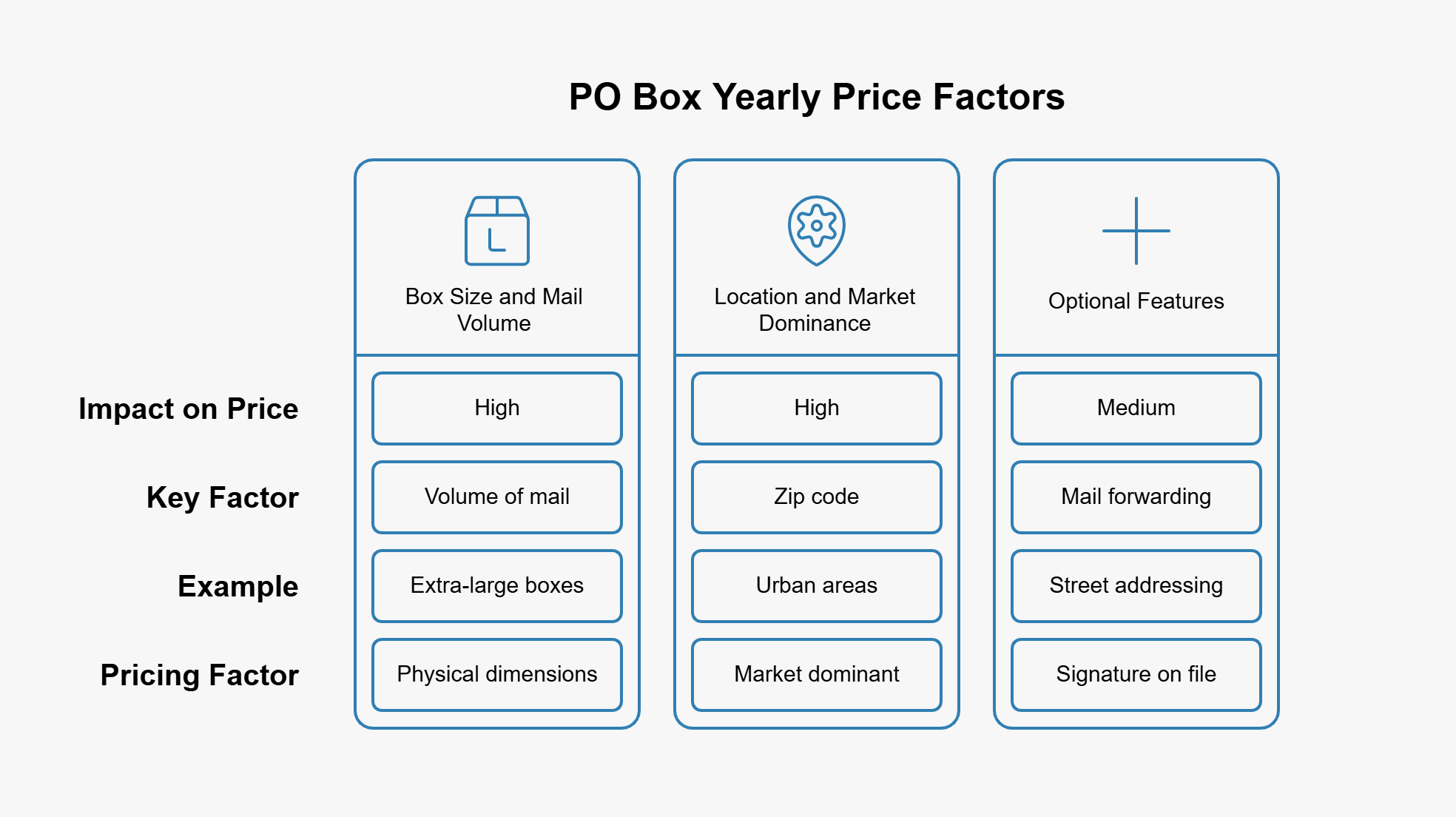
A “one-year PO Box price” is really three separate decisions rolled into one: the box size you choose, the Post Office fee group you land in, and any add-ons or fees you trigger along the way. USPS prices are organized by fee groups and are also classified as Competitive or Market-Dominant depending on the location.
Box Size and Mail Volume
Your box size is the biggest lever you actually control. USPS pricing steps up by size, so choosing one tier larger can cost meaningfully more, but choosing too small can turn into a convenience problem fast.
If you only check the box once or twice a week, size it for a full week of mail rather than an average day. Overflow mail means extra trips to the counter.
A simple way to choose:
- Small works if you mostly get letters and you check often.
- Medium is a common “safe” choice for business mail because it handles thicker mail and fewer trips.
- Large or XL only makes sense if you regularly receive bulky envelopes, catalogs, or frequent parcel notifications.
Location and Fee Group Classification
Two people can rent the same size box and pay very different yearly totals because the Post Office itself drives the fee group.
USPS explains it like this:
- Competitive PO Box service applies in locations within the service area of a competitive mailbox provider.
- Market-Dominant PO Box service is meant to serve customers not served by a nearby competitor.
Practically, this is why your ZIP Code matters so much. PO Boxes are assigned to fee groups, and USPS points you to Notice 123 (the price list) for the fee-group tables.
Optional Features and Extra Fees That Change Your Total
Some “extras” are features (available only at certain offices), and others are fees (you pay when something happens).
Competitive-location features (varies by Post Office):
- New customers in some competitive locations receive 13 months of service for a 12-month payment and may get expanded access hours or earlier mail deposit times.
- You may also be able to opt in to Street Addressing, Real Mail Notification, and Signature on File by completing a customer agreement.
- Street Addressing lets you use the Post Office street address plus “#” and your box number, and can help with private-carrier deliveries where supported.
- Signature on File can allow USPS to use your stored signature for certain signature-required items (it has important exclusions, like Registered Mail and Certified Mail).
Fees that can raise your all-in yearly cost:
- Deposit per key issued: $6
- Key duplication or replacement (after the first two keys): $14
- Lock replacement and late-payment fee: $30
Forwarding option (separate program, useful if you travel):
If you need mail bundled and shipped to you temporarily, USPS Premium Forwarding Service Residential has an enrollment fee ($26.40 online or $28.70 at the Post Office) plus a weekly shipment fee ($29.70 per week).
Smarter Alternatives to Annual PO Box Rentals
If you do not want to check a physical box regularly, or you need a street-style address for business mail, there are two alternatives that often deliver better “yearly value” than a PO Box in a high-cost fee group: virtual mailboxes and registered agent address services. The right pick depends on whether you need day-to-day mail convenience, legal compliance coverage, or both.
Virtual Mailboxes with Yearly Plans
A virtual mailbox gives you a real street address where your mail is received, then you manage it online (view envelopes, request open-and-scan, forward, shred). Plans usually fall into three tiers:
- Low-cost plans:
basic mail handling with a small monthly allowance of scanned items. - Mid-range business plans:
more mail items and scans included each month. - Higher-touch “mailroom” style plans:
full mail handling, often with usage fees on top.
The trade-off is that “annual price” is not the full story. Most virtual mailbox services charge extra for things like additional mail items, content scans, check deposits, and forwarding/shipping.
Estimate your monthly volume first (how many envelopes and how many full scans you actually need), then pick a plan where the included limits match your reality so you do not get nickeled-and-dimed later.
Why Registered Agent Services May Be a Better Investment
If you operate an LLC or corporation, a registered agent solves a different problem than a PO Box. In every state, the registered agent must be available at a physical street address in the state, and PO Boxes are commonly not accepted for the registered agent address on filings. If you are still in the “paperwork” stage, the SBA’s overview of the registration process is a useful checklist for what your state may require: SBA guide to registering your business.
Cost-wise, professional registered agent services are commonly in the $100 to $300 per year range, depending on what is included. For example, some providers advertise pricing like $125/year (Northwest), and packages may include mail scanning or privacy features.
Where this can outperform a PO Box is compliance value. You get a compliant address for legal and state mail, plus document handling. Where it can disappoint is day-to-day logistics. A registered agent address is not a catch-all mailbox for packages and routine deliveries unless the provider clearly supports that workflow. If you are unsure which address should go where on your formation documents, this explainer helps clarify the difference: principal office address for an LLC and what it means.
Long-Term Mail Handling for Remote Entrepreneurs
If you travel frequently, run a remote team, or operate across regions, virtual mailbox services are often the most “set-and-forget” option because you can manage mail from anywhere. Many services are built around a simple loop: receive mail, show it to you online, then you choose open-and-scan, forward, shred, or archive.
With a virtual mailbox, per-item fees for scans and forwarding can outweigh the base subscription price. Before picking a plan, answer two questions: how many envelopes you get per month, and how often you need full content scans.
How to Get and Renew a PO Box for One Year
Getting a PO Box for a full year is straightforward, but the details matter. Mistakes to avoid include picking the wrong size, choosing a term that does not match how long you will actually need the box, or missing renewal timing and getting hit with late fees.
Online and In-Person Application Steps
USPS lets you start online (reserve and pay) or apply in person. Either way, you will complete the PO Box application (PS Form 1093) and verify two forms of acceptable ID at the Post Office where your box is located.
Steps to get a one-year PO Box:
- Search availability by ZIP Code and pick the Post Office location you want.
- Choose a box size based on your real mail volume.
- Select your term (3, 6, or 12 months where offered). Note that the 3-month option requires automatic renewal.
- Reserve/pay online (if you start online). You typically have 30 days to activate the box in person.
- Go to the Post Office counter with two IDs (one photo ID and one non-photo ID that is traceable to you), and finalize verification to receive your box number and two keys or combination.
Accepted Payment Methods and Billing Cycles
For PO Boxes, USPS supports both online and in-person payment options.
- Pay online: typically with a credit or debit card, and you can also set up automatic renewal payments.
- Pay in person: cash, check, credit card, or debit card at the Post Office where your box is located.
- Pay by mail (renewal): send a check or money order to the Postmaster where your PO Box is located.
Choose 6 or 12 months if you want fewer renewal moments. The 3-month term can be useful, but remember it comes with the auto-renew requirement.
Managing Renewals and Avoiding Late Fees
Renewals are where people get surprised. USPS policy includes a 10-day grace period after the renewal due date. If you renew more than 10 days late, the lock replacement fee can be charged as a late payment fee, even if the lock is not actually changed.
To keep things smooth:
- Turn on email reminders and/or set a calendar reminder 30 to 45 days before renewal.
- Use auto-renew if you do not want to think about it.
- If you do miss the due date, renew within the 10-day grace window to reduce the chance of extra fees.
FAQ: Yearly PO Box Costs and Long-Term Mail Solutions
Navigating the various options and considerations for annual PO box rentals generates common questions from both individuals and businesses. This collection of frequently asked questions provides quick, authoritative answers to help guide your decision-making process.
Can I Get a Discount for a 12-Month PO Box Rental?
Yes, but it is not a “monthly discount” in the usual sense. USPS does not sell true month-to-month PO Boxes. You pay in 3-, 6-, or 12-month terms, and the longer term is often cheaper than repeating shorter renewals.
For example:
Size 1 (Market Dominant, Fee Group 1) is $81 per 6 months versus $50 per 3 months. Paying for 12 months as two 6-month periods is $162, while four 3-month payments total $200.
Also, new customers in Competitive locations receive 13 months of service for a 12-month payment.
Is It Cheaper to Use a Virtual Mailbox Long-Term?
Sometimes, but only if the plan matches how you actually use mail.
In pricing terms, you can find virtual mailbox options at very different prices, and premium or “prestige” addresses cost the most.
Where people get surprised is add-on billing. Scans, extra mail items, forwarding, check deposits, and storage can push the real yearly total above the sticker price.
Can a PO Box Be Used as My Business Address All Year?
You can use a PO Box to receive business mail, but it can be risky to rely on it as your “official” address for filings.
USPS does offer Street Addressing at some locations, which lets you use the Post Office’s street address plus a “#” and your box number for deliveries that require a street format.
Still, many states require a physical street address for a registered agent, and a PO Box does not meet that requirement.
What Happens If I Cancel Before the Year Ends?
Refunds are not always “month-by-month.” USPS refund rules are based on the 6-month service period:
– If you discontinue service within the first 3 months of a 6-month period, half of the fee may be refunded.
– If you discontinue after the beginning of the 4th month, none of that 6-month fee is refunded.
– If you prepaid for a future 6-month period (for example, you paid a full year up front), that next 6-month fee can be fully refunded if it has not started yet.
– A 3-month auto-renew term is never refunded.
USPS also notes you can request a refund for unused time at the Post Office where the box is located.
How Do I Switch from Monthly to Annual Billing?
USPS PO Boxes are not billed monthly. The available payment terms are 3, 6, or 12 months.
Terms can be switched during the renewal window:
– USPS lets you renew online starting 30 days before your next payment is due, and you can select the payment period during the process.
– USPS documentation also indicates you can edit payment details, including the payment period, in PO Boxes Online.
If you want to change the actual payment-period start month (not just choose a longer term), USPS allows a change of payment period by submitting a new application, with any unused fee potentially refunded under the refund rules.
Are PO Box Prices Likely to Increase Every Year?
USPS can change PO Box fees and fee-group assignments, but it is not a guaranteed “once per year” rule. USPS states that when fees increase, you do not pay the new price until the end of your current service period, and the fee charged is the one in effect on the date you pay.
- USPS: PO Boxes (overview, sizes, payments, renewal)
- USPS Postal Explorer: Notice 123 – Price List (PO Box fees)
- USPS Postal Explorer: 508 Recipient Services (PO Box rules, fee groups)
- USPS FAQ: PO Box – The Basics (apply, renew, close, refund)
- USPS: PS Form 1093 (PDF), How To Apply for a PO BOX
- USPS: Customer Agreement for Premium PO Box Service (Additional Services)
- Earth Class Mail: Virtual Mail – Pricing details
- USPS: PS Form 1583 (PDF) – Application for Delivery of Mail Through Agent
Professional address, full compliance
Harbor Compliance provides a physical business address plus registered agent service to protect your privacy and meet state requirements.