
Department of Financial Institutions, Madison
Wisconsin Business Entity Search: DFI Corporate Records
Search Corporate Records, the business link on the Wisconsin Secretary of State’s site, opens the Department of Financial Institutions (DFI) corporate records search: every Wisconsin business entity search, LLC or corporation, runs there. Looking up a record is free; certificates and copies of filed documents are paid orders.
Search Wisconsin businesses
Wisconsin onlyOne distinctive word finds more than the full legal name.
Try:
Why a Wisconsin Secretary of State Business Search Ends at the DFI
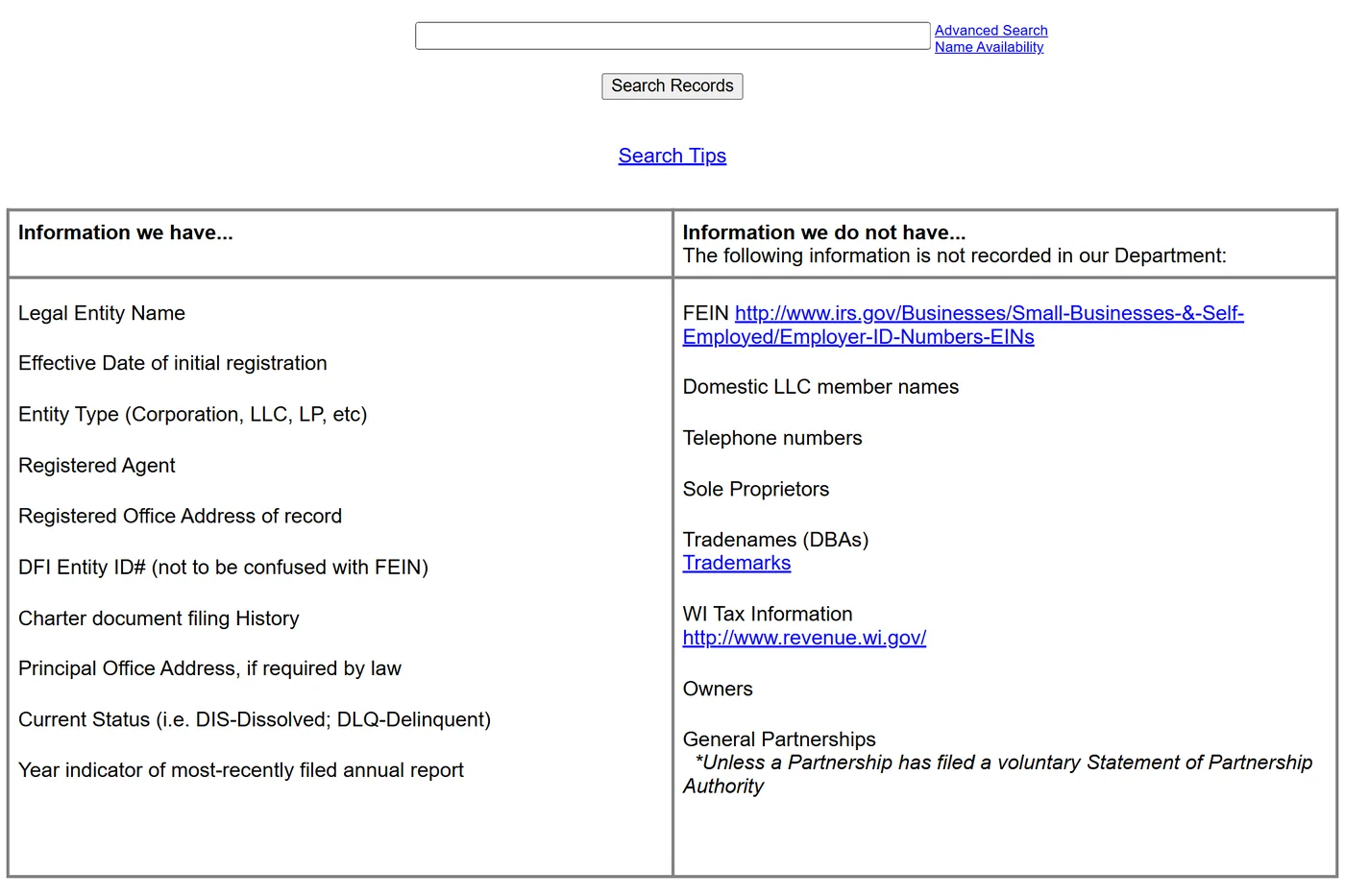
The DFI’s database is the Corporate Registration Information System (CRIS), labeled Business Entity Search on the DFI’s own pages; its bulk data order form and the retired wdfi.org address call the department WDFI. The search form lists what the DFI has, such as the entity ID, status and registered agent, and what it doesn’t: FEIN, LLC member names, owners, sole proprietors and trade names.
Official site: Search Corporate Records (Department of Financial Institutions)
Step 1: Enter Part of the Name, or the Entity ID
The DFI’s search tips ask for the name without its ending, then fewer words if nothing comes back, since common words can match so many records that not all of them are returned. The entity ID (one letter and six digits, such as 1P05236) works in the same box. Advanced Search adds three match options (“exact phrase”, “all words”, “start with”), a registered agent name search, old names, and filters by entity type, status and registration date.
Step 2: Read Each Row’s Status and Status Date
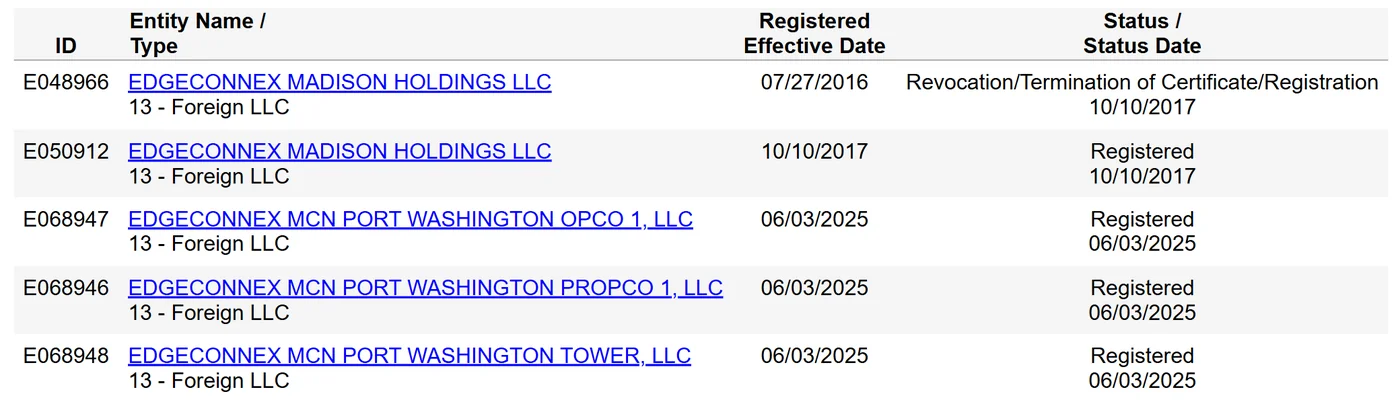
Results show the ID, the entity name with a numbered entity type (12 for a domestic LLC, 13 for a foreign LLC), the registered effective date, and the status with the date it took effect. One name can carry two IDs: Edgeconnex Madison Holdings LLC’s registration was revoked, and it registered again the same day under a new ID.
Step 3: Open the Record’s Three Blocks
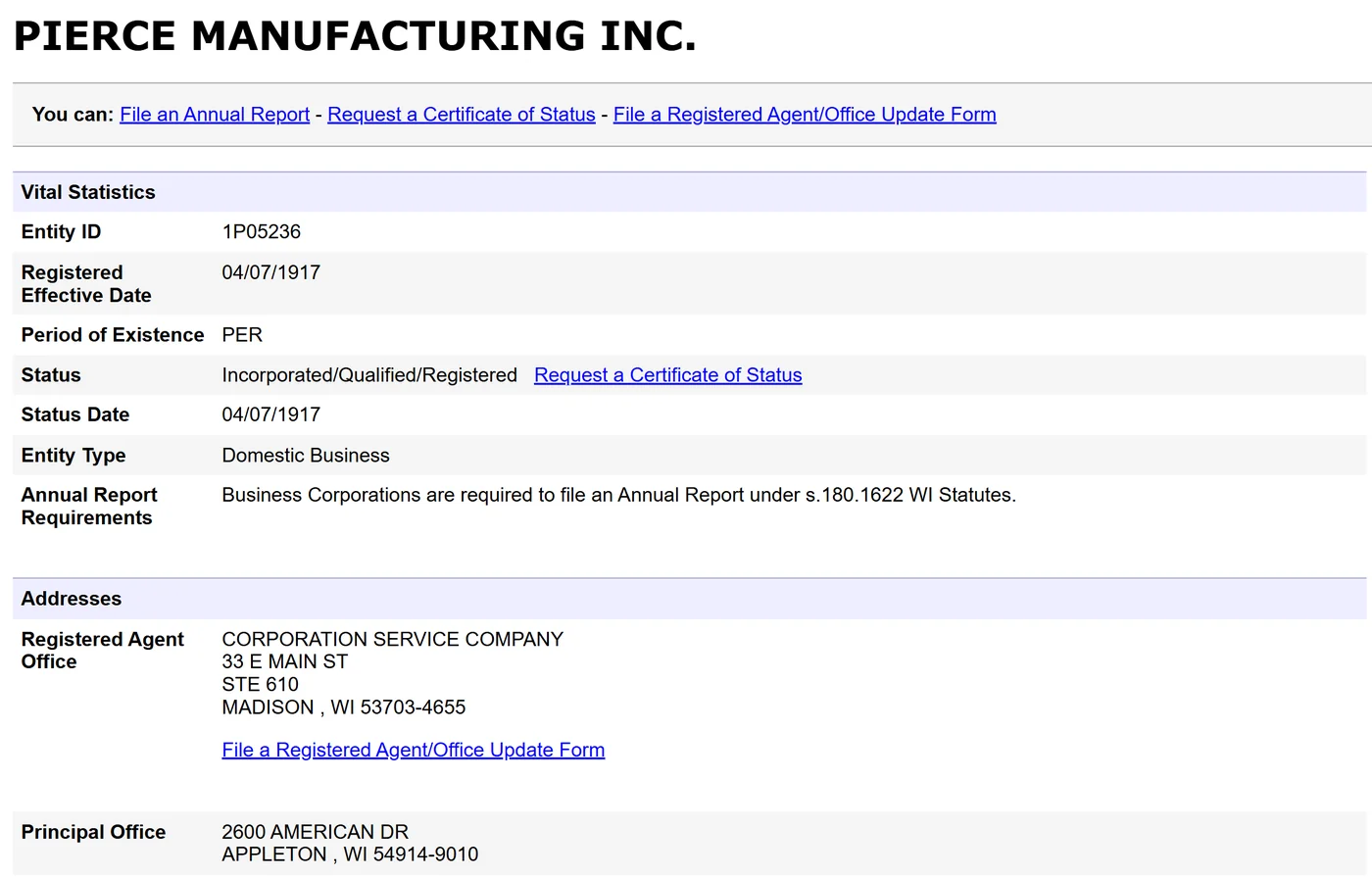
Vital Statistics gives the entity ID, registered effective date, period of existence, status and entity type; Addresses gives the registered agent office and the principal office; Historical Information lists each annual report, old names and a chronology of filings. Filed documents don’t open from the record: copies are ordered through the DFI’s Online Order System, $5 each or $10 certified. Articles of organization and of incorporation are ordered the same way.
No “Active” in Wisconsin: What a CRIS Status Means
CRIS has no status called Active; “good standing” appears only in Restored to Good Standing, after a delinquency. A company that is up to date shows the status it got when it was formed or registered, such as Organized for a Wisconsin LLC, and the DFI’s FAQ adds that a status “is not an assessment of the entity’s financial condition, stability, or business practices.”
| Status on the record | What it means |
|---|---|
| Incorporated/Qualified/Registered | A corporation formed or a foreign entity licensed, current with its reports. |
| Organized | A Wisconsin LLC formed, with no filing that ended it. |
| Restored to Good Standing | Delinquent before, current again. |
| Delinquent / In Bad Standing | An annual report hasn’t been filed. |
| Administratively Dissolved | Dissolved by the DFI, for grounds such as unfiled annual reports or no registered agent. |
| Dissolved | Ended by the company’s own articles of dissolution. |
| Registered | A foreign entity registered to do business in Wisconsin. |
| Revocation/Termination of Certificate/Registration | A foreign entity’s registration revoked after a missed report; it has six months to reinstate. |
| Terminated | Existence ended by a filing, which can be a conversion into another entity rather than a closure. |
The Annual Report Is Due in the Anniversary Quarter
A Wisconsin LLC or corporation files its annual report each year during the calendar quarter of its registration anniversary: an LLC formed on May 10 files between April 1 and June 30, starting the year after (s. 183.0212). Online, filing the Wisconsin annual report costs $25 for an LLC ($40 on paper); a foreign LLC files by March 31 for $65. The DFI lists no late fee: a delinquent entity catches up by filing the current report and paying the back annual report fees.
Administrative Dissolution, and Coming Back
Each quarter the DFI writes to entities that have gone years without a report, then posts the ones it can’t reach in a public Notice of Administrative Dissolution; 60 days later they are dissolved, at no cost to them. The name becomes available to others from the date of the dissolution. A dissolved entity that wants to return writes to DFICorporations@dfi.wisconsin.gov, which sends the reinstatement forms.
Proof of Status: the $10 Certificate of Status
Wisconsin’s version of a certificate of good standing is the Certificate of Status, $10. Ordered online from the record’s Request a Certificate of Status link, the short form arrives by email right away and can be printed as often as needed; the long form and copies notarized for an apostille take up to 10 business days.
Under s. 183.0211, anyone can order one, and it states whether the company filed its annual report for its most recently completed report year. The same law has the DFI confirm a certificate’s details by telephone.
“WI Certificate Service” and Other Invoice-Style Letters
The DFI’s warning page names mailings made to look like invoices from “WI Certificate Service” and “US Business Regulations Dept.”, and states that a properly formed company “is not required to purchase or receive a certificate of status to be considered valid.” Filing a false document with the DFI on purpose is a Class I felony in Wisconsin.
Owners Aren’t in CRIS, but Annual Reports Can Name Officers
The online record names no owners, members or officers, and the DFI’s FAQ says entities aren’t required to reveal ownership to it. A corporation’s annual report, though, lists each director and principal officer, and an LLC’s report names at least one member or manager (s. 183.0212).
Those reports aren’t displayed on the record; copies are ordered like any other filed document (Step 3). The record does show the registered agent’s name and address. The agent must be a Wisconsin resident or an entity with an office in the state, at a street address rather than a post office box. The Person tab finds an agent’s companies from its name; the DFI searches current agents only and warns that results may not be all-inclusive.
Name Checks in Wisconsin: LLC, Inc. and Other Endings Don’t Count
For a Wisconsin business name search, the DFI’s standard is a name distinguishable on its records, and endings such as LLC, Inc., Corporation or Limited Liability Company are not taken into account (s. 183.0112), so ABC LLC and ABC Inc. count as the same name. Names of administratively dissolved entities are left out of the comparison.
The DFI’s Name Availability search and its phone line, (608) 261-7577, give tentative answers only: the FAQ says no name should be assumed available until the formation filing is accepted. The LLC statute allows a 120-day reservation for $15, and it can be renewed. Trademark conflicts are a separate question, covered in clearing a business name against trademarks.
No DBA Registry at the DFI, Only an Optional Trade Name Filing
The DFI keeps no DBA registry: CRIS lists trade names among the things it doesn’t record. What exists is the optional registration of a mark or trade name with the DFI’s Trademarks Bureau, $15 for 10 years, notarized, and searchable in the WIMS trademark search. Registration gives no ownership, and because it’s optional the DFI says it holds only a partial list of names in use.
Wisconsin EIN Lookup Needs the EIN Already
No Wisconsin search gives another company’s EIN. CRIS doesn’t record it (its form says the entity ID is “not to be confused with FEIN”), and the Wisconsin Department of Revenue’s tax account lookup asks for the business’s FEIN or SSN, its name and its ZIP code before it shows anything.
That lookup exists to find a business’s own Wisconsin tax number and filing frequency. The EIN itself comes from the IRS, which can resend it through a Letter 147C or a call to 800-829-4933, as explained in tracing a lost EIN.
Seller’s Permits Aren’t at the DFI, and Other Short Answers
Does the DFI issue business licenses or seller’s permits?
No. The DFI is a filing registry. A seller’s permit comes from the Department of Revenue, which may ask for a security deposit of up to $15,000, and the Wisconsin One Stop Business Portal registers a new business with the DFI, the Department of Revenue and the Department of Workforce Development.
How fast is a Wisconsin filing processed?
Online filings are usually accepted on receipt, with an email confirmation. Paper filings can be expedited for $100 (next business day), or at the Madison counter for $250 (four hours) or $500 (one hour).
How many businesses are active in Wisconsin?
More than 600,000 business entities, most of them Wisconsin LLCs, according to the DFI’s monthly statistics. The full database is sold as a text file for $40 a delivery, and new formations for $5 a month.