
Corporations Division, Georgia Secretary of State
Georgia Business Entity Search: GA LLC Lookup on eCorp
Georgia’s eCorp shows a company’s status in the result list itself, before the record is opened: a Georgia business entity search on the Secretary of State Corporations Division’s free Business Search takes a business name, control number, registered agent or officer name. The record adds the last annual registration year, the registered agent and, for a corporation, its CEO, CFO and secretary; LLC members and managers are never listed. The search on this page covers Georgia companies by name, control number or person.
Search Georgia businesses
Georgia onlyOne distinctive word finds more than the full legal name.
Try:
How to Look Up an LLC in Georgia by Name, Control Number or Officer
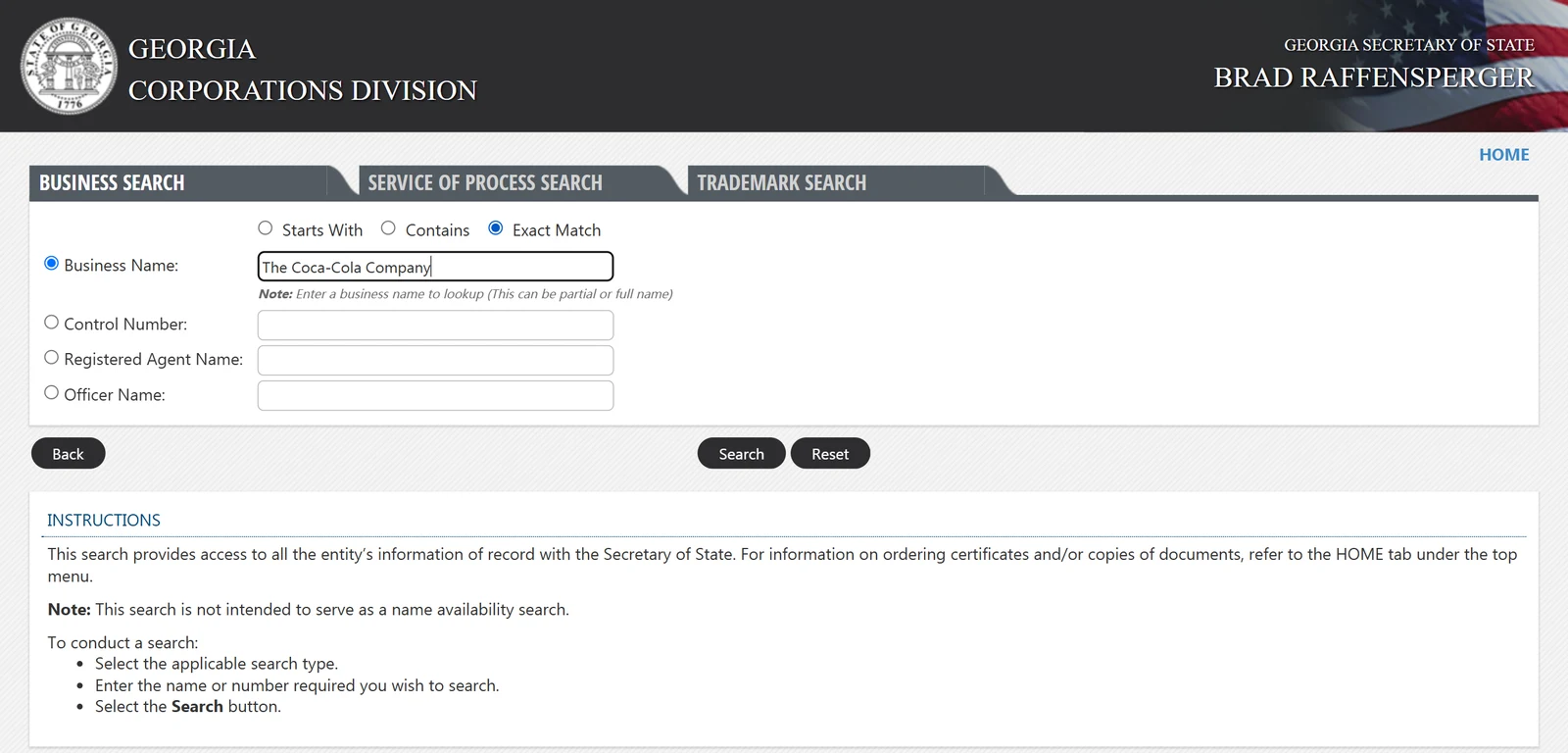
The Georgia business search of the Secretary of State Corporations Division, on eCorp, needs no account and searches one field at a time: Business Name, Control Number, Registered Agent Name or Officer Name, matched Starts With, Contains (the default) or Exact Match. Each result line shows the business name, control number, business type, principal office, registered agent and status.
Step 1: Choose the Field and the Match
Contains finds the words anywhere in a name; Exact Match narrows a common one. Officer Name is Georgia’s search by person, useful for corporations, since those are the only companies with officers on file. The form itself warns that this search isn’t meant to confirm name availability.
Step 2: Check the Type and Status Before the Name
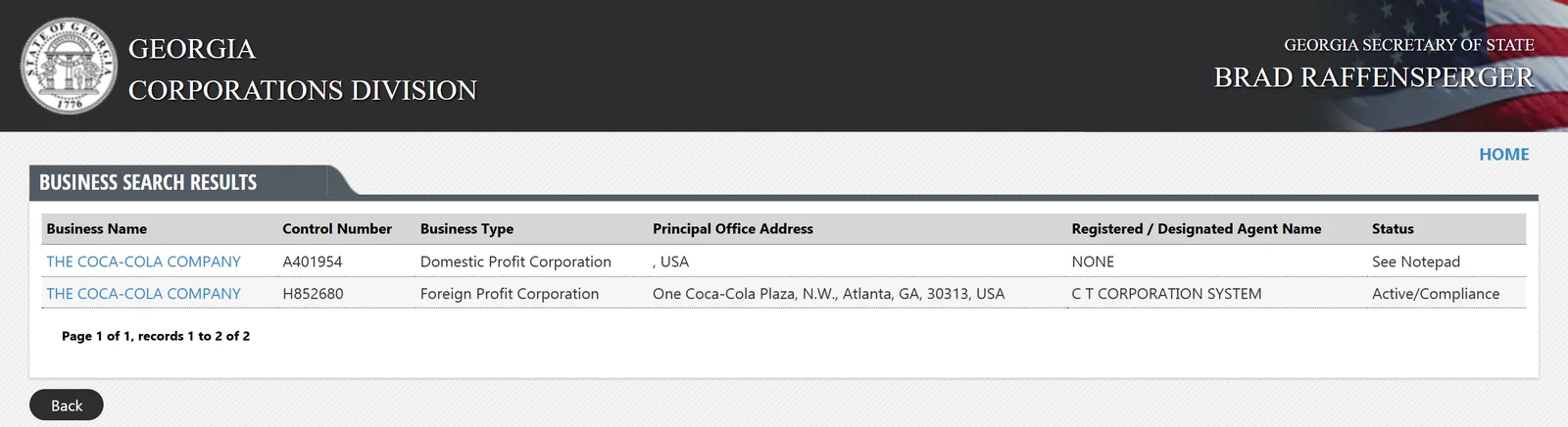
A well-known name can match more than one record. The Coca-Cola Company returns two: A401954, an old Georgia corporation showing See Notepad, and H852680, the Delaware corporation registered in Georgia as a Foreign Profit Corporation and in Active/Compliance. Delta Air Lines, Inc. (H853425) is a Delaware corporation too. Both have their principal office in Atlanta, but there is no separate Atlanta LLC search: eCorp is one statewide register, covering corporations, nonprofits, LLCs and limited partnerships. Sole proprietorships aren’t registered with the Secretary of State and never appear. Name reservations do, marked Name Reservation.
Step 3: Open the Business Information
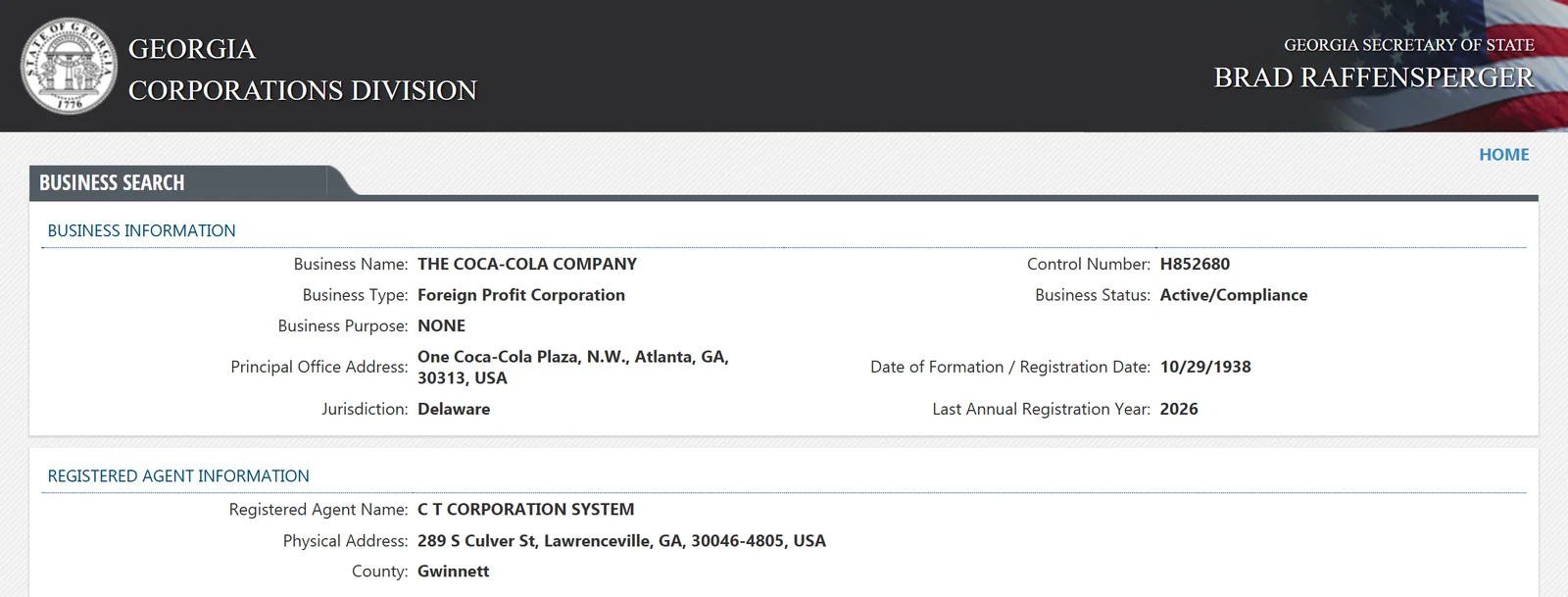
The record shows the control number, business type, business status, principal office address, date of formation or registration, state of formation or jurisdiction, Last Annual Registration Year, and the registered agent with its physical address and county. A Filing History button lists the company’s filings, and a Name History button sits next to it. Control numbers are short codes, usually 8 digits for newer entities or a letter and 6 digits for older ones (some older records use 7 digits); search control number exactly as the record shows it. Any filing on a record sends an email to every address tied to the company, a check against business identity theft.
Bulk records are sold, not published: the Secretary of State offers the full corporations list, with officers, agents and filing history, for $500 once or $5,000 a year.
Why a Georgia Record Says Active/Noncompliance
A Georgia LLC or corporation files an annual registration between January 1 and April 1 for $60 ($50 plus a $10 service charge; nonprofits pay $40), and a late one adds $25. An entity that misses it shows Active/Noncompliance, which the Secretary of State says means it will be administratively dissolved or revoked that year unless it files.
A Georgia corporation files its first registration within 90 days of incorporation; an LLC, a limited partnership or a foreign corporation files between January 1 and April 1 of its second calendar year. Up to three years can be paid at once, and One Click Annual Registration files it online without logging in when nothing has changed and earlier years are paid; the Georgia LLC annual registration guide goes through the form.
A Notice of Administrative Dissolution gives 60 days to file. After that, a Georgia corporation or LLC is administratively dissolved and can reinstate within five years for $260, and its existence is restored retroactively; its name stays reserved for those five years. A foreign company is revoked instead, can’t reinstate, and must apply again for a certificate of authority.
| Status | What it means |
|---|---|
| Active/Compliance | Active and current with its annual registrations. |
| Active/Noncompliance | Behind on its annual registration; dissolution or revocation follows that year. |
| Admin. Dissolved | Dissolved by the Secretary of State; it may only wind up, or reinstate within five years. |
| Revoked | A foreign company’s authority to do business in Georgia was revoked. |
| Dissolved | Shown for an entity that has been dissolved; unlike Admin. Dissolved, the state publishes no definition. |
| Withdrawn | A foreign company that filed an Application for Withdrawal. |
| Merged | Absorbed into another entity by a merger. |
| Expired | A name reservation that ran out after 30 days. |
| See Notepad | No public definition; call the Corporations Division at (404) 656-2817. |
Certificate of Existence: $20, Issued Online at Once
The Certificate of Existence, Georgia’s good standing certificate, costs $20 on eCorp and is issued immediately; only a company active and in compliance gets one. The Secretary of State has warned about mailers asking $72.50 for the same certificate, and new Georgia businesses don’t need one to register.
Who eCorp Names: CEO, CFO and Secretary, Never LLC Owners
Only a corporation’s chief executive officer, chief financial officer and secretary are listed with the Corporations Division, and eCorp shows them with a business address. Georgia law requires a limited liability company to list only its registered agent, so eCorp lists no LLC members or managers, and an LLC can’t be looked up by its owner’s name. When an owner is the LLC’s own registered agent, a Registered Agent Name search finds it.
Shareholders, phone numbers and a corporation’s S or C tax status aren’t on file either.
Georgia LLC Name Search: eCorp Can’t Confirm Availability
A Georgia LLC name must be distinguishable upon the records of the Secretary of State from other corporations, LLCs and limited partnerships, but eCorp can’t confirm that, and the Corporations Division doesn’t confirm availability by phone either. Names are reviewed only through a reservation or a filing.
Name test
Distinguishable under Georgia's distinguishable standard?
Applies the Secretary of State's rules on punctuation, capitals, spacing, articles and the word and, singular and plural forms and entity endings. The state makes the final call.
The Secretary of State’s examples treat The Auto Store, LLC and The Auto Store, Inc. as the same name, and A & B, Inc., A and B, Inc. and AB, Inc. as one name too. The test above handles those cases, plus articles and plurals. It doesn’t catch abbreviations (Ga. and Georgia) or sound-alike spellings (Boyz and Boys), which the state also treats as the same, so check those by eye. A name reservation costs $35, online with an eCorp account or by mail, lasts 30 days and takes up to three choices; the name of an entity administratively dissolved within the last five years can’t be requested or reserved. Filing isn’t name protection, the Secretary of State warns, so a trademark search is a separate step in checking an LLC name before filing.
A Georgia DBA Is Filed at the County, Not on eCorp
Georgia trade names, the state’s DBAs, are registered with the clerk of superior court of the county where the business is chiefly carried on (O.C.G.A. 10-1-490), not with the Secretary of State, so they don’t appear in eCorp; searching one means checking with that county’s clerk.
State trademarks are a separate record, searchable in eCorp’s Trademark Search tab.
Georgia Tax Center, Not eCorp, Handles Tax Numbers
The Corporations Division doesn’t issue or keep EINs, and a company doesn’t need one to register with the Secretary of State. A company that needs an EIN must have it to register with the Georgia Department of Revenue, whose Georgia Tax Center emails a tax account number within 15 minutes of the request.
The IRS gives a company its EIN at no charge; for another company’s, see how to track down an EIN. Almost every business also needs a city or county business license, the Secretary of State notes, and 42 professional licensing boards sit within its office.