

If you are deciding between a trust and an LLC, it helps to start with one simple idea: they solve different problems. A trust is a legal arrangement for holding and transferring assets (including real estate). An LLC is a legal structure that can own property and assets, run operations, and limit certain risks.
Before we go deeper, here is a quick comparison to keep in your head while reading.
| Feature | Trust | LLC |
|---|---|---|
| Primary goal | Transfer and manage each asset under written rules | Run an operating business or hold property with a risk boundary |
| Who sets the rules | Creator sets rules; successor manager carries them out | Members or managers run it under an operating agreement |
| Risk separation | Not a blanket shield; depends on type and design | Can limit exposure, but only if maintained correctly |
| Privacy | Often more private than probate filings and court records | Varies by jurisdiction; some filings are public |
| Taxes (high level) | Many revocable arrangements are taxed like you still own each asset | Default pass-through, with optional elections |
| Ongoing upkeep | Administration and keeping titles updated | Annual reports or fees in many places, plus a registered agent |
What Trusts Are and How They Work
A trust is a written legal arrangement where one person (often called the grantor, meaning the creator) transfers an asset or account title to be held and managed by another person or institution (often called the trustee). For an official baseline, the IRS definition of a trust is a helpful reference. The document sets the rules: what is owned, who receives it, when distributions happen, and who has authority to act for the beneficiaries.
How it works in real life
Most people picture a signature and then they are done. The step that actually matters is funding. Funding means moving ownership into the arrangement, such as retitling a home, changing account ownership, or updating beneficiary designations where appropriate.
Types that matter for this decision
For this choice, two categories matter most:
- Revocable living trust (most common).
You can change it while you are alive, keep decision authority and control, and typically serve as your own manager. For federal income reporting, many revocable arrangements are treated under grantor rules, meaning income is generally reported by the creator. - Irrevocable trust (high level).
You generally give up some decision authority in exchange for goals like creditor protection, specialized distribution rules, or certain estate strategies. These trusts are more sensitive to local laws and drafting details, so the “right” version depends on your facts and the jurisdiction where you live. In some cases, an independent third party helps protect heirs by limiting who has say over distributions.
What an LLC Is and How It Works
An LLC is a Limited Liability Company (LLC) formed under state law (if you want a quick refresher, this plain-English LLC overview breaks it down simply). This entity can own assets, sign contracts, sue or be sued, and operate a business. Owners are called members, and the rules for who decides what and how profits flow are usually laid out in an operating agreement.
If you’re still choosing between structures, this LLC-versus-corporation comparison gives a quick, practical overview
How it works (members, managers, and compliance)
The structure can be member-managed (owners run day-to-day operations) or manager-managed (a manager runs operations, which may or may not be an owner). If you’re deciding which model fits, this member-managed vs. manager-managed breakdown makes the tradeoffs easy to compare. In that case, decision authority is centralized in the manager role. The filing creates it, but your operating agreement is what sets the internal rules: voting, profit splits, and how money is actually paid out (this guide to LLC distributions is a helpful reference if you want the practical difference. It also covers buyouts, and what happens if someone dies or wants out.
The basics do not end after formation. The structure stays healthy when you keep clean books, separate bank accounts, and meet ongoing requirements like annual reports and fees.
Common uses
In practice, these setups show up in three common patterns. Here are the most typical ones:
- Operating a small business (services, online store, agency, consulting).
- Holding rental real estate (especially when there is tenant risk).
- Holding valuable assets that create ongoing third-party exposure, like equipment or intellectual property.
In some cases, owners use multiple LLCs to separate properties and simplify reporting. One way to arrange them is a holding company LLC that owns each property LLC, and the trust holds the membership interest in that parent LLC.
Form Your LLC with ZenBusiness
Ready to create a clear legal structure for your business or rental property? ZenBusiness helps you form your LLC quickly, file the required paperwork in your state, and set up your company the right way from day one.
Setup, Costs, and Ongoing Maintenance
Both structures have upfront work and ongoing “keep it clean” work. The difference is where the friction shows up.
Typical setup steps
Here is the usual flow (exact steps vary by jurisdiction and situation).
For a trust:
- Define goals and people (successor trustee, backups, beneficiaries).
- Draft documents and sign them properly (an attorney can help here).
- Fund it by moving titles and updating accounts; pair it with a simple will (often a “pour-over” will) to catch anything left out.
For an LLC:
- Choose where to form and confirm naming rules for your State.
- File formation documents and designate a registered agent.
- Draft and sign an operating agreement.
- Get an EIN (when needed), open a dedicated bank account, and pay the initial filing fee.
If you haven’t done it before, this walkthrough for getting a tax ID number explains what you’ll need and the fastest way to apply.
The Due-on-Sale Clause Trap (Mortgages and Real Estate)
If you own real estate with a mortgage, the way you transfer title matters. Many mortgages include a due-on-sale clause, which can give the lender the legal right to demand full repayment if the property is transferred.
Transfer to a revocable living trust:
Federal law generally limits due-on-sale enforcement when you transfer a residential property (typically under five dwelling units) into an inter vivos trust, as long as the borrower remains a beneficiary and the transfer does not change occupancy rights. You can see this trust-transfer carve-out listed in the eCFR due-on-sale exceptions. In that scenario, the lender generally cannot accelerate the loan solely because of the trust transfer.
Transfer to an LLC:
That federal trust exception generally does not apply to transfers into an LLC. As a result, transferring mortgaged property into an LLC can trigger the due-on-sale clause and give the lender the legal right to call the loan due, even if some lenders may allow it with written consent.
Estimated costs in the U.S. (what most people actually pay)
People searching “LLC vs trust” are often asking a financial question: How much does it cost, upfront and per year? The short answer is that an LLC is usually cheaper to start, while a trust is often more expensive upfront because attorney drafting and proper funding take time.
Typical LLC costs
- State filing fees (formation):
Commonly about $35 to $500, and in some states can be around $50 to $520 depending on where you file. - Registered agent (annual):
A professional service is typically $100 to $300 per year. - Ongoing state fees:
Many states also require an annual or biennial report fee, which varies widely.
Typical trust costs
- Attorney-prepared revocable living trust (setup):
Often $1,500 to $3,000+ on average, depending on complexity and location. - Funding costs (asset transfers):
“Funding” usually includes time and paperwork to retitle assets (and sometimes recording or filing fees depending on what you transfer). The funding step is a major driver of total cost and effort.
Quick comparison table:
| Cost item | Trust | LLC |
|---|---|---|
| Setup | Typically $1,500 to $3,000+ with an attorney, depending on complexity. | State filing fees often $50 to $500+, depending on the state. |
| Funding / transfers | Time and paperwork to retitle assets; may include recording fees depending on the asset. | Not applicable in the same way; you still need clean books and separate accounts. |
| Registered agent | Not required. | If you hire a service, often $100 to $300 per year. |
| State reports / fees | Typically none, but ongoing admin is required to keep titles and records aligned. | Often annual or biennial reporting fees, depending on the state. |
Ongoing work and fees
The ongoing workload is different:
- LLC ongoing work commonly includes annual reports or renewals, state fees, and registered agent fees (where required), plus regular bookkeeping and separate bank activity.
- Trust administration is often lighter day to day, but it still needs attention: keeping a record of what it owns, updating ownership when you acquire new assets, and following the written rules when distributions happen.
Asset Protection and Liability (What Each Can and Can’t Do)
If you are doing this mainly for protection, slow down. Neither structure is magic, and courts look at substance, not paperwork.
Trust asset protection basics
A common misconception is that “having a trust” automatically shields property from lawsuits or creditors. In reality, the type of trust matters, and so does timing.
- A revocable living trust is generally not designed to protect assets from your own creditors during your lifetime. Since you keep decision authority and control, creditors can usually reach those assets.
- Some irrevocable designs can create a stronger separation, but results vary by state law and drafting details. One high-intent example is a Domestic Asset Protection Trust (DAPT), which is an irrevocable trust structure available in certain states and typically requires careful setup, timing, and compliance. Even with a DAPT, outcomes depend heavily on how it is drafted, who controls distributions, what rights you keep, and what local laws allow. It is not a DIY weekend project, and we usually recommend an attorney for this level of protection.
LLC liability basics
A properly run LLC can help separate an owner from certain business-related obligations and help protect your assets in that limited sense. But it is not a shield if you do not respect the separation. Courts can “pierce the veil” in some situations and hold owners personally responsible, especially where there is abuse, fraud, or a failure to treat the structure as separate.
On the “asset protection” side, a key concept is Charging Order Protection. In many states, a member’s personal creditor is limited to a charging order. This generally means the creditor can reach distributions that would have gone to the member, but typically cannot take management rights or directly seize LLC property (such as real estate held by the LLC).
One detail that matters: charging-order rules vary by state, and they can be weaker for single-member LLCs in some jurisdictions.
The fastest ways to weaken the shield are commingling funds, undercapitalization, and signing things in your own name.
Privacy and Public Records (Trust vs LLC)
When people say they want “privacy,” they usually mean they do not want family or ownership details showing up in easy public searches. Probate is a court-supervised process, and court files are often public records, which is why privacy comes up so often in trust planning.
A properly funded trust can reduce how much information ends up in probate filings, because assets titled to the trust may not need to go through probate at death. Privacy is not absolute, though, and it depends on what was actually funded and how local procedures work.
LLC privacy works differently. It depends on what your formation state requires in public filings. Certain states such as Wyoming, Delaware, and Nevada allow the creation of Anonymous LLCs, meaning the public formation record may not list members or managers.
Form Your LLC with Bizee and Protect Your Privacy
Want a cleaner separation between your personal name and your business activities? Bizee helps you form your LLC efficiently and understand your state’s filing requirements, so you can build the right structure with greater confidence.
Taxes and Estate Planning Implications (High-Level)
This is a high-level overview, not advice. The goal is to keep you from making a structural choice based on a myth.
How a trust is treated in simple terms
Many revocable living trusts follow grantor rules during your lifetime, so income is generally reported on the creator’s return.
After death, reporting often changes because the arrangement can become a separate filer, which is one reason administration matters.
LLC tax in simple terms
For federal income tax purposes, the IRS generally treats:
- A single-member LLC as disregarded (unless it elects corporate treatment).
See: What Is a Disregarded Entity? - A multi-member LLC as a partnership (unless it elects corporate treatment).
That is why you often hear “pass-through.” The structure can also elect corporate treatment when that fits.
If you’re weighing a corporation instead of an LLC, it helps to understand the pros and cons of forming a corporation, and to review a tax-and-structure comparison of LLCs vs. C corporations before you commit.
Taxes and reporting when a trust owns the LLC
Moving a single-member LLC’s membership interest into a revocable (grantor) trust doesn’t change where the LLC’s income is reported: it stays on the grantor’s own return (Instructions for Form 1041).
An irrevocable non-grantor trust is a separate taxpayer. When it is the LLC’s only member, the LLC’s income is reported by the trust, and the trustee files Form 1041 for any year the trust has taxable income or $600 or more of gross income.
Placing a US LLC in a trust creates no beneficial ownership (BOI) report: FinCEN exempts all entities created in the United States from BOI reporting.
When this should not be the main reason
If you are only choosing between a trust and an LLC because you heard “it saves money,” pause. Outcomes depend on what you own, your income, how you operate, and your jurisdiction. Structure can support a plan, but it does not replace a plan.
Decision Framework: Do You Need a Trust, an LLC, or Both?
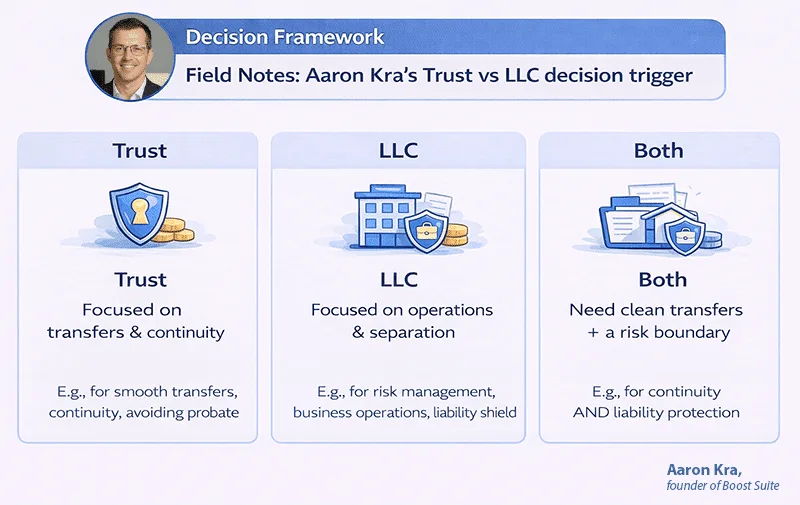
Most people get stuck on “trust vs LLC” because they are trying to solve two different problems with one tool. A trust is mainly about transfers and continuity in your estate plan, while an LLC is mainly about running activity with cleaner separation. The framework below is a simple way to choose the lightest setup that matches what you are actually trying to protect and why.
Conclusion
If you remember one thing, make it this:
Trusts are mostly about smooth transfers, while the LLC is mostly about operations and risk boundaries.
Many people end up using both, but only after they are clear on the goal. We recommend starting with the simplest structure that solves the real problem, then adding layers only if you can maintain them. When in doubt, write down your goal in one line, then choose the simplest structure you can maintain. Also, even with a strong plan, a simple will is often still the safety net that catches anything you forgot to title correctly.
Frequently Asked Questions About LLC vs Trust
If you’re still unsure which route fits, these quick answers cover the questions people ask most when comparing these two structures.
What are the primary benefits of using a trust over an LLC?
A trust is built for control and continuity, not business liability. A revocable living trust can help you organize ownership, plan for incapacity, and make transfers smoother for beneficiaries by keeping your instructions in one document. An LLC can own assets, but it does not automatically solve inheritance logistics the way a well-funded trust can.
How do trusts and LLCs impact estate taxes?
Usually, they do not change estate tax results by themselves. Estate tax depends on your overall estate and elections, not simply whether assets sit in a trust or an LLC. The IRS notes that many estates do not even need to file an estate tax return unless thresholds or specific elections apply, including portability. Trust design can matter in advanced cases, but structure alone is not a shortcut.
Are there specific state laws affecting trusts and LLCs?
Yes, and the differences can be decisive. LLC formation, annual reports, fees, and ongoing compliance vary by state. Trust and creditor rules also vary; for example, under versions of the Uniform Trust Code adopted in some states, assets in a revocable trust can be reachable by the settlor’s creditors during life.
What are the costs associated with setting up a trust or LLC?
LLC costs are state-driven; trust costs are mostly service-driven. The SBA notes business registration costs are often under a few hundred dollars, but vary by state and structure. Ongoing LLC costs can include annual or biennial filings and fees that may exceed $300 in some states. Trust costs vary mainly with complexity and who drafts and funds it; ask for a clear scope and pricing.
Can a trust own an LLC?
Yes, a trust can own LLC membership interests. This is a common “both” structure: the LLC handles operations and liability separation, while the trust helps continuity and inheritance planning by passing the ownership interest under trust terms. The key is documentation and administration: the trust must be properly named as the member, and the operating agreement should align with trustee authority and succession planning.
If I have a living trust, do I still need an LLC for a rental property?
Often yes, if liability is your concern. A living trust is excellent for planning and transfer, but it is not designed as a business liability shield. For rentals, an LLC is commonly used to separate property-related risks from personal assets, assuming you operate it correctly. Many owners combine them by having the trust own the LLC interest for smoother inheritance.
- Internal Revenue Service (IRS): Limited liability company (LLC)
- Internal Revenue Service (IRS): Single-member limited liability companies
- Internal Revenue Service (IRS): LLC filing as a corporation or partnership
- U.S. Government Publishing Office (GovInfo): 12 U.S.C. § 1701j–3, Preemption of due-on-sale prohibitions (PDF)
- Financial Crimes Enforcement Network (FinCEN): News release – BOI reporting changes for U.S. companies/U.S. persons
- U.S. Small Business Administration (SBA): Choose a business structure
- Delaware General Assembly: Delaware Code Online – Delaware Limited Liability Company Act (Subchapter VII; includes charging order section)
- Wyoming Secretary of State: Business Division Filing Fee Schedule (PDF)
- Nevada Secretary of State: Commercial Recordings – Forms & Fees
Form Your LLC with Harbor Compliance
Once you’ve decided an LLC is the right structure for liability separation and operations, Harbor Compliance helps you form it correctly and stay aligned with state requirements. From filing to ongoing compliance support, build your LLC with confidence.