

A single member LLC operating agreement is the internal document that explains how your LLC will be run, even when you are the only owner. It is where you put your rules in writing so your business decisions, money flows, and authority are clear on day 1. It matters because an LLC is created under state law, and states can treat internal governance differently. The IRS also treats single-member LLCs differently for federal tax purposes by default, so you want your internal paperwork to match how your business actually operates.
What a Single-member LLC Operating Agreement Is and Does
A single-member LLC operating agreement is your LLC’s internal rulebook, written for a 1-owner (single-member) LLC. It explains how the company is managed, how money moves in and out, and how you will keep the LLC separate from you personally. Even though LLCs are created under state law and rules vary, this document helps you run the LLC consistently instead of relying on default rules when questions come up.
How the Definition Works in a Single-Member Setup
In a single-member setup, the operating agreement is the document where the sole member (you) sets the company’s operating rules in writing. Practically, it is where you record the decisions that would normally be agreed to by multiple members, so your LLC has clear governance and a clear paper trail.
What it covers and why it exists
Think of this document as the “how the company works” file. It usually covers:
- who has authority to act for the LLC (you, as the sole member, and any managers you appoint)
- how the business is managed day to day (member-managed vs manager-managed structure, if your state uses that concept)
- how money is handled (capital contributions, expenses, distributions, and basic accounting records)
- how the agreement can be amended later (so changes are clean and trackable)
In plain terms: it exists to put your decisions into a clear legal document, so your business has a consistent structure you can follow and show when needed.
Single-member vs multi-member operating agreements (key differences)
Both types cover management and money rules, but a multi member agreement usually needs extra “relationship” rules between members.
Here’s the practical difference:
| Area | Single-member LLC | Multi-member LLC |
|---|---|---|
| Decision-making | You set authority and signing rules (simple and direct) | Voting thresholds, deadlock rules, and meeting/consent rules |
| Ownership changes | Often just notes on transfers and succession | Buy-sell terms, member exits, restrictions, and valuation methods |
| Money rules | Clear owner distributions and recordkeeping | Allocation rules, capital accounts, and dispute protection around distributions |
Start your LLC the right way with ZenBusiness
ZenBusiness helps you form your LLC, organize key business documents, and keep your company compliant. So you can focus on running your business with confidence.
Why a single-member LLC operating agreement matters
When you are the only member, the risk is not “disagreement with partners.” The risk is that your LLC looks and behaves like you personally. A solid single member operating agreement helps you run the company with clear rules, consistent records, and fewer gaps where default rules take over.
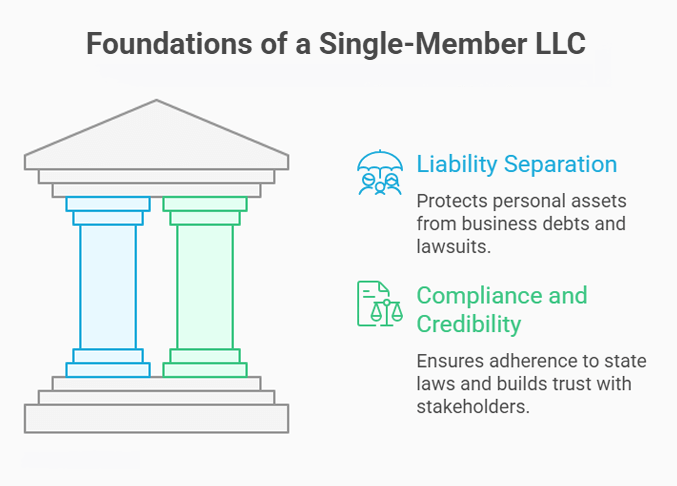
Liability separation (protecting your personal assets)
An LLC is designed to create limited liability, meaning your personal assets are generally separated from business liabilities. But the strength of that separation depends on how you actually run the company, not just what you filed.
A single-member LLC operating agreement supports that separation by putting clear rules in writing: who has authority, how decisions are documented, and how money is handled. It does not “guarantee” protection, but it helps show your LLC is a real legal business with a consistent operating process.
One last reality:
LLC rules are state-based, so details can vary. That is exactly why a written agreement you follow consistently matters, and why you should align it with your state’s current LLC guidance instead of relying on assumptions. That includes practical “contact and compliance” items like your registered agent.
If you want the plain-English version of that role, read what a registered agent does for an LLC.
Compliance and credibility (banks, vendors, audits)
Even when nobody “requires” the document in daily life, an operating agreement often becomes your credibility file. It helps you answer basic questions quickly: who owns the company, who has authority, how decisions get made, and how money is handled.
Staying compliant with state rules
Your obligations depend on your business and location. A written agreement helps you keep your structure consistent with what you filed and how you actually operate.
Helping your LLC stay in good standing
Good standing is mostly about meeting ongoing state and tax obligations on time. If you expand to another state, you may also run into requests tied to good standing in your home state. Clear internal records and a consistent operating process make those moments easier.
Keep your LLC compliant with Northwest Registered Agent
Northwest Registered Agent helps your LLC stay in good standing by handling legal notices, protecting your privacy, and keeping your compliance on track with reliable registered agent service.
What to include in a single-member LLC operating agreement
A strong single member llc operating agreement is not about being long. It is about being specific in the places that control authority, money, and recordkeeping. If you start from an operating agreement template, plan to customize the parts that match how your LLC actually operates.
Core details (LLC info, effective date, purpose)
Start with clean, matching identifiers so the document lines up with your formation records:
- Legal name of the limited liability company and principal business address
- State of formation (and any internal ID you want to reference)
- Effective date of the agreement
- Business purpose (keep it broad, but accurate)
- Reference to your formation filing such as the articles organization (naming varies by state)
- Optional: your registered agent and address (must match what you filed)
Short rule: if you ever open a bank account, sign a lease, or respond to a compliance question, these basics should be consistent across every legal and financial record.
And if you’re double-checking the exact legal name or status, run a quick state business entity search first.
Owner authority and decision-making rules
This section answers one question: who can act for the LLC, and under what rules?
Include:
- Whether the LLC is member managed or manager managed (if your state uses this structure)
- What actions you will document in writing (opening/closing bank accounts, borrowing money, signing long-term contracts, buying major assets)
- How you appoint a manager (if you delegate) and what authority they have
- How you will amend the agreement and keep prior versions in one place
Money rules (capital, expenses, distributions, records)
This is where most problems start, because money moves fast and memory is unreliable. Your agreement should make money handling boring and consistent (and if you’re unsure about the mechanics, start with how to pay yourself from your LLC so your “rules” match what you’ll actually do in real life).
Below is a simple structure that works for most single-member setups:
| Money topic | What to write (keep it practical) | Why it matters |
|---|---|---|
| Capital contributions | How you fund the LLC and how you record contributions | Keeps funding separate from personal spending |
| Expenses | What counts as a business expense and what documentation you keep | Supports clean bookkeeping and audit-ready records |
| Distributions | How you take money out (timing, method, and how you record it) | Prevents “random transfers” that blur the boundary |
| Records and books | What you track, where it is stored, and how often you update | Creates a reliable paper trail for the company |
Tax section (default treatment and election flexibility)
Your operating agreement should align with how the IRS treats your LLC, without trying to turn the agreement into a tax return. For most single-member LLCs, that starts with understanding the default disregarded entity treatment, because your recordkeeping and “money rules” should match the reality of how income and expenses flow for tax purposes.
At minimum, include:
- A sentence acknowledging that, for federal income tax purposes, a single-member LLC is treated as an entity disregarded from its owner by default, unless an election is made.
- Language that allows the LLC to change federal tax classification if you file an election, such as Form 8832.
- A clear statement of who is responsible for tax filings and recordkeeping (you, as the owner), and where you keep supporting records.
State rules for LLC operating agreements
Because an LLC is created under state law, operating agreement expectations vary. Your safest approach is to treat the agreement as a core business document and confirm what your own state expects.
Does your state require an operating agreement?
Some states require an operating agreement by statute, while many do not. The SBA notes that whether an operating agreement is required depends on the state where the LLC was formed, and that you can usually confirm this through your Secretary of State or equivalent state business filing office.
Even if it is not required, you still benefit from having one, because it reduces reliance on default rules when something is unclear.
Common state variations
Across states, you will commonly see differences in:
- whether the agreement must be written (vs allowed to be oral or implied)
- what happens if your agreement is silent on a topic.
- which topics states restrict you from changing by agreement (limits vary)
- how strongly courts enforce certain provisions if they are vague or inconsistent
What can go wrong without one
Without a clear operating agreement, common problems include:
- You fall back on state default rules when a question comes up (authority, distributions, transfers).
- Banks, vendors, or partners ask for proof of authority and you have no clean internal rules to show.
- Your recordkeeping becomes inconsistent, which can weaken separation between business and personal matters.
- Updates become messy because there is no defined process for amendments or version control.
This is not about fear. It is about reducing friction and risk in normal operations.
Templates, drafting, and review options
Most people start with a template, and that is fine. The key is to treat the template as a starting point, then tailor it to your real structure and money flow. The SBA also suggests considering an attorney and accountant for the legal and financial aspects of the agreement.
Using templates safely
Before you sign anything, customize these high-impact parts:
- company identifiers and effective date (must match your formation records)
- authority rules (who can sign, when you document decisions)
- money rules (contributions, expenses, distributions, records)
- amendment process (how changes are approved and stored)
- tax alignment language (default treatment plus election flexibility)
When to consider professional review
Professional review makes sense when the setup is not standard, for example:
- you plan to bring in investors or convert to a multi-member structure soon
- you want a manager-managed structure with delegated authority
- you have unusual profit-sharing plans, complicated financing, or high-stakes contracts
- your business has higher liability exposure and you want tighter governance and documentation
Even a short review can help you spot weak clauses and missing steps, especially when your agreement needs to match real management and financial operations.
If cost is your hesitation, this breakdown of LLC attorney fees makes it easier to decide whether a quick review is worth it.
FAQ about single member LLC operating agreements
This section covers the practical basics owners usually want to confirm before they draft, sign, or update their agreement. The goal is to keep things simple and actionable, so you can run the LLC consistently and avoid messy gaps later.
What if I don’t have an operating agreement?
If you do not have an operating agreement, your LLC can still exist, but gaps in your internal rules usually fall back to your state’s default rules. That can create friction when you need to prove who has authority, how money is handled, or what your management process is. A simple written agreement, followed consistently, makes your company look and operate like a real separate business.
Can I create an operating agreement on my own?
Yes, a lot of single-member LLC owners write their own agreement using an operating agreement template. The trick is not picking the “best template.” It is making sure the authority section and money section match how you actually run the business, then keeping your records consistent with what you signed. If your setup is unusual, a quick review from an attorney or accountant can catch gaps early.
How often should I update my operating agreement?
As a baseline, review it once a year. Then update it anytime something real changes, like your address, how you handle banking, who can sign, or how you take distributions. Also update it if you change your federal tax classification by filing Form 8832, because your agreement should reflect what you chose and the effective date. Keep older versions, so your paper trail stays clean.
What is the purpose of a single member LLC operating agreement?
Its purpose is to turn your “owner decisions” into a clear internal rulebook for the company. It documents your ownership, authority, and how you run the business day to day, including how you handle money and records. That clarity supports liability protection and helps you avoid relying on generic state defaults when questions come up. It is also a practical file banks or vendors may ask for.
What key provisions should be included in an LLC operating agreement template?
A good template should cover the parts you will actually use: basic LLC details (name, purpose, effective date), who has authority to act for the company, and clear money rules for contributions, expenses, distributions, and accounting records. It should also include a simple amendment process, so updates are easy later. Finally, reference your formation filing (often called articles organization) so everything matches your state records.
What are the tax implications of having a single member LLC operating agreement?
Your operating agreement does not “set” your tax status, but it should match it. The IRS explains that a single-member LLC is disregarded for federal income tax by default (unless it elects corporate treatment), while still treated as separate for employment tax and certain excise taxes. Your agreement should reflect who handles filings and recordkeeping, plus how you track expenses and owner distributions. The IRS also treats the LLC as separate for employment tax and certain excise taxes.
What default rules apply to single member LLCs without an operating agreement?
If you do not have an agreement, or your agreement is silent, your state’s LLC statute usually fills the gap with default rules. Those defaults often cover authority, management structure, and how money is handled on paper. The problem is that defaults are written to fit “average” businesses, not your business. A simple written agreement lets you set rules that match your real operations, and it is easier to prove later.
- U.S. Small Business Administration: Register your business
- U.S. Small Business Administration: Basic Information About Operating Agreements
- U.S. Small Business Administration: Choose a business structure
- Internal Revenue Service: Single member limited liability companies
- Internal Revenue Service: Limited liability company (LLC)
- Internal Revenue Service: LLC filing as a corporation or partnership
- New York State Department of State: Forming a Limited Liability Company in New York
- New York State Department of State: Articles of Organization for Domestic Limited Liability Company
Build your single-member LLC with Harbor Compliance
Harbor Compliance helps you form your LLC properly, organize key documents, and keep your business compliant from day one with reliable filing support.