

A Texas Series LLC is a Limited Liability Company (LLC) that can establish separate series under one parent LLC for different assets, activities, or internal business purposes. Texas law distinguishes between a protected series and a registered series, and that distinction affects how the structure appears in state records and what must be filed. The liability separation associated with this structure depends on proper formation documents, a valid company agreement, and separate records for each series. Before you file, it is important to understand the Texas rules on series structure, naming, and ongoing compliance.
What Is a Series LLC in Texas?
Before you look at filing steps or liability rules, it helps to understand the basic Texas framework. The key starting point is how one parent LLC can create separate internal series, and why that distinction matters for filing, records, and liability separation.
Definition of a Texas Series LLC
A Texas Series LLC is a limited liability company that may establish one or more designated series of members, managers, membership interests, or assets under a single LLC structure. In practical terms, it is one Texas LLC with internal compartments created under the Texas Business Organizations Code, rather than a group of separately formed LLCs.
For a broader overview, see this guide to how a series LLC works.
Parent LLC, series, protected series, and registered series
In Texas Secretary of State guidance, the main filing entity is commonly described as the parent LLC. Inside that LLC, Texas recognizes two forms of series: a protected series and a registered series. The filing difference is the main legal distinction here. A protected series is not evidenced by a certificate filed with the Secretary of State, while a registered series is evidenced by filing a certificate of registered series. Texas also states that neither one is treated as a separate domestic entity for purposes of Title 1 and Chapter 101 of the Business Organizations Code.
A registered series has the same core attributes as a protected series, but it comes with additional public filing consequences. Because it appears in the Secretary of State’s records, it can obtain a certificate of status and can also make certain later filings tied specifically to that registered series.
How a Series LLC works in practice
In practice, the parent LLC is formed first. Then the company creates internal series through its governing documents and internal structure. If the owner wants a registered series, the parent LLC must file a certificate of registered series with the state.
The liability protection people associate with this structure is not automatic. Texas says the required language must be included in the certificate of formation and company agreement, and separate records must be maintained for the assets of each series.
A common example is real estate. One series may hold Property A, while another series holds Property B, which is why many owners compare the structure with using an LLC for rental properties. The goal is to keep those assets and liabilities separated inside one overall LLC framework. That can be useful, but only if the structure is documented and maintained properly.
Form Your Texas LLC with ZenBusiness
ZenBusiness helps you start a Texas LLC with confidence: handling your formation paperwork, business name registration, and compliance steps so you can build the right structure for your business.
How a Texas Series LLC Differs from a Traditional LLC
A traditional LLC is simpler. It is one company with one internal structure. A Series LLC starts as one LLC too, but it can divide operations, ownership interests, or assets into separate series.
The biggest practical differences are easier to see side by side:
| Area | Traditional LLC | Texas Series LLC |
|---|---|---|
| Structure | One LLC | One parent LLC with separate internal series |
| Asset separation | One main pool of company assets | Assets can be allocated to separate series |
| Liability setup | One general liability shield | Texas law allows series-level separation if statutory requirements are met |
| State filing | One LLC filing | Parent LLC filing, plus extra filing only for a registered series |
| Public visibility | Main LLC appears in state records | Registered series appears in state records, protected series does not |
That means a Series LLC can offer more internal organization than a traditional LLC, but it also creates more paperwork, more naming rules, and more room for mistakes. It is best treated as a more advanced structure rather than a cheaper shortcut for forming multiple businesses.
Benefits of a Series LLC in Texas
A Texas Series LLC is usually considered for three practical reasons: liability separation, internal organization, and the ability to keep multiple holdings under one overall company structure. The benefit is not that it removes complexity. The benefit is that, when set up correctly, it can organize that complexity more cleanly than a single traditional LLC.
Asset protection for separate holdings
The biggest reason people look at a series LLC is asset separation. Texas law allows liabilities associated with one series to stay with that series alone, rather than automatically reaching the LLC generally or another series, if the statutory conditions are met. Those conditions include separate records, a compliant company agreement, and the required notice in the certificate of formation.
That can be useful when the same owner wants to keep different properties, projects, or risk profiles separated inside one limited liability company. In a real estate example, one series may hold one rental while another series holds a different rental, so the structure is designed to keep liabilities associated with one holding from automatically reaching the others.
Cost efficiency for multiple assets or businesses
A Texas series llc can also look more efficient than forming several separate LLCs. Texas treats a series LLC as a single legal entity for franchise tax purposes, and the Comptroller says it files one franchise tax report and one Public Information Report under one Texas taxpayer identification number.
That said, the savings are not unlimited. The parent LLC still has a formation filing fee, and a registered series also requires its own certificate filing with the Secretary of State. So the structure may reduce some state-level duplication, but it does not mean every series is free or maintenance-free.
Owners comparing this setup with a standard LLC can also look at the typical Texas LLC filing cost.
Better internal organization under one umbrella
A Texas series llc can also be easier to manage structurally when one business owner wants separate compartments for different assets, investments, or operating activities. Texas law allows a series to have separate rights, powers, or duties with respect to specified property or obligations, which is what makes the umbrella structure possible in the first place.
This can make the business easier to map internally. Instead of placing everything into one undifferentiated LLC, the owner can create a clearer structure for ownership, records, liabilities, and operations inside the same overall framework.
Form Your Texas Series LLC with Northwest Registered Agent
Setting up a Texas Series LLC requires careful documentation and clear records. Northwest Registered Agent helps you form your LLC properly while providing expert support and strong privacy protection for your business.
Drawbacks and Limitations of a Texas Series LLC
The same features that make a Texas Series LLC attractive can also make it harder to run well. The main drawbacks are heavier recordkeeping, uncertainty outside Texas, and extra friction with banks, financing, and tax administration.
More complex bookkeeping and recordkeeping
Texas does not give liability separation automatically just because the LLC uses the word “series.” The statute ties that protection to separate records for the assets of each series, plus the required language in the company agreement and certificate of formation. If the records are sloppy, one of the structure’s main benefits becomes weaker.
That means bookkeeping has to be more disciplined than many owners expect. You are not just tracking one LLC. You are tracking multiple internal compartments that need clean separation in practice, especially where contracts, expenses, income, and title to assets are concerned.
Limited recognition outside Texas
A second limitation is that a Texas series structure does not automatically become simple once it crosses state lines. The IRS notes that an LLC is a business structure allowed by state statute and that each state may use different regulations. Texas also has its own qualification rules for foreign series LLCs, which shows that state treatment is not always uniform.
So if your business will hold property, sign contracts, or register in other states, the practical effect of the Texas structure may be less predictable. That is one reason the Texas Secretary of State repeatedly says owners should consult a private attorney or tax advisor before forming a series llc.
Banking, financing, and tax complexity
A third issue is that third parties may want clearer public evidence of who they are dealing with. Texas says a registered series can obtain a certificate of status, while a protected series is not evidenced by a separate state filing. That difference can matter when a bank, title company, or other counterparty wants documentation from the Secretary of State records.
Tax administration can also be less intuitive than owners expect. Texas franchise tax treats the series LLC as one legal entity with one franchise tax report and one Public Information Report, while federal tax treatment of an LLC depends on classification rules and elections rather than on the label “LLC” by itself. In other words, internal series separation does not always line up neatly with how owners assume tax filing will work.
How to Form a Series LLC in Texas
Forming a Texas Series LLC is not just about filing one standard LLC document and improvising the rest later. The structure only works as intended when the parent LLC, the company agreement, and the series-level records are set up correctly from the start. Texas also uses different filing treatment depending on the type of series involved, so that choice should be made early.
Before the steps, one point matters most:
Texas does not provide a special Secretary of State form specifically labeled for creating a series LLC. The Texas Secretary of State says you may use the general LLC certificate of formation, Form 205, and add the required series language in the supplemental text area.
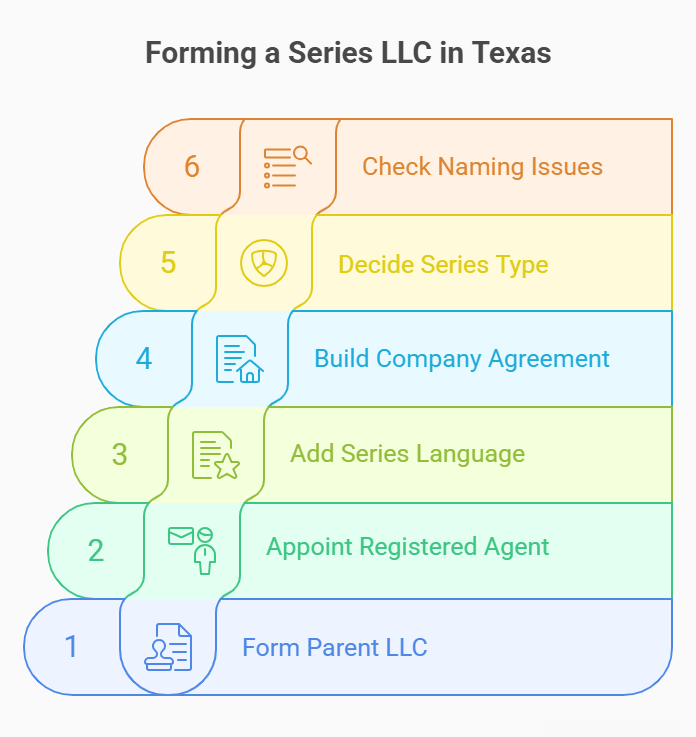
Step 1: Form the parent LLC
The first filing is the parent Texas LLC. Texas Form 205 is the standard certificate of formation for an LLC, and the filing fee is $300. Texas also allows certificates of formation to be filed online through SOSDirect.
For a broader step-by-step overview, see how to start an LLC in Texas.
Step 2: Appoint a Texas registered agent and registered office
Your company must maintain a registered agent and a registered office in Texas. The Secretary of State says the registered office must be a physical Texas address where the agent can be personally served during business hours, and the Secretary of State cannot act as your agent.
Step 3: Add the required series language
Texas makes this part especially important. The Secretary of State states that, to receive the benefits of a series LLC, the language required by section 101.602(a)(1)-(2) must be included in the certificate of formation and the company agreement, and separate records must be maintained for the assets of each series.
Step 4: Build the internal company agreement and records
This is where the structure becomes real in practice. Your company agreement should clearly describe the series structure, management, ownership, and separation of assets and liabilities, including who has authority to act for each series and how management is handled, similar to the choices discussed in different ways an LLC can be managed. Texas also notes that internal governing documents are kept by the business and are not filed with the Secretary of State.
Step 5: Decide whether you need a protected series or a registered series
This is the point where the filing distinction becomes practical. A protected series does not require a separate filing with the Secretary of State. A registered series does. To create one, the parent series LLC must file a certificate of registered series, and the filing fee is $300. Texas also says the name must contain the name of the parent LLC and include “registered series,” “R.S.,” or “RS.”
Step 6: Check naming and assumed-name issues before doing business
If a protected or registered series does business under a specific name, an assumed name certificate may be required (so it is smart to start with a Texas LLC name search). Texas gives special rules here, especially when a protected series name does not include the full legal name of the parent LLC, or when a registered series uses a name different from the one stated in its certificate.
Ongoing Compliance for a Texas Series LLC
A Texas Series LLC is easier to form than many owners expect, but harder to maintain correctly. The ongoing work is mostly about keeping the structure legally clean, operationally separated, and current with Texas tax and filing requirements.
Keep records separate for each series
Texas ties the benefits of the structure to separate records for the assets of each series and to the required language in the formation documents and company agreement. In other words, separation is not just a theory. It has to show up in your books, agreements, and internal documentation.
Maintain your registered agent and registered office
The LLC must continue to maintain a Texas registered agent and registered office. The Secretary of State warns that failure to maintain them may result in involuntary termination of the LLC.
File Texas franchise tax and information reports on time
Texas franchise tax reports are due on May 15 each year, or the next business day if May 15 falls on a weekend or holiday. The Texas Comptroller says a series llc is treated as a single legal entity for franchise tax purposes, filing one franchise tax report and one Public Information Report under one Texas taxpayer identification number.
Do not assume “no tax due” means “nothing to file”
For reports due on or after January 1, 2024, an entity at or below the no-tax-due threshold is not required to file a No Tax Due Report. However, Texas still requires a Public Information Report or Ownership Information Report in those situations unless an exception applies.
Review assumed names and public-facing names
If a series is doing business under a specific name, check whether an assumed name certificate is required (similar to DBA use by LLCs). Texas also notes that assumed name filings do not create exclusive rights to a name, so this is a compliance filing, not the same as taking steps to protect your business name.
You can read more here about using a DBA with an LLC.
Keep tax treatment straight at the federal level
Texas entity structure and federal tax treatment are not the same thing. The IRS says LLC classification depends on the number of members and any election made, so an LLC may be treated as a disregarded entity, a partnership, or a corporation for federal tax purposes, which is why owners often need to understand how to file business taxes as an LLC.
Is a Texas Series LLC Right for You?
A Texas Series LLC can be very useful, but it is not the default best choice for every small business. Texas itself does not tell owners which version of the structure is best for them and recommends consulting a private attorney if they are considering it.
The simplest way to evaluate it is to look at your actual use case:
| Situation | Usually points toward a Texas Series LLC | Usually points away from it |
|---|---|---|
| You want to separate multiple assets or projects inside one overall LLC | Yes | No |
| You want the simplest possible Texas LLC setup | No | Yes |
| You are ready to maintain separate records and tighter internal documents | Yes | No |
| You want clearer state-record evidence for a specific series | A registered series may help | A protected series may feel too invisible |
| You expect multi-state complexity or are unsure how third parties will treat the structure | Get legal advice first | Often a traditional LLC is easier |
The Texas support for this chart is straightforward: the state requires separate records and specific statutory language for the structure’s benefits, treats registered and protected series differently for filing purposes, and says a registered series can obtain a certificate of status for third parties.
The federal side also matters. The IRS treats LLCs based on tax classification rules, not simply on the label “LLC,” so you should not assume the series structure automatically answers your tax questions.
Frequently Asked Questions (FAQ)
Before you form a Texas Series LLC, it helps to get the common questions out of the way first. These answers are direct, practical, and short enough to scan quickly.
What is a Series LLC and how does it work?
A Series LLC is a single limited liability company that can create separate internal series for different assets, obligations, or business activities. In Texas, the parent LLC is formed first, then the structure may include a protected series or a registered series depending on how it is set up and filed. The separation only works as intended if the required documents and records are maintained properly.
What are the pros and cons of a Series LLC?
The main advantages are internal asset separation, better organization for multiple holdings, and the ability to keep them under one overall company structure. The main drawbacks are heavier recordkeeping, more complicated compliance, and extra uncertainty when banks, lenders, or other states are involved. It can be useful, but it is usually not the simplest LLC setup.
How does a Texas Series LLC provide asset protection?
A Texas Series LLC is designed to separate liabilities tied to one series from the assets of another series or the parent LLC. But that protection depends on meeting the statutory conditions, including proper language in the formation documents and separate records for each series. In other words, the structure supports asset protection, but the paperwork and ongoing separation matter just as much as the filing itself.
What should I know before forming a Series LLC in Texas?
Before you file, know that Texas distinguishes between a protected series and a registered series, and only the registered series requires its own state filing. You should also understand the naming rules, assumed-name issues, and the need for a strong company agreement with separate records for each series. Texas itself suggests consulting a private attorney or tax advisor before choosing this structure.
Does a Texas Series LLC file one franchise tax report or multiple reports?
A Texas Series LLC files one franchise tax report and one Public Information Report as a single legal entity, not separate reports for each series. The Texas Comptroller also says that if one series has nexus in Texas, the entire series LLC has nexus in Texas. So even if the structure has multiple internal series, the franchise tax reporting is handled at the overall entity level.
- Texas Secretary of State: Form 205 – Certificate of Formation for a Limited Liability Company (PDF)
- Texas Legislature Online: Texas Business Organizations Code, Chapter 101
- Texas Secretary of State: Registered Agents and Registered Office Requirements
- Texas Secretary of State: Form 503 – Assumed Name Certificate (PDF)
- Texas Secretary of State: Copies and Certificates (Certificate of Fact – Status)
- Texas Comptroller of Public Accounts: Franchise Tax – Rates, Thresholds, and Due Dates
- Internal Revenue Service: Limited Liability Company (LLC)
Start Your Texas Series LLC with Harbor Compliance
Harbor Compliance helps you form a Texas Series LLC the right way, from preparing your Certificate of Formation to guiding you through Texas filing requirements and compliance steps.