

A USPS PO box costs about $5 to $33 a month for the smallest size (Size 1) and up to about $130 a month for the largest (Size 5), depending on the Post Office’s fee group and the payment term. USPS doesn’t rent boxes month to month: you prepay 3, 6, or 12 months, and the 6-month term costs less per month than the 3-month one. Prices come from USPS Notice 123, effective October 4, 2026.
PO Box Monthly Costs and What They Include
Choosing between a traditional PO box, virtual mailboxes, or a professional mail service for your business involves weighing different monthly costs against specific benefits. The price for a mail management solution varies significantly depending on the provider, box size, and location where your box is located. To streamline operations, many business owners choose to use a virtual business address for enhanced flexibility.
USPS Rates by Size and Location
The United States Postal Service offers the most economical box rental options for businesses seeking a basic mailing address. Monthly costs depend on the box size and on the Post Office: USPS classifies each location as Market Dominant or Competitive and assigns its ZIP Code a fee group. The table divides the official 3-month fees by three.
| Size | Market Dominant, per month | Competitive, per month |
|---|---|---|
| 1 3″ x 5.5″ | $7.00-$16.67 | $15.33-$32.67 |
| 2 5″ x 5.5″ | $8.67-$24.00 | $20.00-$43.33 |
| 3 5.5″ x 11″ | $12.67-$42.00 | $31.00-$76.00 |
| 4 11″ x 11″ | $18.33-$72.00 | $37.00-$86.33 |
| 5 12″ x 22.5″ | $32.00-$113.00 | $52.00-$129.67 |
On a 6-month term the same boxes cost less per month: Size 1 runs $5.17 to $28.33 and Size 5 runs $26.00 to $112.83. The spread comes from fee groups: the same Size 1 box costs $21 for 3 months in the cheapest Market Dominant group and $98 in the most expensive Competitive group. For the most accurate rates at your local post office, check the USPS website where current pricing is maintained for all postal facility locations nationwide.
UPS and Private Mailbox Alternatives
For businesses requiring more comprehensive services than a standard post office box, UPS Store locations offer private mailbox options, with prices set by each franchised store. These services provide a real street address rather than a box number, so packages from UPS, FedEx, DHL, and other carriers can be delivered there. Hours to pick up your mail and services such as arrival notifications vary by store. Some entrepreneurs avoid using personal address for LLC by opting for a professional mailbox service.
Optional Fees and Service Add-Ons
Beyond the basic rental fee for your post office box, several supplemental services may affect your total monthly expenditure for mail service. Understanding these potential additional costs helps in budgeting accurately for your business mail needs.
- Key deposit of $6 per key (no deposit for the first two keys at Competitive locations) and $14 for each extra or replacement key after the first two
- Late fee of $30 if you renew more than 10 days after the due date
- Lock replacement ($30)
- Signature on File (free, at Competitive locations that offer it, with a signed customer agreement)
- Premium Forwarding Service Residential ($26.40 online enrollment plus $29.70 per weekly shipment)
To learn more about what are registered agent services, check out our in-depth overview.
Is a PO Box a Good Fit for Your Business?
Is maintaining a traditional PO box the right choice for your growing enterprise, or would alternative mail solutions better serve your professional needs? This crucial question affects not just how you’ll receive mail but potentially impacts your business’s legal standing and professional image.
Legal and Practical Limitations
While budget-friendly, a post office box presents several significant restrictions for businesses. Most critically, every state requires the registered agent to have a physical street address in the state, so a PO box can’t serve as that address. Banks must also collect a street address for a business customer under the federal Customer Identification Program rule (31 CFR 1020.220), so a box address alone won’t open an account. The address rules for each LLC filing are covered in which LLC address can be a PO box.
What a PO Box Can and Can’t Do for Entrepreneurs
Before committing to any mail service option, understand exactly what capabilities a traditional PO box provides for your business operations, and where it falls short compared to alternatives like registered agent services.
- Can provide:
- Basic secure mail reception
- Some privacy for your home address
- Consistent mail management during travel
- Potentially lower costs for simple needs
- 24/7 access at many locations
- Cannot provide:
- A registered agent address in any state
- Acceptance of all carrier packages
- A professional business image
- Mail scanning or digital access
- Mail forwarding without additional fees
These limitations explain why many growth-focused businesses eventually transition from a basic post office box to more comprehensive solutions. While a PO box may initially seem like a way to save money, the functionality constraints often outweigh the modest monthly savings, particularly as your volume of mail and legal requirements increase with business growth. Understanding your principal place of business LLC requirements helps you choose the right mailing solution.
Registered Agent vs. PO Box: Which One Do You Need?
When establishing a business entity, the choice between a simple PO box and a professional registered agent service represents more than just different ways to receive mail—it’s a decision that affects your legal compliance, privacy, and operational efficiency.
Upgrade from a basic PO Box
ZenBusiness provides your LLC with a real business address through registered agent service—ideal for mail, compliance, and privacy.
Legal Requirements for LLCs and Corporations
Every state requires businesses to maintain a registered agent with a physical street address (not a PO box) where legal documents can be delivered during business hours. This agent must have a physical location in the state where your business operates and must be available to receive mail and accept service of process. The consequences of non-compliance can be severe, including loss of good standing, financial penalties, or even administrative dissolution of your business entity. The Small Business Administration provides comprehensive guidance on these requirements through their business registration resources.
Failing to maintain a proper registered agent can result in missed legal notices, default judgments, and the inability to defend your company in litigation—risks that far outweigh the modest savings of using a basic post office box.
Mail Handling, Compliance, and Real Address Benefits
A quality registered agent service delivers significant advantages over a PO box for growing businesses. Beyond meeting legal requirements, these services provide a real street address that enhances your professional image and satisfies requirements for opening bank accounts, applying for business loans, and registering with state agencies. Many registered agents also offer additional mail management features like document scanning, forwarding of physical mail, and compliance monitoring—ensuring you never miss critical communications or filing deadlines that could jeopardize your business address standing with state authorities. By choosing a registered agent address for LLC, you ensure legal compliance and a professional image
Cost and Service Comparison
When comparing the true value proposition of registered agent services versus traditional PO box options, consider the comprehensive benefits each provides relative to their monthly costs for your specific business needs. Ensuring you select the right LLC business address is key to meeting statutory requirements.
With a small USPS PO box at about $5 to $33 a month and registered agent services commonly priced at $100 to $300 a year (about $8 to $25 a month), the cost differential may be smaller than expected, especially considering the added services and protections. Here is how they differ:
- Privacy protection: Registered agents keep your home address off public records; PO boxes offer minimal privacy benefits
- Legal compliance: Registered agents satisfy state requirements; PO boxes don’t meet statutory standards for service of process
- Mail processing: Many registered agents scan incoming mail; PO boxes require physical visits
- Package acceptance: a registered agent receives legal and state mail, not everyday packages; a USPS PO box takes USPS parcels, plus private-carrier packages where Street Addressing is offered
- Professional image: Registered agents provide a legitimate business address; PO boxes can project an unprofessional image
A smarter way to manage business mail
Northwest gives you a physical street address and handles legal mail, so your LLC stays compliant without relying on outdated PO boxes.
How to Get a PO Box for Business Use
Setting up a PO box for your business is a straightforward process that can be completed in just a few steps. Whether you’re seeking a basic mail service or supplementing your existing mail handling system, understanding the procedure will ensure a smooth setup for managing your business mail.
Application Process and Required Documents
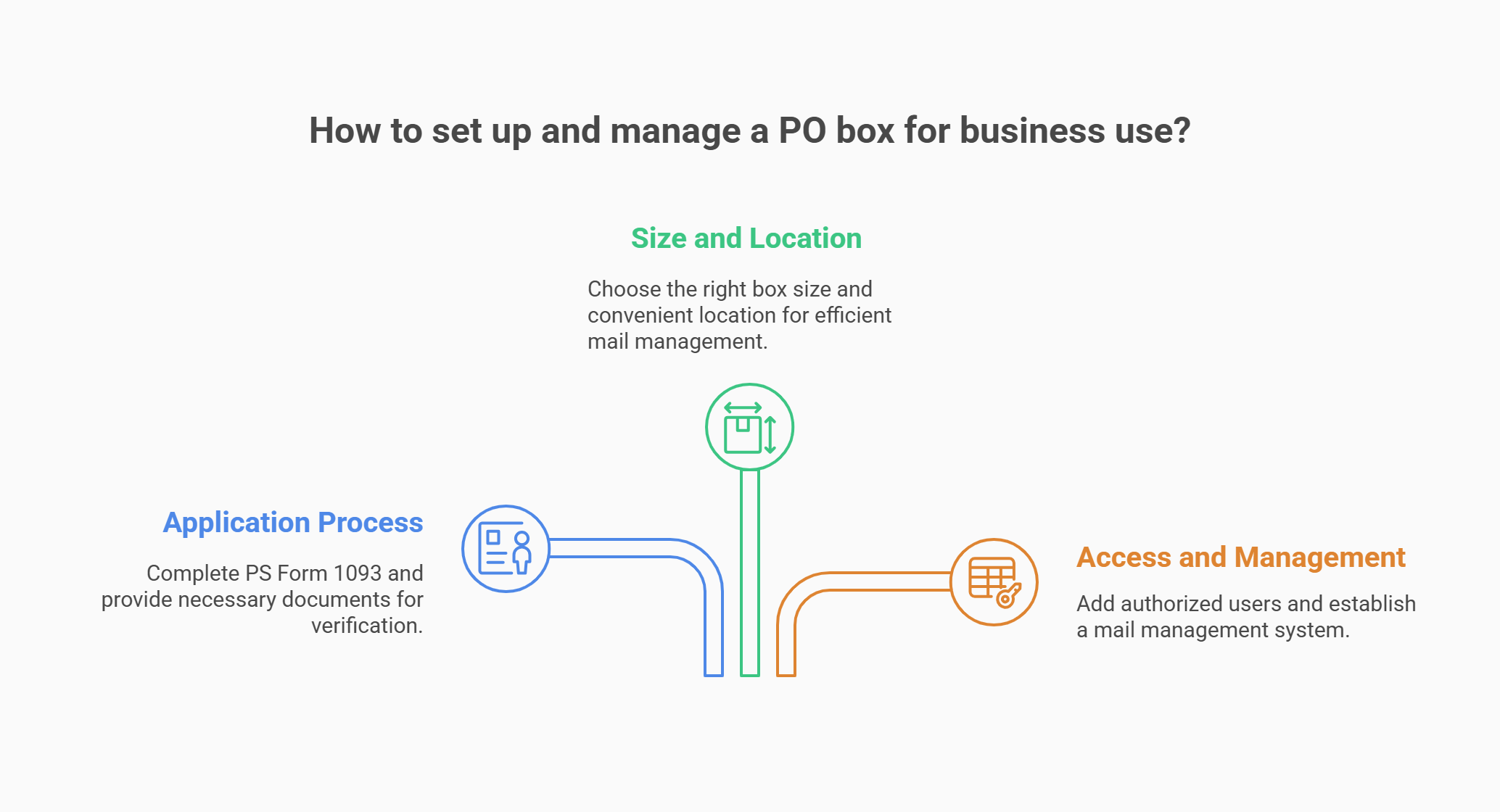
Securing a PO box begins with completing PS Form 1093, available either online through the USPS website or in person at your chosen postal facility. The application requires basic business information including your legal business name, physical address, and contact details. When submitting your application, you’ll need to present two forms of valid identification—typically a photo ID and a second supporting document that confirms your physical location.
Business owners have the option to apply online for convenience, but you’ll still need to visit the local post office in person within 30 days to present your identification and finalize the box rental with payment for your chosen rental period.
Choosing the Right Size and Location
Selecting the appropriate box size is crucial to avoid overflow issues or unnecessary costs for unused space. The United States Postal Service offers five standard sizes, with the small (S) and medium (M) options typically sufficient for most small businesses with moderate mail volume. However, if you regularly receive larger documents or small packages, an extra large box may be necessary despite its higher box cost.
Location selection is equally important—choose a post office that’s conveniently situated between your home and workplace to facilitate regular check-ins. Most Post Offices allow 24/7 access to PO boxes, but hours vary by location, so check the lobby hours of the office you pick.
Managing Access, Forwarding, and Volume Efficiently
Effective mail management extends beyond simply securing a box rental—it requires strategic planning for ongoing maintenance and potential mail routing needs. For businesses with multiple team members, consider adding authorized users who can access the PO box with their own keys to prevent mail collection bottlenecks.
- Set a consistent schedule to check mail (minimum twice weekly)
- Create a system for processing and responding to different mail types
- Establish a tracking method for important documents
- Consider USPS priority mail flat rate services for cost-effective forwarding
For businesses experiencing seasonal fluctuations in volume of mail, develop contingency plans for handling peak periods without missing important communications. Many entrepreneurs find that coupling a basic PO box with a digital mail scanning service provides the ideal balance of affordability and convenience, especially when managing correspondence across multiple locations.
FAQ: Monthly PO Box Pricing for Entrepreneurs
Entrepreneurs frequently have specific questions about utilizing PO box services for their businesses. This section addresses the most common inquiries regarding costs, tax implications, and alternatives to traditional post office box options.
Yes. A box used only for the business is an ordinary and necessary business expense, deductible in full; a box that also gets personal mail is deductible only for the business share. For detailed information on deductible business expenses, including mailbox rentals, consult IRS Publication 535 (2022, the last edition) and maintain receipts for all month plan payments in your tax records.
For many entrepreneurs, virtual mailboxes offer superior functionality compared to traditional PO box services, despite typically higher monthly costs.
Virtual mailbox providers deliver a legitimate street address rather than a box number, can accept packages from all carriers, and provide digital mail scanning—allowing you to view and manage incoming mail from anywhere. This remote access capability proves particularly valuable for traveling business owners or those managing multiple locations who cannot regularly visit a physical post office location to pick up your mail.
A registered agent primarily manages legal and governmental correspondence rather than all business mail. Their core function is receiving service of process, state notices, and compliance documents—not handling routine correspondence, customer communications, or general mail carrier deliveries. Most registered agents focus exclusively on official documents, though some premium services offer additional mail management options. For comprehensive mail handling, many businesses maintain both a registered agent for legal matters and either a PO box or virtual mailbox for general business correspondence, creating a complete system to properly deliver mail to appropriate channels.
USPS asks for payment by the 10th of the month it is due and closes an unpaid box on the 11th. Under DMM 508, renewing more than 10 days after the due date adds the $30 lock replacement fee as a late charge, whether or not the lock is changed.
Yes, you can receive packages at a PO box, but with important limitations. The United States Postal Service will accept parcels addressed to your box number if they’re delivered through USPS services like priority mail flat rate shipping. However, packages from private carriers such as UPS, FedEx, or DHL cannot be delivered directly to a traditional PO box. For businesses regularly receiving shipments from multiple carriers, look for a Competitive Post Office that offers Street Addressing: you sign a customer agreement and use the Post Office’s street address plus # and your box number, so private-carrier packages can be delivered to the box. Notice 123 lists no separate fee for it.
Secure, compliant, and professional
Harbor Compliance offers a registered agent with a real address—so you can receive legal docs and business mail without using your home or a PO box.