

You can file LLC taxes yourself in your first year, as long as you confirm how the IRS treats your LLC for federal tax purposes and file the correct return. The IRS treatment usually depends on how many owners you have and whether you made an IRS election, and your state may add its own filing or payment requirements. Most first-timers run into problems when they mix personal and business records or assume “LLC” automatically tells them which return to file. Start by confirming classification, then keep clean books, and the rest becomes a straightforward checklist.
Overview of LLC Business Tax Filing Requirements
Before you file anything, separate 2 ideas that people often mix up:
- The LLC is a state-law entity created by a state formation filing.
- Your federal tax treatment determines what federal return is filed and where the results are reported.
The IRS explains that an LLC is a business structure allowed by state statute (see the IRS LLC overview), and it also explains that federal tax treatment can differ depending on ownership and elections.
Understanding LLC Tax Classifications
Here is the practical version:
- Single-member LLC (typical default):
The IRS generally treats the LLC as disregarded for federal income tax purposes, so the activity is commonly reported on the owner’s Form 1040, often using Schedule C for business income or loss. - Multi-member LLC (typical default):
The IRS generally treats the LLC as a partnership, so it typically files Form 1065 and issues Schedule K-1 to owners. - LLC treated as a corporation:
An LLC can elect to be treated as a corporation for federal tax purposes, which changes what return it files (generally Form 1120-S for S corporation treatment or Form 1120 for C corporation treatment, depending on eligibility and elections).
Legal Obligations for LLC Owners
At a high level, you are usually dealing with 2 layers:
- Federal layer:
You file the correct federal return for your LLC’s classification and follow IRS due-date rules, including the weekend and legal holiday rule. - State layer:
Your state may require its own return or entity-level charges. New York, for example, explains that state requirements can differ depending on whether the LLC is treated as a sole proprietorship, partnership, or corporation for tax purposes.
Some states reduce the state-layer work drastically. Florida LLC formation has no personal income tax, so members of pass-through LLCs typically face only the annual Sunbiz report and federal returns, instead of stacking a separate Florida individual return on top of every Schedule K-1 or Schedule C.
Don’t guess here. Start with the state tax agency’s official LLC guidance, then confirm the federal filing path using IRS classification guidance.
Form your LLC the right way with ZenBusiness
ZenBusiness helps you set up your LLC properly from day one. So understanding tax classifications, compliance rules, and filing requirements becomes much easier as your business grows.
Steps for Filing Taxes as an LLC
In your first year, the goal isn’t perfection. You just need a clean, consistent workflow you can support if questions come up later.
Here’s a simple sequence to follow.
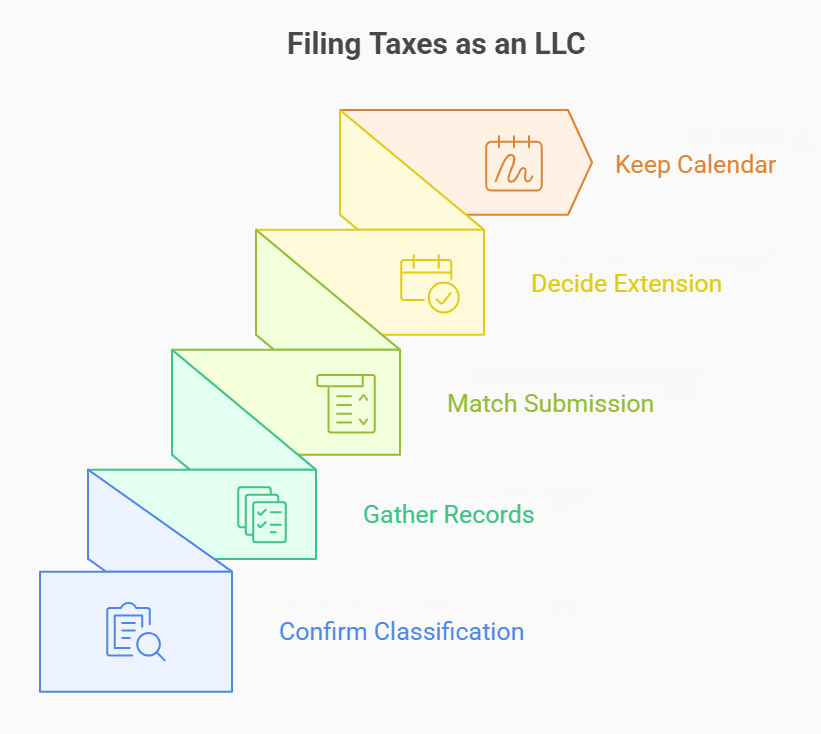
1. Confirm your classification early
Do this before you prepare the return. Use official IRS guidance to confirm your LLC’s federal tax classification and whether it follows the default rules based on the number of owners, or whether you filed an IRS election that changes what return the LLC must file.
Classification ripples through to the state side, and it matters more in some jurisdictions than others. Nevada LLC formation has no individual or corporate income tax, but the Commerce Tax and annual list of managers still depend on how the entity is classified, so checking that classification early prevents Nevada-specific filing mismatches later.
If you are unsure whether an election was made, look for copies of any election forms that were filed and any IRS acknowledgment, and confirm what return type was filed previously (if any). This matters because filing the wrong return type can create a correction project later.
2. Gather the records you will actually need
Before you open any forms, assemble your inputs. A short checklist keeps you from hunting receipts the night before a deadline.
Start with these basics:
- Bank statements and payment processor reports for the year (so you can reconcile income).
- A categorized list of expenses, plus receipts for items that often need clearer support (for example, meals, travel, vehicle use, or home office).
- Informational statements you received (for example, Form 1099-NEC or Form 1099-MISC, if applicable).
- If you have more than 1 owner, a clear record of each owner’s contributions and distributions (so allocations are supportable).
Use 1 spreadsheet or 1 bookkeeping tool that matches your bank feeds. The point is traceability, not fancy reporting.
One more control point:
do not wait until the last week to reconcile your books. Do a monthly reconciliation where you match bank and processor totals to your records and clear uncategorized transactions. That way, your numbers are ready long before your return is due.
3. Match your situation to the correct submission
Once your records are clean, match them to the correct federal return.
- Single-member LLC (default, disregarded):
Many owners report income and expenses on Schedule C (Form 1040). - Multi-member LLC (default, partnership):
Many entities file Form 1065 and provide Schedule K-1 to owners (see our multi-member LLC tax basics). For calendar-year partnerships, the due date follows the March deadline and shifts to the next business day when the date falls on a weekend or legal holiday. - LLC treated as an S corporation:
File Form 1120-S and follow S corporation rules and deadlines. - LLC treated as a C corporation:
File Form 1120 and follow corporate rules and deadlines (here’s a quick LLC vs C corporation breakdown).
The state submission you pair with that federal return depends on where the entity sits. Texas LLC organization doesn’t add a personal income tax, but most Texas LLCs owe the franchise tax (often zero-due No Tax Due Reports below the threshold) and an annual Public Information Report, so the federal Schedule C or Form 1065 timeline needs to align with the Texas Comptroller cycle.
4. Decide early if you need an extension
Extensions are not a “get out of paying” card. They are time to finish the return correctly.
- Business returns:
Form 7004 is used to request an automatic extension of time to file certain business income tax, information, and other returns. - Individual returns:
Form 4868 is used to request an extension of time to file Form 1040. An extension to file is not an extension to pay.
Owners in light-touch states often need extensions less often than they think. Wyoming LLC formation involves no state personal income tax return and a simple annual report tied to the LLC’s assets located in Wyoming, so once the federal classification is set, the year-end workload is meaningfully shorter than in income-tax states.
5. Keep a simple deadline calendar (and document decisions)
Once you know the submission type, create a one-page calendar for the year (and if you changed your legal business name during the year, note when you notified the IRS of the name change. This is especially helpful if you have no wage withholding and need to plan estimated payments, or if you must deliver K-1s to owners. Publication 509 is designed as a calendar of key actions and deadlines, and it can help you sanity-check what is due each quarter.
The calendar gets shorter when the formation state adds few moving parts. South Dakota LLC formation has no state personal or corporate income tax, so the annual rhythm for many owners is built almost entirely around the federal due dates plus the South Dakota annual report, instead of stacking quarterly state estimated payments.
Use a short note for decisions that affect reporting, such as:
- The date you confirmed classification (and any election paperwork).
- The method you used to track revenue and costs.
- Any large, unusual expenses and the documentation you saved.
Start your LLC with Northwest Registered Agent
Northwest Registered Agent helps you form your LLC with privacy protection and expert support, so you can focus on running your business while staying organized for compliance and tax obligations.
Differences in Filing: Corporations vs. LLCs
This comparison is about federal tax treatment, not the label you used on your state formation filing. An LLC is created under state law, but the IRS filing path depends on how the LLC is classified for federal tax purposes.
The easiest way to think about it:
- A typical single-member LLC (default) is treated as disregarded for federal income tax purposes, so the activity is commonly reported on the owner’s Form 1040 using Schedule C.
- A typical multi-member LLC (default) is treated as a partnership, so it generally files Form 1065 and issues Schedule K-1 to each member.
- If the LLC is treated as a corporation, it follows corporate filing rules. That usually means Form 1120-S (S corporation) or Form 1120 (C corporation), depending on elections and eligibility. And if you’re weighing that choice, this LLC vs S corporation comparison can help.
Here is a compact side-by-side view.
| Scenario (federal tax treatment) | What is filed | What owners receive |
|---|---|---|
| Single-member LLC (default, disregarded) | Form 1040 with Schedule C | No Schedule K-1; results flow to the owner |
| Multi-member LLC (default, partnership) | Form 1065 | Schedule K-1 for each member |
| LLC treated as an S corporation | Form 1120-S | Schedule K-1 for each owner |
| LLC treated as a C corporation | Form 1120 | No Schedule K-1; the corporation is the filer |
The IRS classification page is the anchor for these buckets, and the corporate instructions describe when 1120 is used if an LLC elected corporate treatment.
Order of checks: Confirm the federal tax treatment first, then check the state tax agency rules for any extra state-level filing or payment requirements.
Common Forms and Deadlines for LLC Tax Filings
The table below focuses on calendar-year due dates. Always apply the IRS weekend and legal holiday rule, because a due date can shift to the next business day. You will see this concept in partnership and S corporation instructions, and the IRS applies the same idea broadly across filing deadlines.
| Common situation | Typical federal submission | Typical due date (calendar year) | Extension request |
|---|---|---|---|
| Single-member LLC (default, disregarded) | Form 1040 with Schedule C | April 15, 2026 (for 2025 returns) | Form 4868 (individual extension) |
| Multi-member LLC (default, partnership) | Form 1065 + Schedule K-1 | March 15 (next business day if weekend/holiday) | Form 7004 |
| S corp-style | Form 1120-S + Schedule K-1 | March 16, 2026 (calendar-year 2025 return) | Form 7004 |
| Corporate (C corp) | Form 1120 | 15th day of the 4th month after year end | Form 7004 |
A quick reminder on extensions: an extension is an extension of time to file, not an extension of time to pay. The Form 4868 instructions state this directly for individual returns.
Frequently Asked Questions (FAQ)
Below are the most common first-year questions. Each answer starts with a direct takeaway, then a short explanation you can scan.
What documents do I need to file my LLC taxes?
You need 2 things: the correct federal return for your LLC’s federal tax treatment and records that support the numbers.
Start with:
– The return package (Form 1040 + Schedule C, Form 1065 + K-1, Form 1120-S, or Form 1120).
– Bank and payment processor totals, expense records, and notes for unusual items.
– Any state return, annual fee, or entity-level payment your state requires.
How do I know what tax classification my LLC falls under?
Start with how many owners the LLC has, then check whether an IRS election changed the default. A domestic LLC with 2 or more members is generally treated as a partnership unless it files Form 8832 to elect corporate treatment. If treated as a corporation and eligible for S status, Form 2553 is used to elect S corporation treatment.
What are the penalties for late filing?
Late filing can trigger a failure-to-file penalty (often charged monthly up to a cap) and, if you owe, a failure-to-pay penalty (also charged monthly). Partnerships and S corporations can also face per-owner monthly penalties for late returns, generally up to 12 months. If it’s your first penalty or you qualify under other criteria, penalty relief may be available.
Are there tax deductions specific to LLCs?
There are no deductions that exist only because you are an LLC. Deductions usually depend on your business activity and what is allowed under general business expense rules (ordinary and necessary expenses, with documentation). The IRS also notes that many owners of pass-through businesses, including partnerships and S corporations, may qualify for the Qualified Business Income (QBI) deduction (up to 20%) if eligible.
Do I need to file taxes if my LLC made no money?
Often, yes. Some returns are required even if you had no profit, especially for partnership or S corporation filing paths. Your state may also require a return, annual fee, or entity-level payment even in a low-activity year. The safest approach is to confirm the LLC’s federal tax treatment first, then follow the return rules for that treatment and your state’s guidance.
When are LLC taxes due?
It depends on the return type, not the LLC label. For calendar-year filers, Form 1065 is due March 15 (or the next business day if it lands on a weekend or legal holiday). Form 1120-S follows the “15th day of the 3rd month” rule (March 16, 2026 for the 2025 calendar year). Individual returns are due April 15, 2026 for most calendar-year filers.
What tax forms are required for a single member LLC?
In many cases, a single member default path is reported on the owner’s individual submission, commonly using the Schedule C attachment to report profit or loss from a business operated by the owner (see how single-member LLCs work). The correct answer depends on whether you made an election to be treated as a corporation. Start with IRS guidance on LLC classification, then confirm which schedules and attachments fit your activity.
Which forms do I need to file my LLC’s tax return?
Pick the submission type first, then the paperwork follows. Many single-owner setups use Schedule C with 1040. Many multi-owner setups submit 1065 and provide K-1s. S corp treatment uses 1120-S(if you’re considering that election, see how to convert an LLC to S corp status, and corporate treatment uses 1120. If you need more time, 7004 is the extension mechanism for many entity returns.
- Internal Revenue Service: About Form 8832, Entity Classification Election
- Internal Revenue Service: 2025 Instructions for Form 1065 (PDF)
- Internal Revenue Service: 2025 Instructions for Form 1120-S (PDF)
- Internal Revenue Service: 2025 Instructions for Form 1120 (PDF)
- Internal Revenue Service: About Publication 509, Tax Calendars
- New York State Department of Taxation and Finance: Limited Liability Companies (LLCs) and Limited Liability Partnerships (LLPs)
- Internal Revenue Service: When to file
Start your LLC with Harbor Compliance
Harbor Compliance helps you form your LLC correctly from the start, so handling your first business taxes and staying compliant is much easier. Their guided filing and expert support keep your business on the right track.