

LLCs can receive 1099s. Whether you get one depends on how your LLC is taxed on Form W-9 and what you were paid for, not the fact that your business is an LLC. In most cases, payments for services are reported on Form 1099-NEC, while certain other payment categories (like rent) are reported on Form 1099-MISC.
Does an LLC Receive a 1099? Yes, Depending on How It’s Taxed
If you are an LLC and a client asks for a W-9, they are deciding one thing: should we issue a 1099, and which one? The answer comes from your federal tax classification (as shown on the W-9) and the payment type, not the “LLC” label.
Why “LLC” isn’t the deciding factor
An LLC is a state-level legal structure, but for federal tax reporting, what matters is how the LLC is taxed. On 1099 reporting, payers generally treat you based on whether your W-9 shows you as non-corporate (more likely to receive a 1099) or corporate (often exempt for many payments).
This is why you will see LLCs receive 1099s all the time: many LLCs are taxed as a sole proprietorship (disregarded entity) or a partnership, and those usually remain in the “issue a 1099 if required” bucket.
How your W-9 determines whether a client issues a 1099
Your client does not guess. They use your Form W-9 to decide what to do.
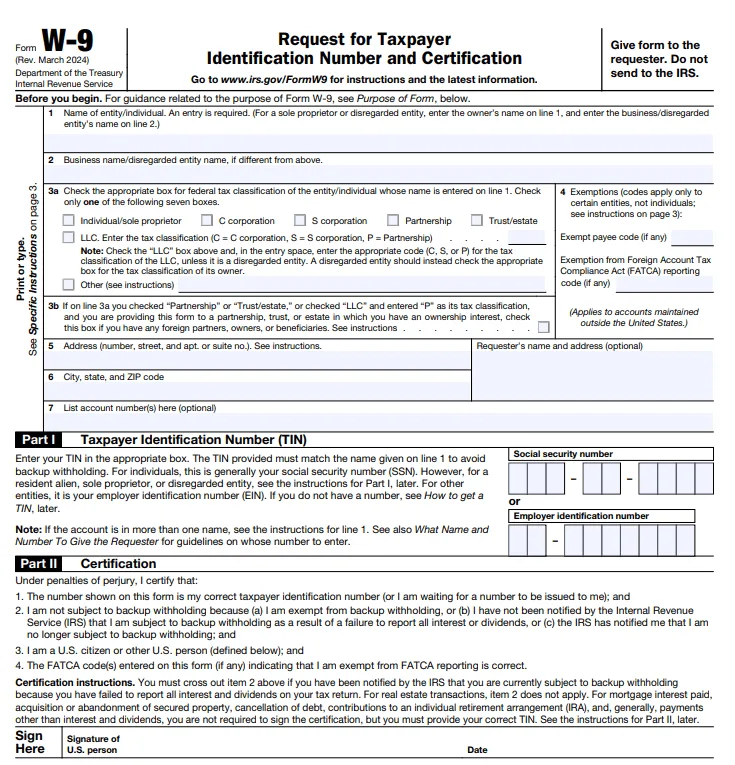
The key line is Line 3a, where an LLC either:
- checks the LLC box and enters C, S, or P, or
- if it’s a disregarded entity, checks the tax classification of the owner instead.
Here are the W-9 fields that most directly affect whether a 1099 gets issued:
- Line 1 (Name): For a disregarded entity, the owner’s name belongs here.
- Line 3a (Federal tax classification): This is the “decision engine” for most 1099 logic.
- TIN (SSN or EIN): Needs to match the name on Line 1 to avoid backup withholding headaches.
This quick table shows what clients typically do for service payments based on what your W-9 indicates:
| What the W-9 indicates (Line 3a) | Typical result for service payments | Important note |
|---|---|---|
| Individual/sole proprietor (often single-member LLC disregarded to an individual owner) | Often gets 1099-NEC if reporting rules are met | Classification comes from the owner when disregarded. |
| Partnership (including LLC taxed as partnership, or LLC with “P”) | Often gets 1099-NEC if reporting rules are met | Common for multi-member LLCs. |
| C corporation or S corporation (including LLC with “C” or “S”) | Often exempt for many 1099 payments | Exceptions exist, especially legal services and certain other reportable categories. |
The W-9 is the anchor document. If it’s filled out cleanly and matches the way you invoice, most 1099 issues never happen. If it’s messy, the 1099 often looks “wrong” even when the client followed your paperwork correctly.
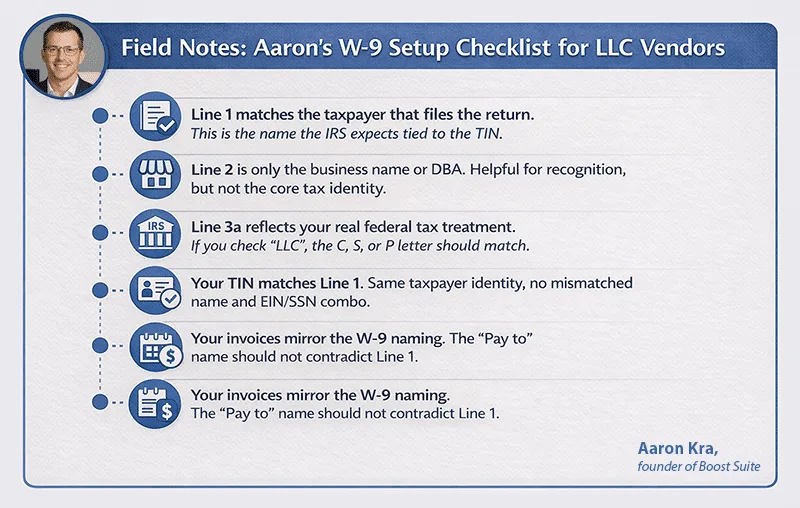
Before sending a W-9 to a new client, run this checklist to keep everything aligned:
- Line 1 matches the taxpayer that files the return.
This is the name the IRS expects tied to the TIN. - Line 2 is only the business name or DBA.
Helpful for recognition, but not the core tax identity. - Line 3a reflects your real federal tax treatment.
If you check “LLC,” the C, S, or P letter should match. - Your TIN matches Line 1.
Same taxpayer identity, no mismatched name and EIN/SSN combo. If you need a quick refresher, see the guide on the difference between a TIN and an SSN. - Your invoices mirror the W-9 naming.
The “Pay to” name should not contradict Line 1.
One naming mismatch causes a lot of confusion: your invoice headline leads with the LLC name, but your W-9 Line 1 is the owner name (common for disregarded entities). Clients often follow Line 1, then the 1099 arrives under the owner name and it feels wrong. It usually is not wrong. It’s just inconsistent presentation.
Form Your LLC the Right Way with Northwest
Start your LLC with Northwest and get expert guidance on structure, compliance, and tax classification from day one. Set up your business correctly so issues like 1099 reporting and W-9 filings don’t become costly mistakes later.
1099 Basics for LLCs: 1099-NEC vs 1099-MISC (What’s the Difference?)
Think of these two forms as “buckets.” 1099-NEC is mainly for services, while 1099-MISC covers specific non-service payment types (rent is the classic one).
The way the IRS treats your 1099 reporting often traces back to how the LLC was originally organized at the state level. Owners who handled Florida Sunbiz LLC filing on their own, for example, may have defaulted to single-member status on the formation paperwork, which directly shapes whether 1099-NEC or 1099-MISC applies down the line.
Here’s the simplest way to compare them:
| Form | What it’s mainly used for | Common examples |
|---|---|---|
| 1099-NEC | Nonemployee compensation (services) | Contractors, freelancers, service providers, and payments to attorneys for services |
| 1099-MISC | Specific categories of miscellaneous payments | Rent, royalties, prizes and awards, medical/health care payments, crop insurance proceeds |
When 1099-NEC is used
1099-NEC shows up when a business pays a nonemployee for services in the course of business. This is the form most LLC vendors see when they provide services.
Service payments that commonly trigger 1099-NEC include:
- Freelance or contractor work (marketing, design, development, consulting, operations)
- Service retainers and project-based fees
- Payments to attorneys for legal services
Invoices that are very clear about what is being paid for (service vs rent vs reimbursement) make the payer’s 1099 decision straightforward and reduce back-and-forth in January.
When 1099-MISC is used
1099-MISC is for certain payment categories that are not “services in Box 1 of 1099-NEC.” If your LLC receives this form, it’s usually because the payment type falls into one of these buckets.
Here are common 1099-MISC payment types (straight from how the IRS frames the form):
- Rent
- Royalties (threshold can differ for royalties)
- Prizes and awards
- Medical and health care payments
- Crop insurance proceeds
If you want the quickest “mental filter,” use this:
- If it’s services, think 1099-NEC.
- If it’s rent or other specific categories, think 1099-MISC.
- If you were paid through cards, payment apps, or marketplaces, you may see Form 1099-K from the platform instead.
Card and payment-app payments are the exception to the 1099-NEC rule: the IRS instructions for Form 1099-NEC tell payers to leave them off, because the processor reports them on Form 1099-K. A client who files both reports the same income twice. And if a client never receives a valid W-9, or the TIN doesn’t match IRS records, backup withholding can apply: 24% of each payment goes to the IRS until a correct W-9 is on file.
Start Your LLC the Smart Way with ZenBusiness
ZenBusiness helps you form your LLC correctly from day one, so your business structure, tax classification, and compliance setup support accurate 1099 reporting. Build a strong foundation that keeps paperwork simple and stress-free.
Do Single-Member LLCs Get a 1099?
Solo contractors who went through navigating Nevada LLC formation typically end up filing as disregarded entities, so the 1099s you receive flow straight onto your personal Schedule C without a separate business return.
Single-member LLCs commonly receive 1099s because many single-owner LLCs are treated as disregarded entities for federal tax purposes unless they elect corporate treatment. In that setup, clients typically follow your Form W-9 and treat the LLC like the owner’s tax entity for reporting purposes. The practical result is simple: if you provide services and your W-9 reflects non-corporate treatment, you may be in the normal 1099 flow.
Single-member LLC taxed as sole proprietor
When a single-member LLC is disregarded, the IRS instructs that the owner’s name generally goes on Line 1 of the W-9, and the business name (if any) may go on Line 2. This matters because the payer typically issues the 1099 using the name and TIN combination that matches federal tax records.
If your single-member LLC provides services, it is common to receive Form 1099-NEC (assuming the reporting requirements are met).
How it typically appears on the 1099
Payers usually rely on your W-9 to populate the 1099. In practice, most single-member LLC situations look like one of these:
- Disregarded entity (owner is an individual):
1099 is often issued to the owner’s name with the owner’s SSN, unless the owner provides an EIN they use for federal tax purposes (here’s a quick guide to getting an EIN). - Disregarded entity (owner is another entity):
1099 is typically issued to the owner entity’s name and EIN, because the LLC is disregarded. - Elects corporate treatment (C or S):
often changes whether a payer issues a 1099 at all for many payment types, but there are important exceptions. And if you’re evaluating the switch, this guide on converting an LLC to an S corp helps clarify the move.
Match your invoicing details to your W-9. If your invoices say “ABC LLC” but your W-9 Line 1 is your personal name for a disregarded entity, clients can end up issuing the 1099 in a way that looks “wrong” on your end, even when they followed the W-9 correctly. Keeping the names aligned helps avoid January cleanup.
Do Multi-Member LLCs (Partnership LLCs) Get a 1099?
Multi-member LLCs often receive 1099s because the default federal treatment for many is partnership taxation unless the LLC elects corporate status (here’s a primer on how a multi-member LLC works). For clients, the process is straightforward: they look at the LLC’s Form W-9, confirm the tax classification, then issue the appropriate 1099 when the payment type and reporting rules require it. In most cases, the 1099 is issued to the LLC entity, not to each owner.
Partners who set up South Dakota LLC organization documents naming two or more members will see their 1099 income aggregated at the partnership level and then split via K-1 to each owner.
Multi-member LLC taxed as a partnership
If the LLC is taxed as a partnership, it typically indicates that on the W-9 (LLC with “P” or partnership classification). In service-provider relationships, that often leads to a 1099-NEC being issued to the LLC when reporting rules are met.
A simple way to think about it:
- The LLC (partnership) is the vendor
- The LLC gets the 1099, not each owner
Do owners/partners in an LLC get a 1099 personally?
Clients generally issue the 1099 to the entity they paid, so when they pay an LLC, the form usually goes to the LLC using the LLC’s W-9 details, not to each owner personally.
There are a few common exceptions where an owner or partner can show up on a 1099 anyway. This typically happens when the payer has a separate relationship with the individual, such as:
- The owner personally provided services outside the LLC relationship (separate vendor relationship).
- Payments were made directly to the individual (not to the LLC) based on that individual’s W-9.
- The owner is paid through the LLC and then receives a Schedule K-1 from the partnership instead of a 1099 (this is internal partner reporting, not client reporting).
Form Your Multi-Member LLC with Bizee
Starting a partnership LLC? Bizee helps you form your LLC properly, choose the right tax classification, and stay compliant. So issues like 1099 reporting and K-1 distributions are handled the right way from the start.
Do LLCs Taxed as S Corps or C Corps Get a 1099?
If you completed your Texas Secretary of State LLC filing and later elected corporate taxation via Form 2553 or 8832, most payers stop issuing 1099s to you altogether (corporations are generally exempt), with attorney fees being the notable exception.
When an LLC is treated as a C corporation or S corporation for federal tax purposes, most clients do not issue a 1099 for typical vendor service payments. That said, the IRS lists specific exceptions where corporate payees still get reported (and if you’re still weighing entity options, see LLC vs C corp differences).
LLC taxed as an S corporation
For many everyday contractor-style services, clients generally treat S corp vendors as corporation-exempt for 1099 purposes (assuming the W-9 supports that classification).
Before assuming “no 1099,” it helps to remember the IRS exception buckets. Here are common cases where an S corp can still be reported:
- Legal services (payments for legal services are reportable)
- Medical and health care payments (reportable in specific situations)
- Gross proceeds paid to an attorney (a separate reporting category)
LLC taxed as a C corporation
C corp treatment follows the same broad pattern: payments to corporations are generally exempt, but exceptions apply.
If you want a clean rule-of-thumb:
corporate treatment reduces how often you receive 1099s, but it does not eliminate them. The IRS instructions list several corporate-reportable categories, including medical/health care payments, gross proceeds to attorneys, and certain fish purchases for resale.
Common Situations People Ask About
Edge cases multiply when the entity itself is unusual. Owners who pursued Wyoming LLC setup with anonymous member listings still receive 1099s addressed to the LLC name, but the IRS matches them back to the responsible party EIN on file.
These scenarios come up constantly with LLC vendors because they sit right on the line between “normal 1099 behavior” and “why did I get this form?”
If you’re an LLC vendor providing services, do you get 1099-NEC?
Service payments are the most common reason an LLC receives Form 1099-NEC. The key is whether your W-9 shows you as non-corporate (for example, sole proprietor/disregarded entity or partnership) and whether the payer’s reporting rules are met.
To sanity-check it quickly, use this sequence:
- Confirm it was services (not rent or another 1099-MISC category).
- Confirm your W-9 classification is not C or S corporation (unless an exception applies).
- Confirm the threshold for the payment year: $600, and $2,000 for payments made after December 31, 2025.
Do LLCs get a 1099 for rent?
Rent is typically reported on Form 1099-MISC when it meets the threshold. One nuance that surprises people: if rent is paid to a real estate agent or property manager, the payer may not have to report it, but the agent or manager may have to report the rent paid over to the property owner.
Also, match the threshold to the payment year: IRS guidance notes $600, and $2,000 for payments made after December 31, 2025.
What to do if you got a 1099 “even though you’re a corp”
First, assume it might be correct. The IRS instructions list corporate exceptions such as attorney-related reporting and certain other categories.
Then do a fast verification:
- Check your W-9: did you indicate C or S corp treatment, or something else?
- Check what the payment was for: legal services and some other categories are reportable even for corporations.
- If it truly looks wrong, request a corrected form (steps below).
What If You Didn’t Get a 1099 (or It’s Wrong)?
A missing or incorrect 1099 is common, especially when clients rush through January filings or your vendor profile is outdated. It also does not change your obligation to report income accurately. If you were paid, you still report that income based on your own records, even if the form never arrives or the details are wrong.
In many cases, the real issue is not the 1099 itself. It is that the payer does not have a valid W-9 on file, or the TIN does not match IRS records, and that can trigger backup withholding before you even get paid.
You still report income even without a 1099
The IRS is explicit that not receiving a 1099 does not mean the income is not reportable. So if you were paid, you report it based on your own records. And having clean records is much easier when you’re using a dedicated LLC business bank account
If you need to reconstruct income, these sources usually get you there:
- Bank deposits and payment processor statements
- Invoices sent and contracts signed
- Emails confirming payments and year-end client summaries
How to request a corrected 1099
Start with the issuer. The IRS says taxpayers should first contact the payer and request a copy of the missing document or a corrected one.
A clean correction request usually includes:
- A short note describing the error (name, EIN/SSN, entity type, amount, or wrong form)
- A fresh W-9 that shows the correct tax classification and TIN
- A request that they issue a corrected 1099 (payers typically check the “CORRECTED” box when fixing a previously furnished or filed form)
If you cannot get a corrected form in time, the IRS notes you can contact the IRS for help with missing or incorrect information returns.
Frequently Asked Questions About 1099s for LLCs
If you only read one section, make it this one. These answers cover the most common LLC 1099 situations, using the same core rule throughout: your Form W-9 tax classification plus the payment type drives what a client does.
Do all LLC companies get a 1099?
No, an LLC may or may not get a 1099 depending on how it is taxed and what the payment was for.
Two LLCs can get different outcomes because “LLC” is not the deciding factor. Clients follow your W-9 federal tax classification (including whether the LLC is disregarded, a partnership, or taxed as a corporation) and the payment category (services vs rent, etc.). In many cases, corporations are exempt from certain 1099 reporting, but exceptions exist, like payments for legal services.
Do single-member LLCs get 1099-NEC?
Often yes, especially when the LLC provides services and is taxed as a disregarded entity (sole proprietor).
For a disregarded single-member LLC, the IRS clarifies that the owner’s name is generally used on W-9 Line 1, and the LLC name can appear on Line 2. Clients typically issue 1099-NEC for reportable service payments to nonemployees when thresholds are met. If you want to sanity-check amounts, IRS guidance notes $600, changing to $2,000 for payments made after Dec 31, 2025.
Do LLC partnerships get a 1099?
Yes, many LLCs taxed as partnerships receive 1099s for reportable payments.
A multi-member LLC is commonly taxed as a partnership unless it elects corporate treatment. When the LLC provides services, clients often issue Form 1099-NEC to the LLC (not the individual owners), based on the LLC’s W-9 classification. The key is that the vendor being paid is the LLC entity, so the information return usually goes to that entity’s name and TIN, consistent with the W-9.
Do owners/partners in an LLC get a 1099 personally?
Usually no, Owners typically do not receive a 1099 just because they own the LLC.
When a client pays the LLC, the 1099 is generally issued to the LLC (if required), not split across owners. Owners of an LLC taxed as a partnership typically receive Schedule K-1 from the partnership to report their share of income, deductions, and credits. A 1099 to an owner personally usually happens only if the payer paid the individual directly under a separate vendor relationship.
Do LLCs taxed as S corps get a 1099?
Usually not for typical service payments, but it depends on the payment category.
Clients often treat S corporations as exempt from certain 1099 reporting when the W-9 indicates S corp taxation. However, the IRS lists exceptions where corporate payees are still reportable, especially attorney-related reporting (legal services and certain gross proceeds paid to attorneys). So an LLC taxed as an S corp may still receive a 1099 in those exception categories even when other vendors would not.
Do LLCs taxed as C corps get a 1099?
Usually not for many categories, but common exceptions still apply.
The general pattern is similar to S corps: payments to corporations are often exempt from many 1099 reporting requirements, but the IRS specifies exceptions. One of the most common is attorney-related payments, where reporting may be required even when the provider is a corporation. So if your LLC is taxed as a C corp and you still received a 1099, the first step is to verify the payment type and compare it to the exception categories in the IRS instructions.
Do LLCs get a 1099 for rent?
Yes, rent commonly falls under 1099-MISC when it meets the reporting rules.
Rent is a classic Form 1099-MISC category, so an LLC receiving rent payments may get 1099-MISC depending on the payer’s reporting obligation and the vendor’s W-9 classification. One nuance: if rent is paid to a real estate agent or property manager, reporting can follow special handling described in the IRS instructions. If you receive rent and get a 1099-MISC, it is often normal, not a mistake.
- Internal Revenue Service (IRS): Instructions for the Requester of Form W-9
- Internal Revenue Service (IRS): Instructions for Forms 1099-MISC and 1099-NEC
- Internal Revenue Service (IRS): Form 1099-NEC & Independent Contractors (FAQs)
- Internal Revenue Service (IRS): What to do when a W-2 or Form 1099 is missing or incorrect
- Internal Revenue Service (IRS): Understanding your Form 1099-K
Form Your LLC with Harbor Compliance
Harbor Compliance helps you establish your LLC with the right structure and compliance foundation – so tax classification, W-9 filings, and 1099 reporting align correctly from day one. Build your business with clarity and confidence.