

A “Doing Business As” name is a public-facing label you use when you want customers to see something different from the name on your formation records. It is mainly about clarity and disclosure, not about creating something new or separate.
What Is a DBA?
DBA stands for “Doing Business As.” Think of it as the “customer-facing” label used for day-to-day activity when you do not want to present the name on your official record. The SBA frames it as one of several ways a name can be recorded, and notes it may be required depending on structure and location.
DBA vs. Legal Business Name
Here’s the practical difference most people care about. The first is the name tied to your formation records; the second is the name customers see.
A quick way to remember it:
| What it is | What it’s used for |
|---|---|
| Name on formation records | The “official” name tied to your paperwork and identity on record |
| DBA (public-facing label) | The name you present to customers when you want a different storefront name |
If you’re also weighing whether you need a DBA, an LLC, or both, see our LLC vs DBA breakdown.
Other Names for DBA
You may see different labels depending on where you operate. Common terms for the same idea include assumed name, trade name, and fictitious name. If you are unsure which term your jurisdiction uses, look at the name section on the official portal where you submit the record.
When Do You Need a DBA?
You usually need one when the name customers see in real life does not match the name on your official record. That matters most when you use the public-facing name on invoices, contracts, signage, ads, or account paperwork. Requirements vary by state, so start with the official portal for your area to confirm whether you must record it and where to submit.
If you already formed an LLC, this quick checklist helps you spot the usual triggers: when an LLC needs a DBA.
Sole Proprietors Using a Business Name
If you run things as an individual and the label you use does not include your “real and true” name, many places treat that as an assumed name situation. Oregon, for example, explains that if the name includes the real and true name of each owner, you generally do not need an assumed name, and it provides a clear example.
If you’re also deciding whether to stay a sole proprietor or form a single-member LLC, compare the tradeoffs in single-member LLC vs sole proprietorship.
LLCs or Corporations Using a Different Brand Name
If you already have a formed organization but want to sell, advertise, or sign agreements under a different storefront label, an assumed name is often the mechanism that connects that label back to the underlying organization for public notice. Connecticut describes this function as public notice that an individual or an organization is conducting activities under an assumed name.
Businesses Operating Multiple Brands
If you run multiple storefront labels under 1 umbrella, you may need separate assumed-name entries for each label you actively use. If you’re consolidating brands under a single entity (or using a parent-subsidiary setup), see multiple businesses under one LLC. This is common when you want clean separation for customer-facing messaging while keeping the underlying structure the same. The SBA also notes that some structures require using a DBA in certain situations, depending on location and rules.
What a DBA Does and Does Not Do
Think of this as a disclosure and usability tool. It helps the public connect a storefront label to the person or organization behind it, but it does not transform your underlying structure.
| A DBA Can Help You | A DBA Does Not |
|---|---|
| Use a customer-facing label in marketing, signage, and day-to-day communications | Create a separate legal entity |
| Present a clearer identity to customers when your formation record name is long or technical | Give you a liability shield by itself |
| Use a label different from the name on your formation record or personal name | Automatically create trademark rights |
| Make account opening, contracts, and customer paperwork match what people recognize | Change how you are taxed, because that flows from your underlying structure, not your storefront label |
I have seen small naming differences create real headaches. A missing comma, an extra word, or a slightly different storefront name can slow down account setup, contract reviews, and customer payment workflows.
Before I suggest using a public-facing name, I check these 3 details first:
The customer-facing name should match the submitted name letter for letter.
The name behind it should match the formation record or personal name tied to the operation.
The name should be checked separately if exclusivity, expansion, or long-term branding matters.
How to Register a DBA
The steps are consistent almost everywhere, but the exact authority and rules depend on where you operate. The SBA notes you may need to record a DBA at the state, county, or city level, depending on the place.
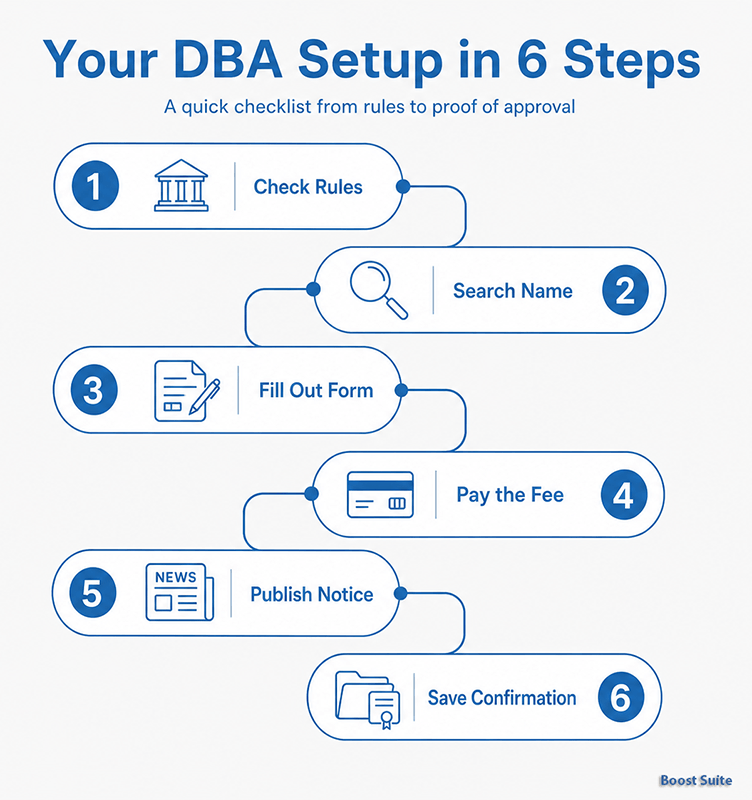
Step 1: Check State, County, or City Rules
Start by finding the official portal that covers assumed-name submissions for your area. The SBA is explicit that the right level can vary. We recommend saving the rule page (PDF or screenshot). It prevents “I read it somewhere” confusion later, especially if requirements change.
Step 2: Search Name Availability
Most places want you to confirm the name is not already in use in their index before you submit anything. If your area has an online portal, do the search there first, then take a screenshot for your records.
If you want a simple walkthrough, use this step-by-step business name availability check.
Step 3: Complete the DBA Application
Complete the form with clean, consistent details (especially spelling and punctuation). Small mismatches are a common reason submissions get rejected or delayed. If you are privacy-sensitive, note that some places treat these details as public record.
If your state gives you flexibility, these alternatives to using your home address for filings can help.
Step 4: Pay the Filing Fee
Fees vary, treat the fee as part of your “name rollout” checklist and keep the receipt. We recommend saving 2 things: the receipt/confirmation number and a PDF copy of what you submitted. That combo usually solves most follow-up issues quickly.
Step 5: Publish a Notice If Required
Some places also require a newspaper notice. The key is that it is not universal, and the proof is typically kept with your own records, not sent in.
Example:
Pennsylvania’s official form instructions state that advertising is required and that proofs of publication should be kept in permanent records, not submitted to the department.
Step 6: Save Your DBA Certificate
After approval, download and store the proof document (often a certificate or confirmation). Keep a copy where you store key compliance records.
We recommend saving it in 2 locations: a primary folder and a backup (cloud or external drive). This is also the document a financial institution may ask for when the account name needs to match the name customers see, especially when you open a business bank account for your LLC.
Register your DBA the right way with Northwest
Northwest helps you handle DBA filings accurately, keep your business name records consistent, and avoid common mistakes that slow down approvals.
DBA Cost, Duration, Renewal, and Updates
This part varies the most by jurisdiction, so the best approach is to confirm the rules on the official portal where your DBA is recorded. Requirements can differ depending on where you operate.
How Much Does a DBA Cost?
Most places charge a processing fee, but that is not always the only cost. Depending on the jurisdiction, you may also run into publication charges, certified copy fees, amendment fees, renewal fees, or late charges.
Before you submit, check these cost points:
| Cost item | What to confirm |
|---|---|
| Initial processing fee | The base charge to record the name |
| Publication cost | Whether notice publication is required and what it typically costs |
| Certified copy or proof document | Whether you need a paid copy for recordkeeping or account setup |
| Amendment fee | The cost to update the record later |
| Renewal fee | The amount required to keep it active |
| Late fee | What happens if you renew after the deadline |
How Long Does a DBA Last?
There is no single universal term. Some jurisdictions use a fixed term, others tie renewal to the anniversary date, and some use a calendar-based deadline.
Here’s how to interpret what you see on the portal:
| Term type | What it means in practice |
|---|---|
| Fixed-year term | Active for a set number of years |
| Anniversary-based | Renewal is tied to the approval date |
| Calendar-based | Renewal is tied to a specific calendar deadline |
| Manual tracking | You are responsible for tracking the deadline and renewing on time |
When Do You Need to Renew a DBA?
Renew when you still use the name in customer-facing activity and the record is approaching expiration. Missing the deadline can create mismatches across invoices, contracts, ads, and account records.
A simple renewal routine:
- Add a reminder 60 days before the renewal window opens or the deadline hits.
- Add a second reminder 30 days before the deadline.
- Renew early enough to handle portal downtime or payment issues.
- Save proof of renewal with your original approval documents.
How to Update or Cancel a DBA
If key details change or you stop using the name, update the record or cancel it through the same authority that issued it. Use the official portal to confirm which form applies.
Common situations and what to do:
| Situation | What to do |
|---|---|
| Address or contact details changed | Submit an update or amendment through the issuing authority |
| Ownership or underlying structure changed | Confirm whether an update is required, and update the record if so |
| You no longer use the name | Submit a cancellation or withdrawal form |
| You adopt a different public-facing name | Record the new name rather than assuming the old record covers it |
FAQ About Doing Business As
A DBA is useful for branding and public-facing business names, but it does not replace forming a legal entity. These answers explain the most common DBA questions before you register or operate under one.
What are the benefits of registering a DBA?
The main benefit is clarity for customers when you use a customer-facing label that differs from the label on your formation records. The SBA also notes that there are different ways to protect a business name, and some steps can be mandatory depending on structure and location.
Before you spend time on it, think in outcomes:
– Clearer customer-facing identity (especially for marketing, signage, and contracts)
– Cleaner paperwork alignment when the storefront label differs from your underlying records
How does a DBA affect taxes?
In most cases, it does not change how you report federal taxes. The IRS instructions for Form SS-4 explain that the “trade name” line is for a “doing business as” name, but they also emphasize using the full legal name on returns filed for the entity.
If you are choosing how to report, the IRS notes your structure determines which return form you file. A customer-facing label does not change that on its own.
Can you operate a business without a DBA?
Sometimes yes, sometimes no. The SBA notes that recording a DBA may be necessary depending on location and structure.
A common exception is when the storefront label matches the owner’s real name. For example, Oregon’s official guidance explains that if the assumed business name includes the real and true name of each owner, you generally do not need an assumed business name.
What is the renewal process for a DBA?
Renewal timing varies, so the fastest reliable path is checking the official portal that issued it. Two official examples show how different renewal rules can be:
– Oregon: assumed business names renew every 2 years (often tied to the anniversary date).
– Florida: fictitious name renewals are valid for 5 years and expire on December 31 of the final year.
A simple renewal workflow that works almost everywhere:
– Confirm the renewal window and deadline on the official portal.
– Submit the renewal form and keep the confirmation.
– Update your contact details if the portal allows changes at renewal.
Do you need a new EIN when you add a DBA?
Usually, no. The IRS explains you generally need a new EIN when ownership or structure changes, and you do not need a new EIN just because you change the name on record.
If you are applying for an EIN (or reviewing how forms treat alternate labels), IRS SS-4 instructions note that the “trade name” line is where you list a “doing business as (DBA)” name when it differs from the name on record.
If you need the application steps, see how to get an EIN without mistakes.
Does a DBA block other people from using the same label?
Not necessarily. Some offices accept an assumed-name submission without checking whether you have exclusive rights to that label. For example, Texas explains it may accept an assumed name certificate without determining what rights you have to use the name, and more than 1 person can have the same assumed name on file.
The SBA also notes that multiple businesses can use the same DBA within a single state, and that trademark infringement laws still apply.
If you want the practical “state rules vs trademark risk” checklist, see can two businesses have the same name.
- U.S. Small Business Administration: Choose your business name
- Internal Revenue Service (IRS): Instructions for Form SS-4 (Trade name line = “doing business as” (DBA))
- United States Patent and Trademark Office: Search our trademark database (Trademark Search system)
- Pennsylvania Department of State: Application for Registration of Fictitious Name
- Connecticut State: Trade Names (public notice; not a legal entity; no name exclusivity)
- Texas Secretary of State: Name Filings FAQs
Make your business name official with Bizee
Bizee helps you register your DBA, organize your filing details, and keep your business name aligned with how customers know your brand.