
Texas Secretary of State and Comptroller
Texas LLC Name Search and Business Entity Lookup
A Texas LLC name search checks whether a name is distinguishable in the records of the Texas Secretary of State (SOS). The official online search is SOSPortal, which needs an account and costs $1 per search, and the Secretary of State also gives a preliminary answer by phone at (512) 463-5555. Whether an existing company is active is free to check at the Comptroller, whose Franchise Tax Account Status Search shows its status, file number, registered agent and officers. The search here looks up Texas companies by name or file number.
Search Texas businesses
Texas onlyOne distinctive word finds more than the full legal name.
Try:
Texas LLC Name Availability: Distinguishable in the Records
A Texas LLC name is available when it is distinguishable in the Secretary of State’s records from the names of existing entities, reserved names and registered names (Business Organizations Code 5.053). A preliminary answer by phone or email isn’t final: the Secretary of State decides only when it processes the filing, and its Name Filings FAQ warns against spending money on a name cleared that way.
Name test
Distinguishable under 1 TAC 79.39 and 79.40?
Applies the Secretary of State's rules: punctuation, capitals, spacing and articles and conjunctions don't make names different, and entity endings, plurals, common abbreviations or an added state name need the other entity's consent. The state makes the final call.
Under the Secretary of State’s name rules (1 TAC chapter 79), two names are the same when they differ only in capitals, punctuation, spacing or symbols, articles or conjunctions, or a repeated letter: The Truck Stop is the same as Truck Stop, and Texxas Strong as Texas Strong. One different key word, the same key words in another order, or a word in another language makes a name distinguishable, so Summit Energy can sit next to Energy Summit. Names that differ only in the entity ending (Sampson, Inc. and Sampson, PLLC), a common abbreviation (Smith Bros. Plumbing), a plural or possessive (On the Banks) or an added state after a city are available only with the existing entity’s notarized consent (1 TAC 79.40).
Under the Secretary of State’s rules, only active entities, reservations and registrations count in that review, not whether a company is actually operating. The Comptroller’s free search lists names that start with the words typed, but it covers franchise taxpayers only, not reservations or registered names, so it’s a first look, not an availability check. Texas wants limited liability company, limited company or an abbreviation of one of them in an LLC’s name; limited or company alone isn’t enough. Forming the LLC only stops the Secretary of State from later accepting a name it finds not distinguishable, so federal and state trademark checks matter too.
Reserving a Texas Name: 120 Days for $40
A name reservation holds a name for 120 days for $40 (Form 501) and can be renewed for another 120 days by filing again in the last 30 days of the period. Reservations are generic, usable for any type of filing entity, and a reservation can be renewed without limit.
Texas Secretary of State Name Search in SOSPortal
The Texas SOS business search moved to SOSPortal at 8 a.m. on September 29, 2026, replacing SOSDirect and SOSUpload for filings, orders and searches. A search needs an SOSPortal account with multifactor authentication, and each one carries a $1 statutorily authorized fee, paid by credit card or ACH before the search runs.
Several official pages, including the Secretary of State’s FAQs, still mention SOSDirect; its old address now only announces the switch to SOSPortal. A filing already submitted can be followed in the Business Filing Tracker.
The Free Texas Business Entity Search Is at the Comptroller
To look up an LLC in Texas and check if it is active without paying, the Texas Comptroller of Public Accounts’ Franchise Tax Account Status Search, the Comptroller’s Taxable Entity Search, is free and needs no account. It looks up a company by 11-digit taxpayer number, 9-digit EIN, entity name or Secretary of State file number, and its record shows both the franchise tax status and the Secretary of State registration status.
Step 1: Enter One of Three Fields
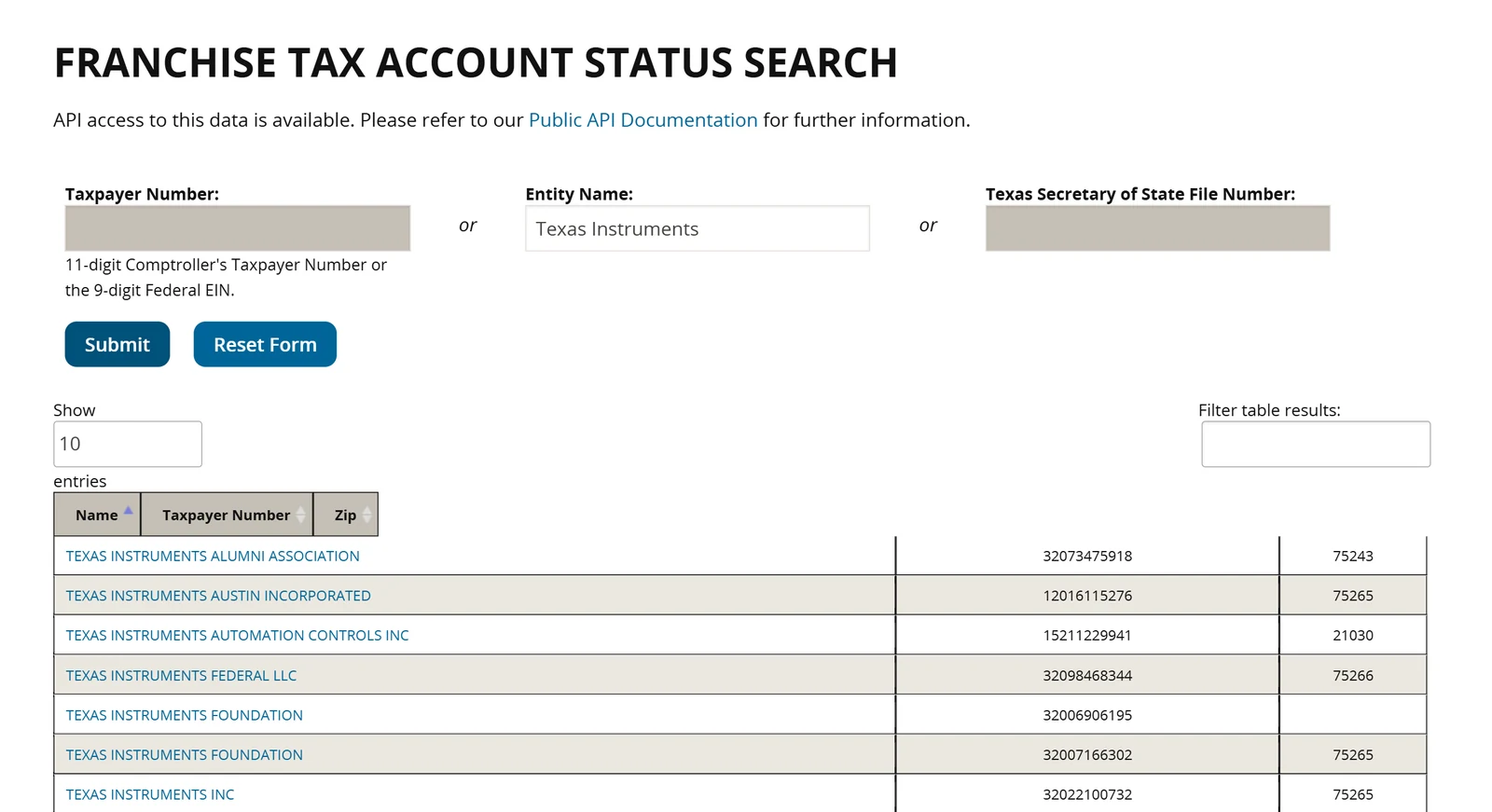
The form takes a Taxpayer Number (the 11-digit Comptroller number or a 9-digit federal EIN), an Entity Name of 2 to 50 characters, or a Texas Secretary of State File Number of 6 to 10 digits; filling one field grays out the others. A name search returns names that start with the words typed: Texas Instruments lists TEXAS INSTRUMENTS INCORPORATED, TEXAS INSTRUMENTS FEDERAL LLC and others, each with its taxpayer number and ZIP code.
Step 2: Or Use the SOS File Number
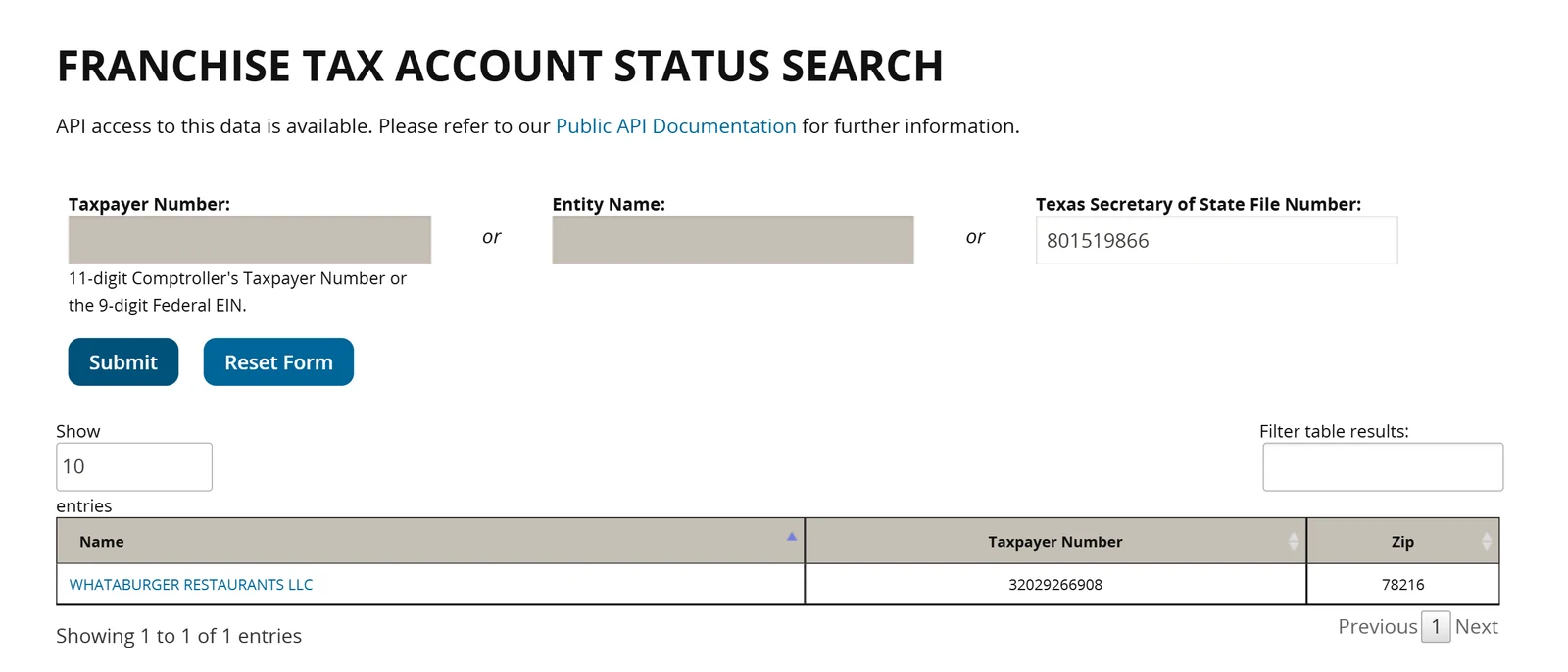
The Secretary of State file number has 10 digits with leading zeros, like 0801519866, and the search also accepts it without them: 801519866 returns a single company, WHATABURGER RESTAURANTS LLC. The file number is the most exact key, since two taxpayers can share a name: TEXAS INSTRUMENTS INCORPORATED appears twice, under two taxpayer numbers.
Step 3: Read the Franchise Tax Account Status
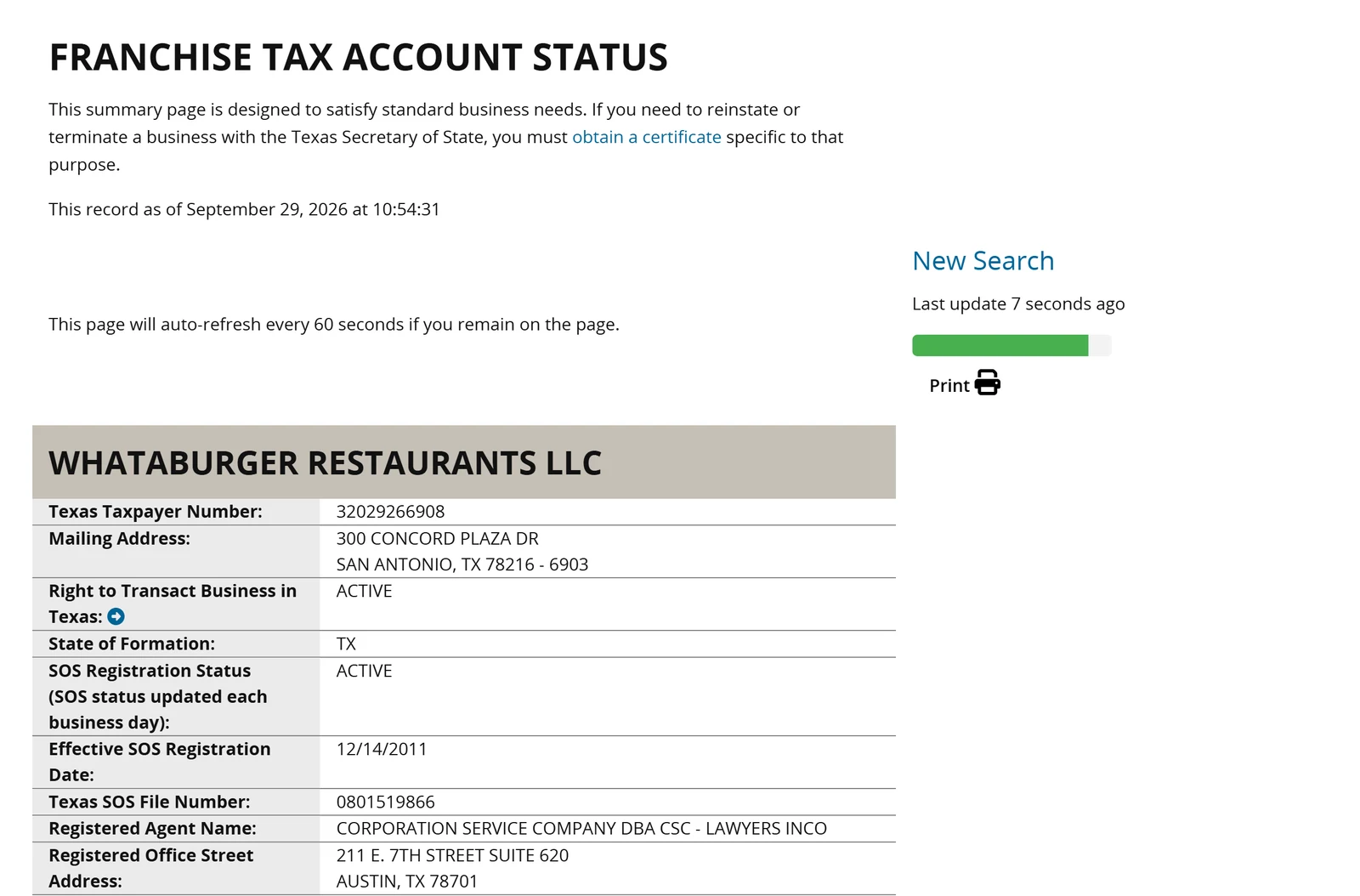
The record lists the Texas Taxpayer Number, mailing address, Right to Transact Business in Texas, State of Formation, SOS Registration Status, Effective SOS Registration Date, Texas SOS File Number and the registered agent with its registered office. Below come the officers from the latest Public Information Report. The page can be printed, and the Comptroller says banks don’t need a separate certificate to see an active status.
Right to Transact Business vs. SOS Registration Status
A Texas company can be active at the Secretary of State and forfeited at the Comptroller at the same time. The Comptroller can forfeit the right to transact business once 45 days have passed after it mails a notice for a missing franchise tax report, PIR or payment; the Secretary of State can then forfeit the charter or registration if the company doesn’t revive within 120 days (Tax Code 171.251, 171.309).
The Secretary of State uses these status terms; the Comptroller’s record shows its own labels, such as ACTIVE.
| SOS status | Meaning |
|---|---|
| In Existence | Active on the Secretary of State’s records: not dissolved, forfeited, withdrawn or merged. |
| Forfeited Existence | Inactive after the Comptroller certified an unfiled report or unpaid franchise tax. |
| Voluntarily Dissolved | The company filed to end its existence. |
| Involuntarily Dissolved | Terminated for failing to keep a registered agent, file a report or pay a fee. |
| RA Notice Sent | Still active, but the registered agent resigned or is missing. |
A forfeited right to transact business means the company can’t sue or defend itself in a Texas court, and each officer or director becomes liable for debts created or incurred in Texas after the due date and before the company revives (Tax Code 171.252, 171.255). A company forfeited for franchise tax can reinstate at any time: it files the missing reports, pays the tax, penalties and interest, gets a tax clearance letter and files a reinstatement with the Secretary of State for $75.
Proof of Good Standing: Two Different Documents
The Secretary of State’s Certificate of Fact (status), $15, is what it calls the equivalent of a certificate of good standing: official proof of existence with the current legal name and formation date, ordered in SOSPortal, by email or by mail, and verifiable online from the document number at its bottom. The Comptroller’s Certificate of Account Status is required only to terminate an entity; for a bank, the Comptroller points to its free search.
Due May 15: The Franchise Tax Report and the PIR
Texas LLCs and corporations file no annual report with the Secretary of State. Their yearly filing goes to the Comptroller, due May 15: the franchise tax report and a Public Information Report. Since the 2024 report year, a company at or below the no tax due threshold, $2,650,000 of annualized revenue for 2026 and 2027, files no franchise tax report, but it still files the PIR or an Ownership Information Report.
For the filings themselves: the Texas franchise tax report and PIR guide.
Skipping the PIR alone can forfeit the right to transact business, even when no tax is owed. Messages from a “Texas Tax Clearance Office” asking for a clearance fee are a scam, the Comptroller warned on October 8, 2025: no such office exists.
Officers Are Public Through the PIR, Owners Are Not
The Public Information Report lists a Texas corporation’s or LLC’s officers, directors and managers with their addresses, and the Comptroller shows them free on the company’s record. Owners aren’t there: the Secretary of State keeps no information on LLC ownership beyond the initial members of a member-managed LLC, and none on a corporation’s shareholders, except for close corporations.
The list comes from the most recent PIR processed, which is filed once a year and can be several years old, as on the Texas Instruments record. Someone listed on a PIR who wasn’t an officer or director on the filing date can file a sworn statement with the Comptroller. Ownership Information Reports stay confidential.
Registered Agent and Assumed Names in Texas
Every Texas LLC and corporation keeps a registered agent and a registered office at a street address in Texas, not a mailbox service; an entity can’t be its own agent, and changing either costs $15 (Form 401). An LLC or corporation doing business under another name files an assumed name certificate, the Texas DBA, with the Secretary of State only, for $25 and up to 10 years; since September 1, 2019 it no longer files with the county. Sole proprietors and general partnerships file with the county clerk. An assumed name gives no exclusive right, so the same name can be on file several times.
An LLC’s or corporation’s assumed name certificate is a Secretary of State record, searched in SOSPortal; a sole proprietor’s DBA is filed with the clerk of each county where the business keeps an office (or, with no office in Texas, where it does business). Licenses are separate again: trades such as electricians, cosmetologists and tow companies are checked in the TDLR Active License Search.
Texas EIN Lookup and the Free Taxpayer List
A Texas EIN lookup works in one direction at the Comptroller: its search accepts a 9-digit EIN and returns the company it belongs to, such as 741563240 for SOUTHWEST AIRLINES CO., but the record doesn’t display the EIN. The 11-digit Texas taxpayer number, which starts with 1 or 3, is a different number from the EIN.
EINs are an IRS matter, not the Secretary of State’s; beyond the Comptroller search, a company’s EIN can be traced through other records that print it.
The Comptroller’s Active Franchise Taxpayers file on data.texas.gov is a free list of taxpayers with their names, addresses, file numbers and status codes, but no officers or agents. The Secretary of State sells its own database in JSON through SOSPortal bulk orders.