
Sunbiz, Florida Division of Corporations
Florida Business Entity Search
A Florida business entity search runs on Sunbiz, the Florida Secretary of State’s (FL SOS) free business register, kept by the Division of Corporations and updated daily. Open a company’s record to see whether it is active, who runs it and which reports it has filed.
Search Florida businesses
Florida onlyOne distinctive word finds more than the full legal name.
Try:
How to Search Sunbiz for a Florida Business
The main Sunbiz search covers corporations, LLCs, limited partnerships and state trademarks, free. Fictitious names, general partnerships and LLPs, and liens each have a separate search on the same Search Records page.
The tool above shows whether a Florida company is active or inactive, its document number, FEI/EIN, agent and officers. It doesn’t show the INACT/UA or NAME HS codes, so to know whether a name is still held, read its row on Sunbiz.
Official site: Search Records on Sunbiz
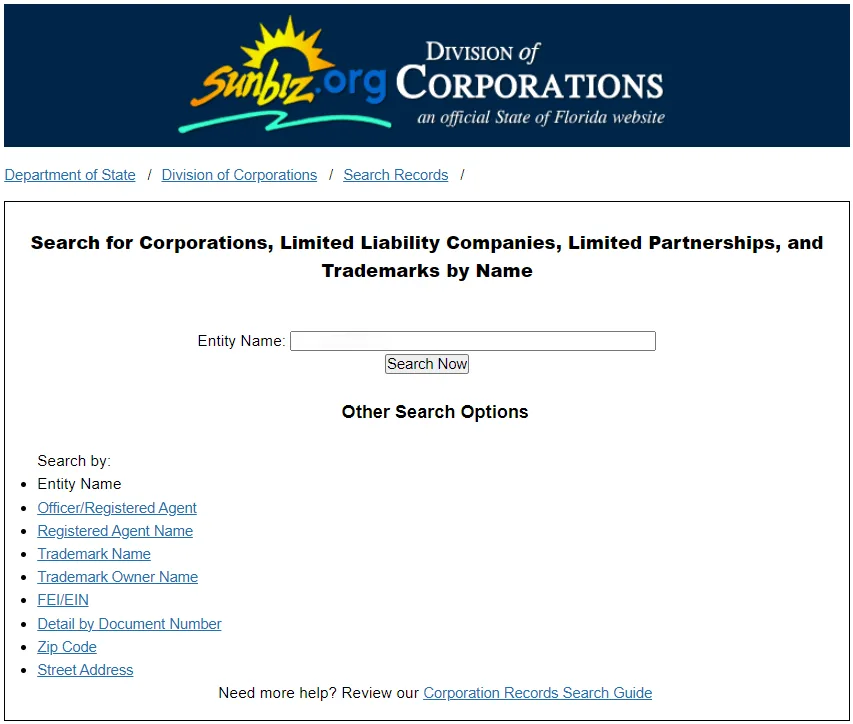
Step 1: Type the Name Without LLC or Inc.
Open the search by name, type the first words of the name in Entity Name and select Search Now. The full name isn’t needed. Leave the suffix off, because Florida doesn’t count LLC, Inc. or Corp. as part of what makes a name different.
Step 2: Scan the Entity Name List
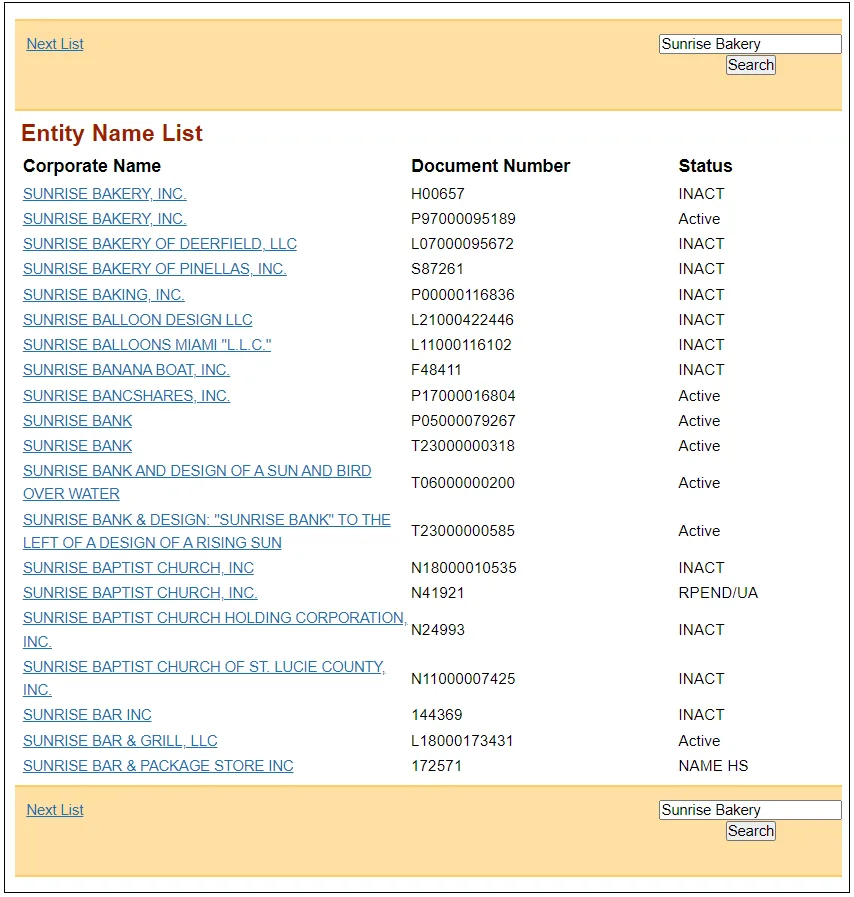
Records are indexed alphabetically; if the exact name isn’t on the first screen, Next List and Previous List move through the index. Each row gives the corporate name, the document number and the status. State trademarks share the list.
Step 3: Open the Record (Detail by Entity Name)
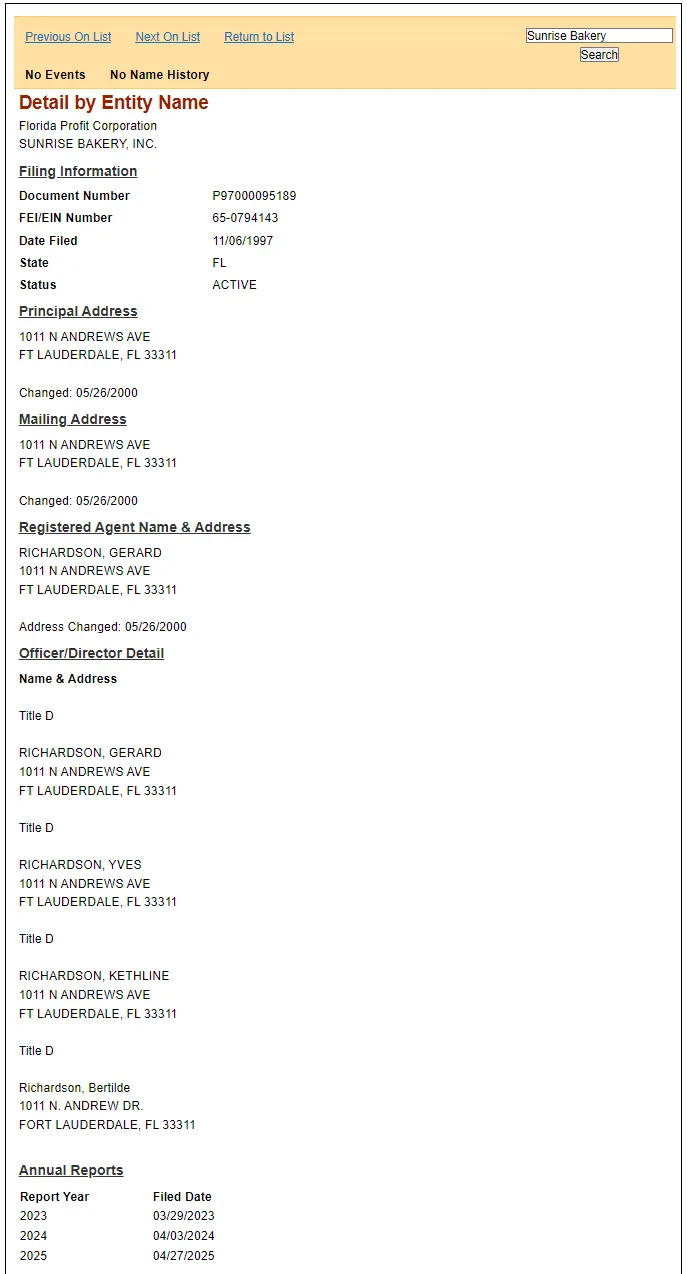
Filing Information holds the Document Number, the FEI/EIN Number, the date filed, the state and the status. Below it come the principal and mailing addresses, registered agent, officers and directors, and the years of the last three annual reports, with the date each address last changed.
Step 4: Open the Filed Documents as PDFs
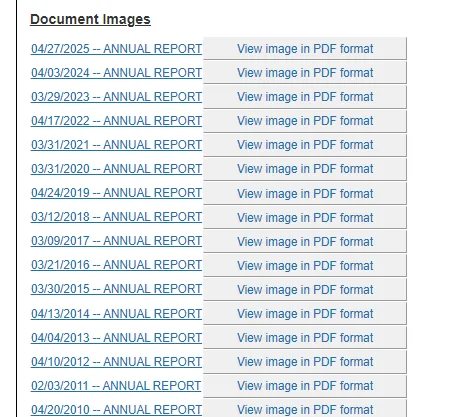
Document Images is the entity’s filing history: View image in PDF format opens each filing, from the articles of organization or incorporation to every annual report, free of charge. New filings take up to 3 business days to appear (5 on paper); some older documents are on microfilm, by request to the Division.
Search by Officer, Registered Agent, Address or Document Number
Officer/Registered Agent finds every entity where a person is listed as an officer, director, manager or agent: type Last Name, First Name, Middle Initial, and partial names such as “Doe, J” work. Zip Code and Street Address search the addresses on file.
With Detail by Document Number, “Record Not Found” means the number doesn’t exist. Type the zero as a zero: the letter O is not accepted.
Who Owns a Business in Florida? AMBR, MGR and the Registered Agent
Sunbiz doesn’t publish ownership shares, and for a corporation it lists officers and directors, not shareholders. For an LLC, the Officer/Director Detail comes closer: AMBR marks an authorized member and MGR a manager, and the Division’s FAQ says that in an LLC, a member is the equivalent of an owner. The owner of a DBA is named on its fictitious name record.
| Code | Title |
|---|---|
| AMBR | Authorized Member |
| MGR | Manager |
| AR | Authorized Representative |
| P | President |
| D | Director |
Codes combine when one person holds several roles: PDST is president, director, secretary and treasurer. The Division’s title abbreviations list is not exhaustive, so an unusual code is best read against the filed document.
The registered agent receives lawsuits and official notices at a Florida street address; a P.O. box is not allowed, and an entity cannot be its own agent. Registered Agent Name and Officer/Registered Agent search the other way, from an agent to all its companies.
Owners change their agent with a Statement of Registered Agent/Registered Office Change ($25 for an LLC) or on the annual report.
Sunbiz Name Search: When Florida Treats a Name as Taken
Florida LLC name availability comes down to one test: the name must be distinguishable in the Division’s records. Five differences don’t count under Fla. Stat. 605.0112 for LLCs and 607.0401 for corporations: a suffix, an article, “and” versus “&”, the singular, plural or possessive form of a word, and punctuation or symbols.
The name of a limited liability company must also contain “limited liability company”, “LLC” or “L.L.C.”, and no name may suggest a link to a state or federal agency.
Name test
Distinguishable under Fla. Stat. 605.0112?
Applies the statute's rules on punctuation, capitals, articles, the word “and” or its symbol, plural and possessive forms and entity endings. The state makes the final call.
An INACT row no longer blocks the name. Active and INACT/UA rows do. Fictitious names (DBAs), general partnership registrations and LLP statements never block an LLC name, because the statute leaves them out of the comparison. A name that clears Sunbiz can still collide with a federal trademark, so check the USPTO database too.
Reserve a Florida Business Name for 120 Days
A name can be held for a nonrenewable 120 days (Fla. Stat. 605.01125) by sending the Secretary of State a signed letter with the name to reserve and the applicant’s name and address: $25 for an LLC, $35 for a corporation. (The 2017 instructions on the Articles of Organization form still say otherwise; the 2019 statute controls.)
Florida EIN Lookup: Search Sunbiz by FEI/EIN
Sunbiz can be searched by federal employer identification number. Choose FEI/EIN in the search options and enter the 9 digits: the results list every Florida entity tied to that number, and one number can belong to more than one legal entity.
The number on a record is self-reported: each annual report asks for the FEIN, or whether one has been applied for (Fla. Stat. 605.0212 for LLCs), so a record shows what the entity last reported. The IRS issues EINs; the Division only records them. The FEI/EIN tab of the search above runs the same lookup on Florida records, and finding a company’s EIN covers the other public sources.
Sunbiz Fictitious Name Search for Florida DBAs
A Florida DBA is a fictitious name, with its own Sunbiz search by fictitious name, owner name, owner charter number, owner FEI/EIN or registration number. Each result shows the owner, the address, the county and whether the registration is active or expired.
Registering costs $50 for 5 years under Fla. Stat. 865.09, and it is public notice only: it doesn’t reserve the name or stop someone else from registering it. A company trading under its exact Sunbiz name needs no fictitious name.
Why Florida Companies Go Inactive in September
Every Florida corporation, LLC and limited partnership has the same annual report filing window, January 1 to May 1. An entity with no report by the third Friday in September is administratively dissolved, or revoked if it is out-of-state, at the close of business on the fourth Friday (Fla. Stat. 605.0714 for LLCs). In 2026 that was Friday, September 25; from then on the record shows INACT/UA and the name is held for a year. Fees and the $400 late fee after May 1 are in the Florida annual report guide.
What Sunbiz Statuses Mean: INACT, INACT/UA and NAME HS
NAME HS is a former name, not a separate company: its row leads to the current record. INACT frees the name; INACT/UA holds it for the period in the table.
| Status | Meaning | For the name |
|---|---|---|
| Active | The entity is active. | Taken |
| INACT | The entity is inactive. | Can be used again |
| INACT/UA | Inactive, name held: 1 year after an administrative dissolution or revocation, 120 days after a voluntary dissolution. | Held until the period ends |
| NAME HS | A previous name of the entity. | Open the row to reach the current record |
| Cross Ref | An out-of-state entity’s name in its home state. | Open the row to reach the Florida record |
| Inactive/MG | Inactive after a merger. | Look up the surviving entity |
| Inactive/CV | Inactive after a conversion. | Look up the converted entity |
Results can also show RPEND/UA, a code the Division’s explanation of status terms does not define. For those rows, the detail page and its latest filed documents say what happened.
Reinstate an Administratively Dissolved Company
A reinstatement returns a dissolved or revoked entity to active status as of the dissolution date. An LLC pays $100 plus $138.75 for each report year due, with no $400 late fee on top. Paid online by card within a year of dissolution, it posts immediately.
Florida Certificate of Status (Good Standing)
Florida’s certificate of good standing is called a Certificate of Status. It costs $5 for an LLC and $8.75 for a corporation, and the Division emails it as a PDF once the payment clears. Anyone handed a certificate can confirm it with Check Certificate of Status, using the tracking number printed at the bottom.
Mail That Looks Official but Doesn’t Come From Sunbiz
The Division has warned about several private solicitations built to look like state notices. None of them is required.
- “Annual Minutes” or “Annual Corporate Record Forms” notices asking $125. The only yearly state filing is the annual report on Sunbiz.
- Offers to sell a certificate of status. A properly filed entity doesn’t need one to be valid.
- Fictitious name renewal notices asking $125. The state renewal costs $50.
- Fake “Corporate Transparency Act” compliance notices, flagged in a Better Business Bureau alert posted on Sunbiz.
Payments to the Division appear on a card statement as “NIC DOS DIVISION OF CORP”, and a filing confirmation goes to the email address on the record. Report impostor mail to 1-800-HELP-FLA.
If someone files a false change on your LLC, a statement of correction delivered within 15 days after the filing notice costs nothing (Fla. Stat. 605.0209). The Division suggests checking your own record every month, so that a changed address, registered agent or officer list doesn’t go unnoticed.
Hiring a Florida Company? What a Sunbiz Record Proves
The Division accepts filings at face value, as a ministerial filing office, so a record proves what was filed, not that it is true.
- Status is Active and this year’s report is listed Between January 1 and May 1 a missing current-year report is normal. After May 1 it means the $400 late fee is due (nonprofits excepted).
- The person you deal with appears in Officer/Director Detail If not, ask who authorized them.
- The registered agent has a Florida street address A P.O. box is not allowed, so one on the record is worth a question.
- The trade license exists outside Sunbiz Professional licenses are verified in the DBPR Verify a Licensee search, by name, license number, city or county, or license type. Local business tax receipts come from the county or city.
The Division doesn’t take complaints about businesses. Those go to the Division of Consumer Services at 1-800-HELP-FLA.
Sunbiz Search FAQ
Is Sunbiz a business license search?
No. Sunbiz holds registrations, not licenses, and Florida has no corporation commission. Licenses are covered in the checks above.
Where does a Florida document number come from?
The Division assigns it when the entity is filed, 6 or 12 characters long, and prints it on the confirmation letter.
Does Sunbiz show UCC filings?
No. Those are in the Florida Secured Transaction Registry; judgment liens and federal lien registrations are on Sunbiz.
Where is a new Florida LLC filing in the queue?
The Division’s Document Processing Dates page shows the receipt dates it is working on for each type of filing. Once approved, the LLC and its document number appear in the search.