

A 147C letter is what you request when you need official proof of your EIN, but you no longer have your original EIN notice (often CP 575). The quickest way to get it is to call the IRS Business and Specialty Tax Line. Most people need it because a third party is asking for written verification, like a bank, lender, payroll provider, or a vendor doing a name and TIN check. It also comes up in IRS workflows like a Second “B” Notice where the IRS specifically references Letter 147C as verification for businesses.
What Is an IRS 147C Letter?
Think of the 147C letter as your replacement proof when you can’t find your original Employer Identification Number (EIN) confirmation notice. It confirms your EIN and the legal business name the Internal Revenue Service (IRS) has on file.
One key detail: if you ask the IRS for another copy of CP 575, the IRS generally does not duplicate it. Instead, they issue Letter 147C, EIN Previously Assigned for EIN verification.
When Do You Need a 147C Letter?
You usually need an IRS Letter 147C (an IRS EIN verification document) when someone asks for written proof of your EIN and legal business name, not just the number itself.
The most common scenarios are:
- Open a business bank account (U.S. bank account) for business banking compliance
- Apply for a loan, credit line, or merchant account
- Set up payroll or verify a business with a payroll provider
- Fix vendor W-9 checks or name and TIN matching issues
- Handle an IRS-related Second “B” Notice situation (the IRS points to Letter 147C as verification for businesses)
Do I really need 147C, or will the EIN alone work?
Sometimes the EIN alone is enough, especially if the other party just needs the number. But many banks, commercial lenders, and payroll systems want written verification. If that’s the case, 147C is the clean solution. Ask them upfront which document they accept, since some will also accept an entity transcript instead.
If you’re still deciding whether your LLC actually needs one, it usually comes down to how many owners it has, whether it has employees, and how it’s taxed. The same question comes up for a corporation (C Corp, S Corp), partnership, or sole proprietorship, especially when business banking compliance triggers a verification request.
And if your main problem is that you simply lost the number (lost EIN recovery), start with these practical ways to find a company’s EIN using records and public filings before you spend time requesting a verification letter.
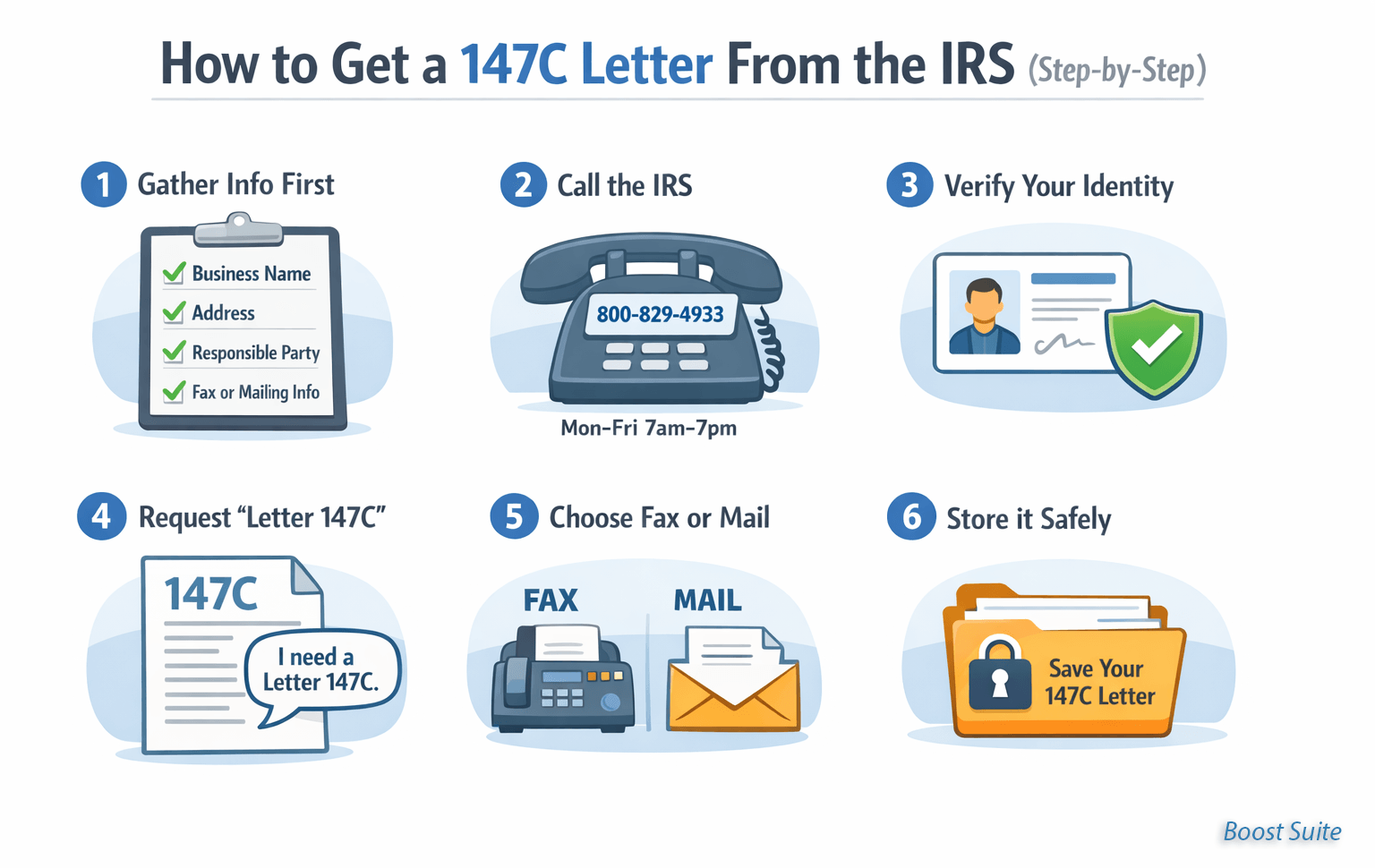
How to Get a 147C Letter From the IRS (Step-by-Step)
If someone needs written proof of your EIN and legal business name, this is the fastest, cleanest way to get it from the IRS.
If you’re earlier in the process and your EIN situation is tied to formation timing, here’s what to know about getting an EIN before your LLC paperwork is finalized.
Step 1 – Gather what you need before calling (checklist)
Before you dial, have these details in front of you so the call does not stall:
- Legal business name exactly as the IRS has it on file
- Business address on record
- Responsible party details (the person tied to the EIN record)
- Your callback number
- A secure fax number (if available) and your mailing address confirmed, so you can choose delivery method if you need the letter in writing
Step 2 – Call the IRS Business and Specialty Tax Line
Call 800-829-4933. Hours are Monday to Friday, 7 a.m. to 7 p.m. local time (Alaska and Hawaii follow Pacific time).
Step 3 – Pass identity verification
The IRS will authenticate the caller and will only disclose EIN information to someone who is authorized. This is why Step 1 matters.
Step 4 – Ask for “Letter 147C, EIN Previously Assigned”
Use the IRS wording. It helps the agent route the request faster. The IRS explicitly calls out requesting Letter 147C, EIN Previously Assigned through this line.
Step 5 – Choose delivery (fax vs mail) and confirm details
After the IRS confirms you are authorized, they can tell you the EIN verbally. If you need written proof, the IRS guidance says they can send a 147C letter via fax or mail when requested (timing rules can apply).
Choose fax only if you have a private, secure number. If not, ask for mail to the address of record.
Step 6 – Store it properly (so you do not repeat this)
Once you receive it, save it in 2 places:
- Your secure company folder (tax and banking docs)
- Your onboarding folder (banks, payroll, accounting)
Limit access to whoever handles banking, payroll, and tax compliance.
Keep your business documents organized with Northwest Registered Agent
Avoid repeating the IRS process. Northwest Registered Agent helps you keep critical records like EIN confirmations and compliance documents secure, organized, and easy to access whenever you need them.
Who Can Request It (and what if you are not the owner?)
The IRS will confirm an EIN and issue Letter 147C to the business taxpayer or an authorized representative, whether the taxpayer is a U.S. LLC, corporation, partnership, sole proprietorship, trust, or estate.
- Owner or responsible party: This is the simplest path. If you are listed as the responsible party on the IRS record, you can usually handle the call and request the letter.
- Authorized representative: If you are not the owner, you typically need a valid IRS authorization on file (commonly Form 2848 or Form 8821) so the IRS can disclose information to you and process the request.
Common Problems and Fixes (Troubleshooting)
If the request feels “stuck,” it is usually one of a few predictable issues. Here’s a quick table you can scan and fix fast.
| Problem | Likely cause | How to fix |
|---|---|---|
| IRS will not discuss the EIN with you | Caller is not recognized as the taxpayer or an authorized representative | Have the responsible party call, or file Form 2848 / 8821 so the IRS can speak with your representative. |
| IRS cannot locate the EIN | Using the wrong legal name, address, or pulling from branding instead of the IRS record | Use the exact legal name and address on IRS records. If still not found, check prior returns, bank records, or licensing paperwork. |
| Bank or payroll says “name and EIN do not match” | Third party is validating against a different legal name format than IRS records | Use the 147C as the source of truth and provide the exact legal name shown there. |
| You do not have a secure fax number | No access to private fax services | Request mail delivery to the address of record. Avoid shared or public fax for tax documents. |
| You were told CP 575 cannot be reissued | CP 575 is original EIN notice; IRS uses 147C for verification | Request Letter 147C, EIN Previously Assigned instead. |
| Long holds or cannot get through | Peak call volume | Call early and use the Business line: 800-829-4933 (7 a.m.–7 p.m. local time). |
| You need proof today but mail will be slow | Immediate written verification required | If you have secure fax, request fax. Otherwise, ask if an entity transcript / business tax transcript is acceptable temporarily. |
Also, if you recently rebranded, make sure IRS records match the current legal name. This guide shows how to notify the IRS about a business name change so bank and payroll checks do not keep bouncing.
Frequently Asked Questions about 147C Letter
These are the questions people ask most when they need a 147C fast for a bank, payroll setup, or a verification request.
What is a 147C letter from the IRS?
A 147C letter is the IRS’s way of confirming, in writing, “this EIN belongs to this legal business name.” It’s mainly used when you no longer have your original EIN notice (often CP 575) and someone needs official proof. The IRS labels it “Letter 147C, EIN Previously Assigned,” and lists it as a standard method to confirm an EIN.
Is a 147C letter the same as CP 575?
Not exactly. CP 575 is the original EIN notice created when the EIN is assigned, typically showing the date assigned EIN after your IRS Form SS-4 is processed by an IRS Service Center. A 147C is a verification letter you request later when you need proof again. IRS CP 575 notice cannot be duplicated, so when someone asks for a duplicate CP 575, the IRS issues Letter 147C for EIN verification instead.
Can I request a 147C letter online?
Usually, no. The IRS does not point to a normal “online request” form for Letter 147C. Instead, the IRS lists 2 official ways to confirm an EIN: request an Entity transcript (business tax transcript) or call the Business and Specialty Tax Line and request Letter 147C. If you need it quickly, calling is typically the most direct route.
If you don’t have an EIN yet (and you’re not verifying an existing one), follow this step-by-step guide to apply for an EIN the right way.
If you need in-person help for other issues, an IRS Taxpayer Assistance Center can help by appointment, but 147C requests are still typically handled through the Business line or transcripts.
What number do I call to request Letter 147C?
Call the IRS Business and Specialty Tax Line at 800-829-4933. The IRS lists the general hours as Monday to Friday, 7 a.m. to 7 p.m. local time (Alaska and Hawaii follow Pacific time). When you reach an agent, ask for “Letter 147C, EIN Previously Assigned.”
Who is authorized to request a 147C letter?
The IRS will only confirm EIN details after they authenticate the caller and confirm the caller’s relationship or authority for the business. In practice, that usually means the taxpayer (responsible party) or an authorized representative with third party authorization on file (Form 2848 / Form 8821). If you are not the owner, it’s often faster to have the responsible party call, especially when timing is tight.
Can the IRS fax a 147C letter the same day?
Often, yes, but it’s not guaranteed. IRS guidance allows the IRS to fax Letter 147C when the caller requests written confirmation and the IRS has completed the authorization and identity checks. Same-day fax depends on call timing, agent workload, and whether you can provide a secure fax number during the call. Use fax only if the number is private and controlled.
How long does it take to receive a 147C letter by mail?
Mail is slower than fax. IRS guidance tells callers to expect the letter in about 10 to 14 business days when it’s mailed to the address of record. There are also timing restrictions in certain situations, so if you need proof urgently, ask whether fax is available or whether the requesting party will accept an entity transcript temporarily.
- Internal Revenue Service: Employer Identification Number (EIN) – EIN confirmation (request Letter 147C)
- Internal Revenue Service: Telephone assistance contacts for business customers
- Internal Revenue Service: Get a business tax transcript
- Internal Revenue Service: Internal Revenue Manual (IRM) 21.7.13
- Internal Revenue Service: Taxpayer Identification Number (TIN) Matching
Stay compliant and EIN-ready with Harbor Compliance
Harbor Compliance helps you keep critical business records organized and up to date, so if you ever need documents like your IRS 147C letter, you’re prepared without the stress.