

A Certificate of Good Standing is a state-issued document that confirms your LLC has met the state’s filing requirements and is currently active on the state’s records.
You can request or download it from your state’s business filing office (often the Secretary of State) once your LLC shows a compliant status, although the ordering method and fees vary by state.
Certificate of Good Standing LLC Overview
A good standing certificate is basically your LLC’s “compliance proof” in a format that banks, government agencies, and partners recognize. States issue it based on what their records show at the moment you order it.
What Is a Certificate of Good Standing for an LLC?
A Certificate of Good Standing is an official document proving that your LLC is active on state records and has met the state’s basic compliance requirements (such as required filings).
What the Certificate Confirms
In most states, the certificate is used as official evidence that your LLC is in a compliant status. It commonly confirms:
- Your LLC legally exists
- Your LLC is active or in good standing
- Required state filings are current
- Required state fees are paid
Other Names for This Certificate
States don’t all use the same label. Depending on where your LLC is formed, you may see:
- Certificate of Status
- Certificate of Existence
- Certificate of Compliance (often tied to state tax clearance in some states)
When Does an LLC Need a Certificate of Good Standing?
Most LLCs do not need this document day to day, but you will often be asked for it when another party needs official proof that your LLC is active and compliant as of a specific date. This comes up most often when a bank reviews your LLC business account documents, a lender checks your company before business financing for an LLC, or another state asks for proof before allowing you to operate your business in a different state.
Here are the most common situations where a certificate is requested:
- Opening a business bank account (especially with a new bank or when adding signers)
- Applying for business financing (loans, credit lines, equipment financing)
- Registering as a foreign LLC in another state (many states require a home-state certificate as part of the filing package)
- Providing proof of status to a client, vendor, or agency (risk and compliance checks)
- Completing due diligence for a business transaction (investors, acquisitions, major contracts)
How to Check If Your LLC Is in Good Standing
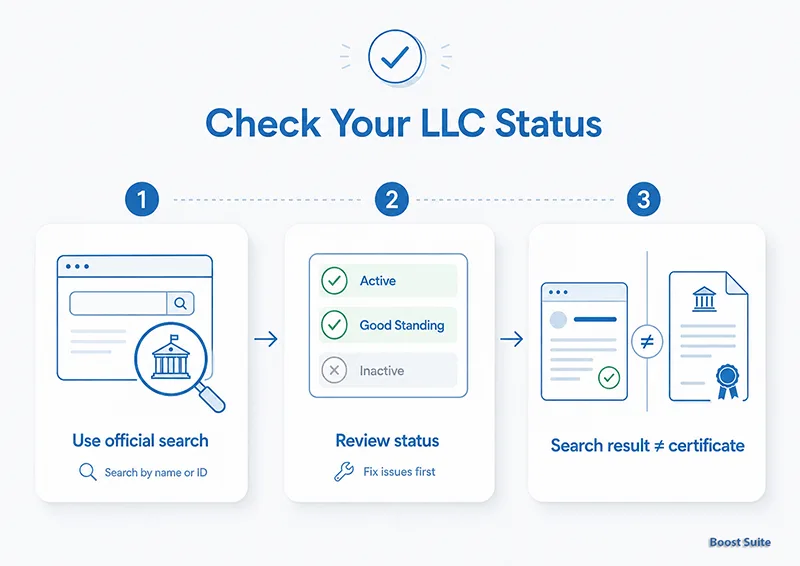
The fastest way to check is to use your state’s official business entity search and review the current status shown on the record.
Use the Official State Business Search
Go to your Secretary of State (or equivalent filing agency) website and use the state’s business search tool to look up your LLC by name or entity ID. This is the source most third parties rely on when they verify your company’s status.
If you are not sure where to find the right search page, our state-by-state business entity search guide can help you locate the official database before you check your LLC’s status or request a certificate
Check the LLC Status
Look for a status label such as Active, Good Standing, or Current. Status wording varies by state, but “Good Standing” commonly means your required filings have been met with the state filing office.
If your LLC is marked inactive, delinquent, dissolved, or revoked, you will usually need to fix the compliance issue first (for example, file missing reports or pay past-due fees) before a certificate can be issued.
Status Search vs Certificate
A business search result shows your LLC’s current status on state records. This is different from checking whether an LLC name is available before formation, because a Certificate of Good Standing is about an already-formed company’s compliance status. The Certificate of Good Standing (also called a Certificate of Status or Certificate of Existence in some states) is a separate document you request or order, often as a printable or certified record.
How to Get a Certificate of Good Standing for an LLC
In most states, you request the certificate through the official business filing website (often the Secretary of State). The exact button names vary, but the workflow is usually the same.
Follow these steps in order:
- Go to your state’s official business filing website.
- Search for your LLC by name or entity ID.
- Confirm the LLC is active or in good standing.
- Select the certificate option (for example, “Get a Certificate of Good Standing”).
- Pay the state fee, if required (some states issue it for free).
- Download the certificate as a PDF or request delivery, depending on your state.
Colorado specifically warns that paid mail solicitations are not “more official” than the certificate you can generate through the state site, and notes its official certificate is available on the Secretary of State website.
Stay Certificate-Ready with Bizee Registered Agent
Bizee helps your LLC receive important state notices and legal documents, making it easier to stay active, compliant, and prepared when you need proof of good standing.
How Much Does a Certificate of Good Standing Cost?
The cost depends on the state. Some states offer a downloadable certificate through the state portal, while others charge a fee that can vary by certificate type and service speed.
Here are a few official examples to show how much fees can vary:
| State example | Official fee example | Notes |
|---|---|---|
| Delaware | $50 short form, $175 long form | Delaware lists different fees depending on the certificate form. |
| New York | $25 | New York lists a $25 fee and also offers optional expedited handling for additional fees. |
Two things are worth confirming before you order: the exact certificate name your recipient wants (status, existence, compliance) and whether they require a recent issue date (many recipients ask for a document issued within 30 to 60 days).
How Long Does It Take to Get a Certificate of Good Standing?
Processing time depends on whether your state issues it online or processes it as a written request.
- Online requests
Some states provide certificates online within minutes, or generate a downloadable PDF after you select the certificate option. - Manual or mailed requests
Other states require a written request and return the certificate by mail, sometimes with optional expedited processing. Mail delivery time can vary.
Why Your LLC May Not Qualify for a Certificate of Good Standing
If your LLC is not shown as compliant on the state’s records, the filing office typically will not issue a certificate until the problem is corrected. This often happens when an LLC misses a required report, misunderstands what an annual report for an LLC is, or falls behind on recurring LLC state fees that must be paid to keep the company active.
Common Issues
These are the most common reasons an LLC cannot get a Certificate of Good Standing:
- Missing annual or biennial report (also called a periodic report in some states)
- Unpaid state fee or tax balance (some states suspend or forfeit entities for tax noncompliance)
- Late penalties tied to missed filings or unpaid amounts
- Registered agent problem (no agent on file, agent resigned, or agent details not maintained)
- Inactive, delinquent, dissolved, or revoked status shown in the state registry
What to Do Next
Fix the compliance issue first, then request the certificate again. In most cases, that means filing the missing report, updating your registered agent details, and paying any past-due fees so your status returns to “Good Standing.”
If the LLC has already been marked dissolved or revoked, you may need to reinstate the dissolved LLC before the state will issue a new certificate.
FAQ About Certificate of Good Standing LLC
A Certificate of Good Standing is a state-issued document that confirms your LLC meets the state’s filing requirements and is currently in an active, compliant status. The exact name and ordering method depends on the state, but it is typically handled by the Secretary of State or a similar filing office.
What is a certificate of good standing?
It is an official certificate from your state that verifies your business is in “good standing” based on the state’s records. For example, Colorado explains that “good standing” means the entity has met statutory filing requirements with the state office.
Why might a business need a certificate of good standing?
You may need it when a third party wants official proof of your LLC’s compliant status, such as for banking, financing, contracts, or foreign registration. Washington notes that foreign entity registrations require a home-state certificate of status and it must be dated within 60 days of submission.
How can I check if my business has a certificate of good standing?
Start with your state’s official business search to confirm the current status shown on the record, such as active or in good standing. Then remember: a status page is not always the certificate itself, because many states require you to generate or order the certificate separately (for example, California offers Certificates of Status through its online system).
What is the process to request a certificate of good standing?
In general, you look up your LLC on the state’s official portal and then select the certificate option if your status is eligible. Some states let you obtain it online within minutes (California), while others may require a written request and a fee (New York lists a $25 Certificate of Status fee).
- Colorado Secretary of State: Business FAQs – Certificate of Good Standing
- Colorado Secretary of State: Alerts Regarding Potentially Deceptive Solicitations
- California Secretary of State: Business Search
- Delaware Division of Corporations: Accessing Corporate Information
- Washington Secretary of State – Corporations & Charities Division: Register a Foreign (Non-WA) Limited Liability Company (LLC) Online
Stay in Good Standing with Harbor Compliance Registered Agent
Harbor Compliance helps your LLC manage official notices, state correspondence, and compliance tasks so your business can stay active and ready for a Certificate of Good Standing.