
Business Filings Division, South Carolina Secretary of State
South Carolina Business Entity Search: SC SOS LLC and Corporation Lookup
The South Carolina business entity search at the Secretary of State works by business name only, and the office keeps no list of owners, officers or members: for corporations, those names sit with the Department of Revenue. Company names and registered agents’ names both go into the search tool here; the state’s own agent search stops at 50 results.
Search South Carolina businesses
South Carolina onlyOne distinctive word finds more than the full legal name.
Try:
Business Entities Online: The SC SOS Business Search, by Name Only
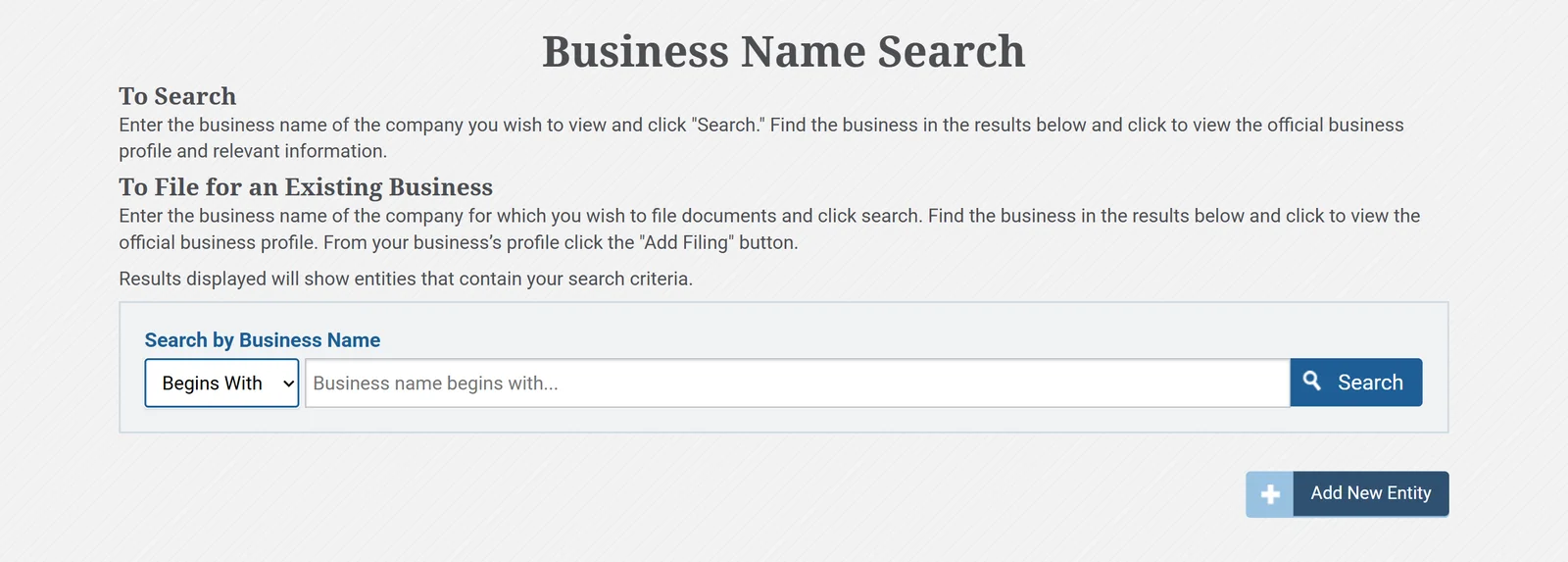
The SC SOS business entity search runs on the Business Entities Online system, at businessfilings.sc.gov: one “Search by Business Name” field with Begins With, Contains or Exact Match. It lists corporations, nonprofit corporations, LLCs, limited partnerships and limited liability partnerships; sole proprietorships and general partnerships don’t file with the Secretary of State, so they never appear. There is no search by number, officer or city, and the page can interrupt with a captcha: “Please complete the following to continue searching.”
Step 1: Pick Contains in the Type of Search Menu
The Type of Search menu starts on Begins With, while the page itself says “Results displayed will show entities that contain your search criteria”; choosing Contains finds a company whose name doesn’t start with the word typed. Searching is free and needs no login; an account is only for filing and ordering documents, and since September 10, 2026 logging in adds an identity verification step.
Step 2: The Business Profile and the 50-Result Agent Search
To look up an LLC in South Carolina, click it in the results to open its business profile; the state says “The public may access general information for all entities on file, including registered agent and registered office information.” A separate Registered Agent Search lists the companies an agent serves, but “The first 50 results will be displayed”; beyond that, the Secretary of State’s office has to be contacted.
Not Dissolved Is All “Good Standing” Means in South Carolina
“‘Good Standing’ does not mean the business entity is currently in operation, but only that its legal existence has not been terminated or dissolved,” the Secretary of State warns. For a nonprofit, it also doesn’t mean the charity may solicit donations; the separate Charity Search answers that.
A Certificate of Existence, South Carolina’s certificate of good standing (a Certificate of Authority when the company was formed elsewhere), costs “a $10.00 fee, which is set by statute,” and copies of filed documents such as Articles of Incorporation or Articles of Organization cost $3 for the first page and $0.50 for each additional page, ordered from the business profile. Mailers from “South Carolina Certified Document Services” asked $399.89 “to remain in good standing”; the office says it “will never send unsolicited correspondence to businesses for the purpose of selling certificates of existence or certified copies.”
South Carolina LLC Owner Search: The SOS Has No Names
“Business entities are not required to disclose the names of directors, officers or members to the Secretary of State’s Office,” so no search by owner exists. For a corporation’s directors and officers, the office sends people to the Department of Revenue at (844) 898-8542.
Those corporate names come from the annual report, and the tax law makes them “open to unrestricted public inspection” (§ 12-20-30). An LLC run by managers lists its initial managers in its Articles of Organization, visible by ordering a copy; the Secretary of State keeps no member list.
Who Files a South Carolina Annual Report, and With Which Agency
The South Carolina LLC Act sets no annual report, so an LLC files nothing yearly with the Secretary of State. A C corporation’s annual report is Schedule D of its SC1120 tax return, filed with the Department of Revenue by the 15th of the fourth month after its tax year ends, with a license fee of $15 plus 0.1% of capital and paid-in surplus, at least $25.
An LLC taxed as a corporation follows the corporate route; a multi-member LLC taxed as a partnership files the SC1065 instead. The details are in why a South Carolina LLC files no annual report. A corporation that doesn’t deliver its report to the Department of Revenue can be dissolved by the Secretary of State (§ 33-14-200).
Reinstatement: Any Time for a Corporation, Two Years for an LLC
“A business corporation may reinstate at any time after administrative dissolution,” while “Nonprofit corporations and Limited Liability Companies must file for reinstatement within two years.” Either way the application needs a Certificate of Tax Compliance from the Department of Revenue; for an LLC the filing fee is $25, and the reinstatement is backdated to the day the company was dissolved.
No State DBA Registry in South Carolina
“The Secretary of State’s Office does not register DBA or trade names,” and the state’s business one-stop confirms that “The state of South Carolina does not register DBAs.” A trade name is recorded locally instead, usually on the city or county business license.
It also appears on the Department of Revenue retail license, which lists “your legal business name alongside your DBA name,” and on the IRS EIN application as the trade name. The closest filing at the Secretary of State is the fictitious name an out-of-state company adopts when its own name is taken.
Identical Names Are Refused: SC Business Name Search Rules
The legal test for a South Carolina name is being “distinguishable upon the records of the Secretary of State,” and the office “will not allow an entity to incorporate or organize with a name identical to a name that the office already has in its database.” An unavailable name is the most common reason filings are rejected.
Every LLC name carries limited liability company, limited company, or one of the abbreviations LLC, L.L.C., LC and L.C. A reservation holds a name for a nonrenewable 120 days, $25 for an LLC and $10 for a corporation. Filing “does not provide an exclusive right to use a name,” and a separate trademark and domain check on an LLC name belongs ahead of forming a South Carolina LLC, which costs $110. State trademarks, $15 per class for five years, have their own trademark search with an option to include expired marks.
SC Business License Lookup: City, County and a $50 Retail License
“South Carolina does not have a statewide business license.” Cities and counties issue them, sometimes both, under the Business License Tax Standardization Act: each license runs from May 1 to April 30 and is renewed before May 1 (§ 6-1-400). Existing licenses renew online through the Local Business License Renewal Center; a new one comes from the city or county.
A retailer needs a Department of Revenue retail license, $50, one per location, and “These licenses do not expire”; the department’s Retail License Number Verification checks one by number. Professional licenses come from the Department of Labor, Licensing and Regulation.
Where an EIN Can Be Found for a South Carolina Company
No South Carolina registry offers an EIN lookup: the Department of Revenue asks for the number on the CL-1 and the SC1120, but tax data isn’t published. The IRS issues EINs free, while a 2022 mailer asked $199.99 for one. Another company’s EIN comes from the company itself or from papers that carry it, such as a W-9; the guide on the documents where a company’s EIN appears lists them.