
Business Services Division, Iowa Secretary of State
Iowa Business Entity Search: Secretary of State Records and Free Filings
Every document an Iowa company has filed, from its certificate of organization to each biennial report, opens as a free PDF in the Secretary of State’s Business Entities Search. That Iowa business entity search is free and works by name or business number only; the box on this page adds a third way in, by registered agent or corporate officer.
Search Iowa businesses
Iowa onlyOne distinctive word finds more than the full legal name.
Try:
The Iowa SOS Business Search Takes a Name or a Number, Nothing Else
The Iowa Secretary of State business search, the state’s only Iowa entity search, has two modes, Search by Business Name and Search by Business Number, with no search by agent, officer or address. A name search drops THE and AN from the front and words like INC from the end, and it returns at most 1,000 results.
Step 1: Search, Then Read the Legal Name Column
To look up an LLC in Iowa, type the first letters of its name. The results list mixes legal names, fictitious names and trademarks, and its Legal Name column shows who owns each: HY-VEE FOOD AND DRUG is a fictitious name of HY-VEE, INC., under business number 19862. The state assigns a 6-digit number but displays it without leading zeros: CASEY’S GENERAL STORES, INC. shows as 7285, and a search for 007285 opens it.
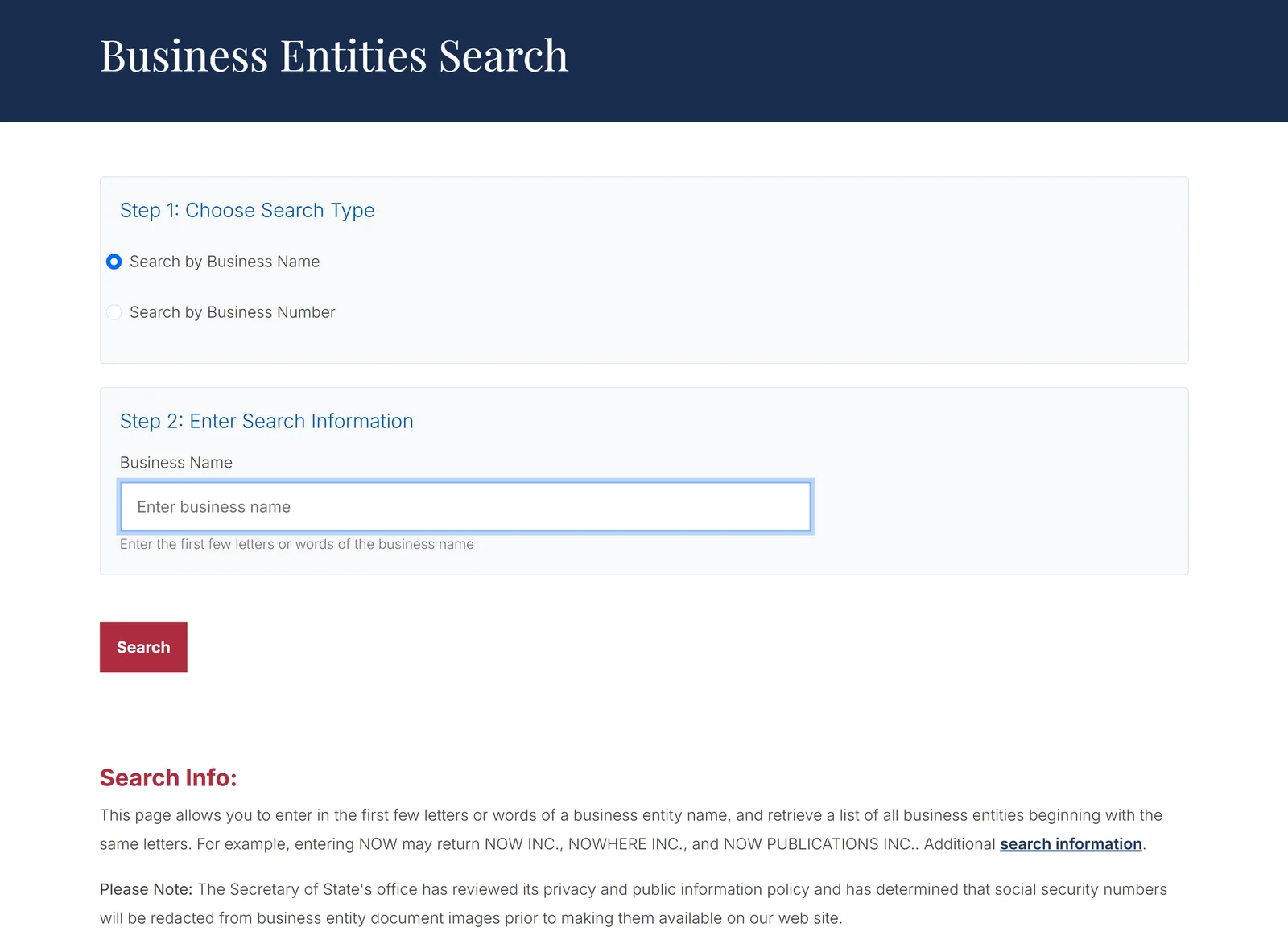
Step 2: Open the Summary and Its Eight Tabs
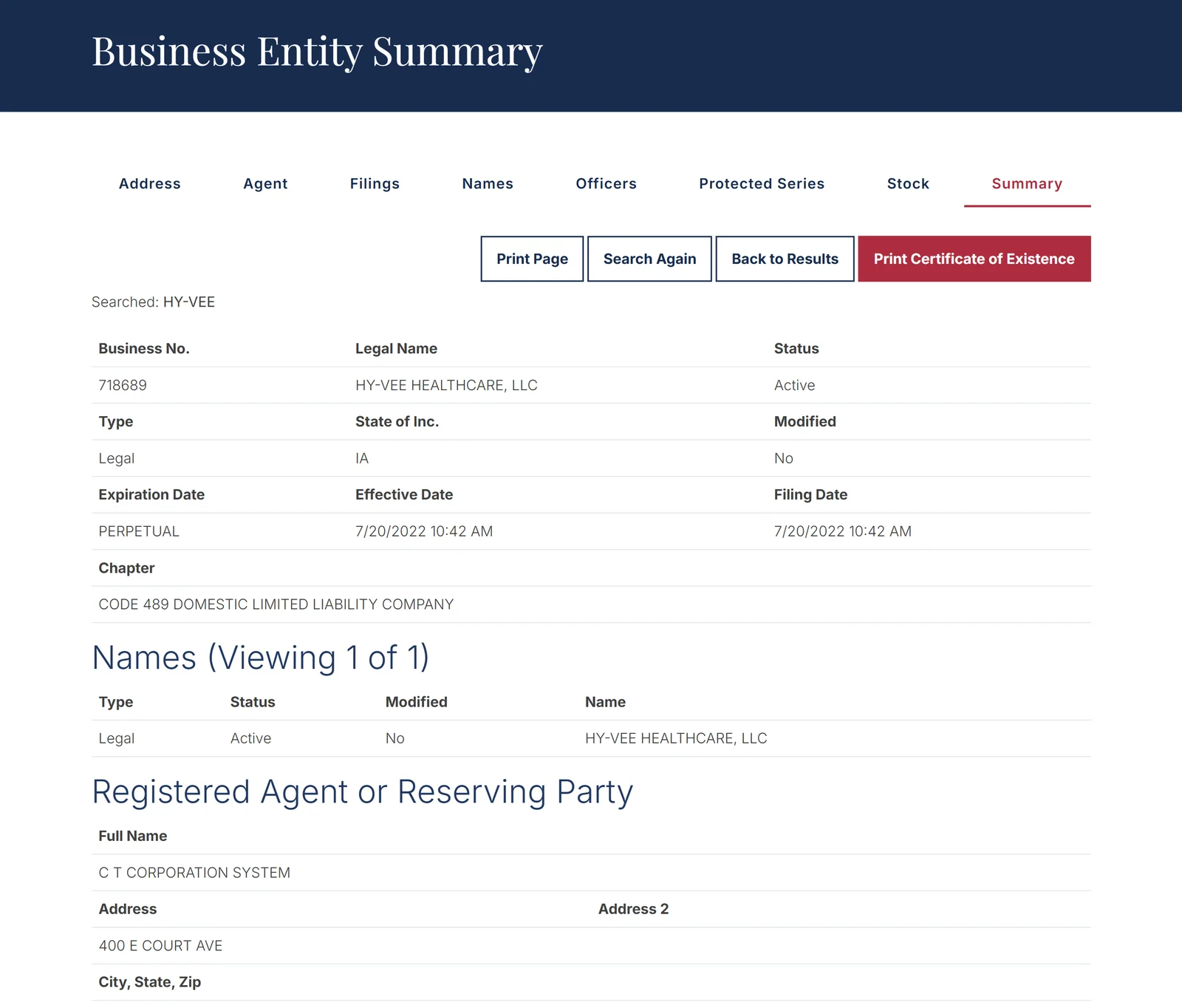
The Business Entity Summary gives the status, the state of incorporation and a Chapter line: CODE 489 for an LLC, CODE 490 for a profit corporation, CODE 548 for a state trademark. That last code explains why a search for CASEY’S GENERAL STORES also shows an inactive record numbered 128928: it’s a state trademark record, not the company. The Address, Agent, Filings, Names, Officers, Protected Series and Stock tabs hold the rest, with social security numbers redacted from document images. In the box on this page, that trademark comes back with CODE 548 as its type, and a fictitious name returns the company that owns it.
Iowa Biennial Report: Corporations in Even Years, LLCs in Odd Years
Iowa has no annual report. Profit corporations file a biennial report in even-numbered years and LLCs in odd-numbered years, between January 1 and April 1, and a missed report leads to administrative dissolution (revocation for a foreign company) by August.
| Entity | Filing years | Fee |
|---|---|---|
| Profit corporation | Even (2026, 2028) | $60 |
| LLC or LLP | Odd (2027, 2029) | $30 online, $45 on paper |
| Nonprofit corporation | Odd | No fee |
An LLC’s first report falls in the first odd-numbered year after the calendar year it was formed (Iowa Code 489.212); the Secretary of State’s FAQ still says March 31, but the statute sets April 1. The report is prefilled with the business name, registered agent and registered office, asks whether the company holds Iowa agricultural land, and, for a corporation, names the president, secretary, treasurer and one director. The registered agent starts receiving reminders in January of the filing year, and Iowa’s LLC biennial report has a dedicated guide.
From Missed Report to Reinstatement: A Real Iowa Record
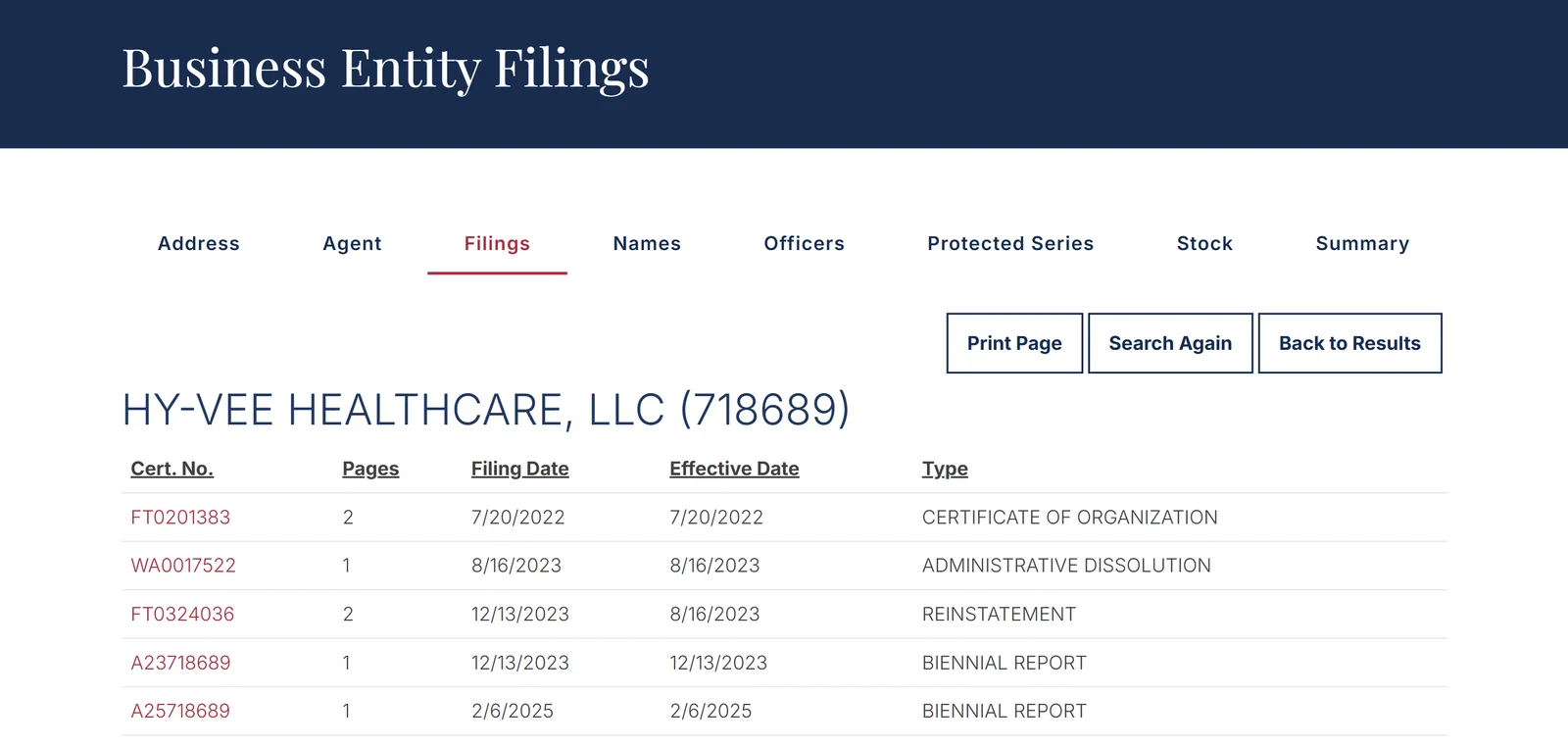
HY-VEE HEALTHCARE, LLC, formed in July 2022, owed its first report between January 1 and April 1, 2023. It was administratively dissolved on August 16, 2023, then filed a reinstatement and its 2023 report on December 13, 2023, and the reinstatement took effect as of August 16, as if the dissolution had never happened. Reinstatement is open at any time for $5 plus the fees of the two most recent biennial reports it must include ($30 each online for an LLC), and no EIN has been required since July 1, 2024. Reinstating within five years of the dissolution keeps the name (Iowa Code 489.710); a foreign company that is revoked registers again under a new number.
Active or Inactive on an Iowa Record: Where the Reason Shows
An Iowa record only reads Active or Inactive. Why a company became Inactive shows in its Filings tab (an ADMINISTRATIVE DISSOLUTION, a STATEMENT OF DISSOLUTION, ARTICLES OF MERGER) or, on the summary, in an Expiration Date that has passed.
“Not in Good Standing” means the business is noncompliant with one or more Iowa laws, the Secretary of State explains, and it warns that “some thieves may look at the state’s records to see which companies are not in good standing because they assume no one is paying attention.” That label never appears on the record; the $5 Certificate of Existence is what shows good standing. The Secretary of State also doesn’t check a filer’s authority, so owners are told to watch their own record.
Print the $5 Certificate Before Closing the Page
A Certificate of Existence shows an Iowa entity is in good standing; a foreign one registered in Iowa gets a Certificate of Authorization. The Print Certificate of Existence button on the summary sells it for $5, and the certificate prints from the receipt page, so the page shouldn’t be closed first. Its number can be checked with the Certificate Validation Tool.
Who Runs an Iowa Company: Officers Yes, LLC Members No
An Iowa LLC lookup shows no owners: the Officers tab reads “None on file” because “Ownership and membership are maintained within your company’s own internal records. We do not file that information,” in the Secretary of State’s words. An Iowa corporation’s Officers tab lists its president, secretary, treasurer and a director, with addresses, because the biennial report requires them.
“Names and addresses provided on documents filed with the State are public record,” and the free PDFs, articles of incorporation included, can name the people who organized a company. The Stock tab shows authorized shares by class, never shareholders. The Person tab here searches officers and registered agents, which the state’s own form doesn’t allow.
An Email or Postcard to the Agent for Every Filing
An owner or employee can be the registered agent if they live in Iowa, are at least 18 and have an office in the state. Changing or resigning the agent is free, and each filing sends an email or postcard to the agent, a guard against unauthorized changes. A misused name or address is reported with the free, notarized Affidavit of Unauthorized Use to fraud@sos.iowa.gov.
Iowa Business Name Search: One Letter, Even a Space, Is Enough
Under Iowa’s administrative rule (IAC 721-40.2), a name is distinguishable if it has one different letter or numeral, and a single space counts as a letter. Plurals, and numerals versus words or Roman numerals, count as differences too; entity endings, protected series or PS, punctuation and special characters, capitals, and & versus and are ignored.
Name test
Distinguishable under IAC 721-40.2?
Applies the Secretary of State's rules on punctuation, capitals, the & sign and entity endings. The state makes the final call.
The symbols $, +, % and ¢ also count as letters. An Iowa LLC may end in L.C. or LC as well as LLC, and an administratively dissolved company’s name stays protected for five years. The rule leaves fictitious names out of the comparison even though the statute lists them, so a name matching a registered DBA is worth avoiding. The Fast Track Filing system tests a name during business formation, a Reservation of Name holds it for 120 days for $10, and a USPTO and state-mark search on the name is a separate step before starting an Iowa LLC.
Iowa DBA and Trademark Search: County Recorder or Secretary of State
A sole proprietor’s trade name is recorded with the county recorder where the business operates, and it’s mandatory (Iowa Code 547.1); those names aren’t in the state search. An LLC or corporation adopts a DBA with a $5 Fictitious Name Resolution at the Secretary of State, and it then appears in the Business Entities Search.
State trademarks have their own Trademark Search, by mark, owner name or business number. A mark costs $10, lasts five years, renews in the six months before it expires, and must already be in use: “A mark cannot be made merely to reserve a right to use it.”
No General Iowa Business License, and a Free Sales Tax Permit
“Iowa does not have a ‘general business license,'” the state’s economic development authority says; licensing depends on the activity or profession. Retailers need a sales and use tax permit from the Department of Revenue, free through its online registration, one per location.
Permits can be checked in the Department of Revenue’s monthly dataset of retail sales registrations, and professional licenses through the Department of Inspections, Appeals, and Licensing. An EIN lookup in Iowa won’t work at the Secretary of State, which neither issues nor shows the IRS-assigned number, calling it “the business equivalent of a Social Security Number,” so a lookup goes through the IRS and other routes to an EIN.
Open Data on data.iowa.gov and Rush Fees
Does Iowa publish its business list as open data?
The Secretary of State publishes Active Iowa Business Entities on data.iowa.gov, updated monthly under a CC BY license, with each entity’s name, type, effective date, registered agent and principal office. Sole proprietorships aren’t in it.
Can an Iowa filing be rushed?
Each document can be expedited for a fee: $15 for five business days, $50 for two, $125 for the same day and $200 for one hour. Trademark applications can’t be expedited.