
Business Entities Division, Alabama Secretary of State
Alabama Business Entity Search: Entity IDs, Exists Status and Name Reservations
An Alabama record reads Exists, not Active. The state stopped issuing Certificates of Good Standing in 2015, and the Secretary of State no longer asks for an annual report. The Secretary of State’s search server can also time out on some networks. The search below reads the same records by name, by 9-digit Entity ID such as 000604088, or by agent, organizer or incorporator.
Search Alabama businesses
Alabama onlyOne distinctive word finds more than the full legal name.
Try:
Alabama SOS Business Search: Four Forms With Their Own Links
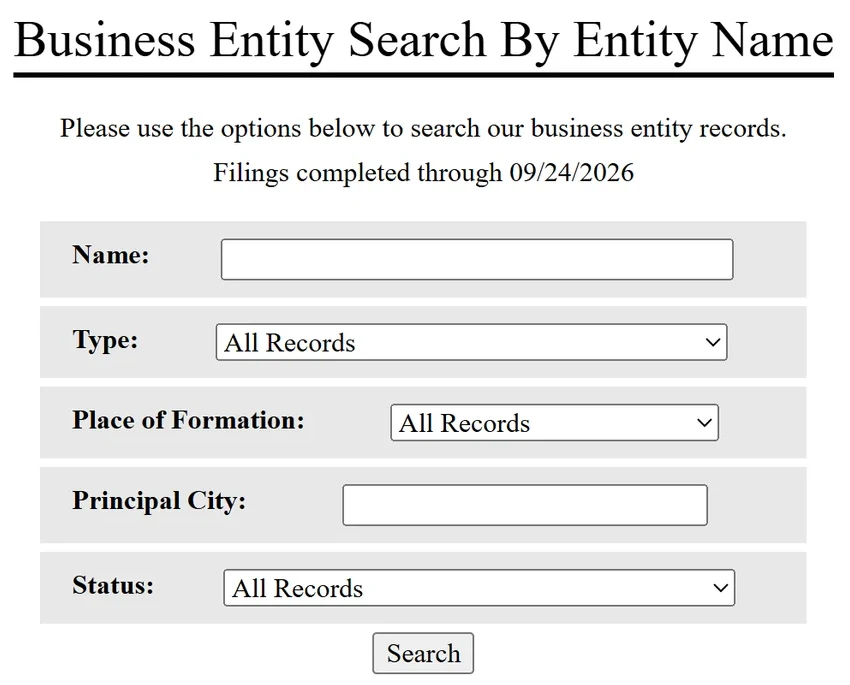
The Secretary of State’s Government Records Inquiry System offers four free searches, each at a fixed address: Entity Name, Entity Number, Officer | Agent | Incorporator and Reservation | Registration by ID. The name form filters by Type, Place of Formation, Principal City and Status, and shows the date the index is current to (“Filings completed through”).
Each record has its own direct link, ending in detail?corp= and the 9-digit number, as in Hyundai’s record. An Alabama LLC lookup ends on that record, which shows Entity Type, principal and registered office addresses, Status, Place of Formation, Formation Date, registered agent, Nature of Business, the Organizers or Incorporators, a Transactions history and the list of Scanned Documents. Copies of those documents cost $2 a page by mail or $3.50 online. Older domestic records give a county as the place of formation, because filings once went through the county probate judge.
How to Get an Alabama Entity ID Number
Search the entity by name and click its number: “Click on the number and verify that this is the correct entity,” the Secretary of State’s own forms advise. The Entity ID is written 000-000-000, and “This is NOT an EIN number.” The state notes that it has “switched from a 6 digit to a 9 digit Entity ID format.”
| Entity ID | Record |
|---|---|
000-604-088 | Hyundai Motor Manufacturing Alabama, LLC, Foreign Limited Liability Company, Exists |
000-000-596 | Alabama Power Company, Domestic Corporation, Exists |
000-704-450 | Alabama Power Company, Domestic Corporation, Consolidated |
000-857-425 | Legacy Vulcan Corp., Foreign Corporation, Withdrawn |
Two entities carry exactly the same name, and only the number tells the live one from the consolidated one. In the search above, type the nine digits without the dashes shown on the record, and an old six-digit number such as 604088 gets the three zeros the state added. Alabama has no EIN lookup: the IRS assigns the EIN, and the state tells filers it “should NOT be put on any of your formation documents,” so no Alabama record shows one; tracking down a company’s EIN takes other sources.
“Exists” Is Not the Same as Good Standing
After formation, “Your status will change to ‘Exists’ on the Secretary of State’s website.” That status means the entity is on file, nothing more, and it carries a cost: “Any entity that shows a status of ‘exists’ on the Secretary of State’s website is subject to being taxed.”
Other statuses include Dissolved, with a dissolution date, Withdrawn for a foreign entity that left, and Merged or Consolidated. A dissolution can’t be backdated: it takes effect the day the Secretary of State receives it, and until then the business privilege tax keeps accruing.
No Annual Report to the Secretary of State Since October 2024
Corporations “are no longer required by law” to send the Secretary of State an annual report, and neither are LLCs. HB 230 ended that annual report filing on October 1, 2024; filing directly with the Secretary of State had applied only since January 1, 2024, a side effect of Act 2022-252.
What remains is the Business Privilege Tax return at the Department of Revenue (Form PPT for pass-through entities, which covers most LLCs; Form CPT for C corporations and LLCs taxed as corporations), due with the federal return, plus an initial BPT-IN return “within two- and one-half months” of forming or registering. For tax years beginning after December 31, 2023, an entity whose tax works out to $100 or less owes nothing and files no return; the maximum is $15,000. The tax stays due “every registered year until the entity is legally dissolved/withdrawn.” That return, when the tax tops $100, is what an Alabama LLC files each year.
Certificate of Compliance or Certificate of Existence?
“Act 2015-382 eliminated the Certificate of Good Standing.” Proof that an entity is current on state taxes is now the Certificate of Compliance issued by the Alabama Department of Revenue (ALDOR), which anyone can request online for about $14 and which usually takes three to five business days.
The Secretary of State issues a Certificate of Existence instead, “not a Certificate of Compliance (Good Standing),” for $28 online, printed at once, or $25 by mail. Closing an Alabama entity or withdrawing a foreign one requires a Certificate of Compliance no more than six months old.
Registered Agent and Organizer Search, but No LLC Members
An Alabama LLC’s certificate of formation only certifies “that there is at least one member,” so the record names its organizers and registered agent and has no field for members. Corporation records list incorporators, and the annual reports filed through 2024 named a president and a secretary.
The state’s Officer | Agent | Incorporator search finds all of those names; the Person tab above finds registered agents, organizers and incorporators. Alabama lets an individual resident or a registered entity serve as registered agent, at a street address, and the agent “may not perform its duties or functions solely through the use of a virtual office” or a mail forwarding service.
No Alabama Filing Without a Name Reservation First
Alabama requires a Certificate of Name Reservation before any formation or registration: $25 by mail or $28 online, good for one year and renewable in the 90 days before it expires. Reservations are filed online through Alabama Interactive, the state’s contracted portal, or on paper; an existing one is found by the RES# printed on the certificate in the Reservation | Registration by ID search. The Secretary of State must find the name distinguishable from those on its records, with LLC, Inc. and similar endings ignored.
For a business name availability check, the Secretary of State’s advice is to search by Entity Name “excluding entity identifiers such as Inc., LLC, etc. and any punctuation” and leave the other boxes empty. Names with bank, insurance, trust or a licensed profession need approval or a license. Filing a certificate of formation to start an Alabama LLC costs $200, and $100 of it goes to the treasurer of the county where the registered agent’s office sits. The entity search skips trademarks and domain names; a broader name check covers both.
DBAs, Trademarks and County Privilege Licenses
The Secretary of State registers Alabama trade names the same way as trademarks, $30 for five years, and they’re searched in the separate trademark records, not the entity search; the state “DOES NOT recognize personal names” as trade names. The Secretary of State’s pages mention no county DBA filing.
A business privilege license, where one is required, is issued by the Probate Judge or License Commissioner of each county the business works in and renewed by October 31, with a 15 percent penalty after that. A business license lookup goes to that county office; cities issue and check their own licenses. Registering for taxes goes through My Alabama Taxes at the Department of Revenue.